
Kitora Kofun: A Painted Tomb Beneath Asuka's Hills
A restored two-tiered mound marks the burial place whose fragile chamber paintings include a detailed star chart and four directional guardians.
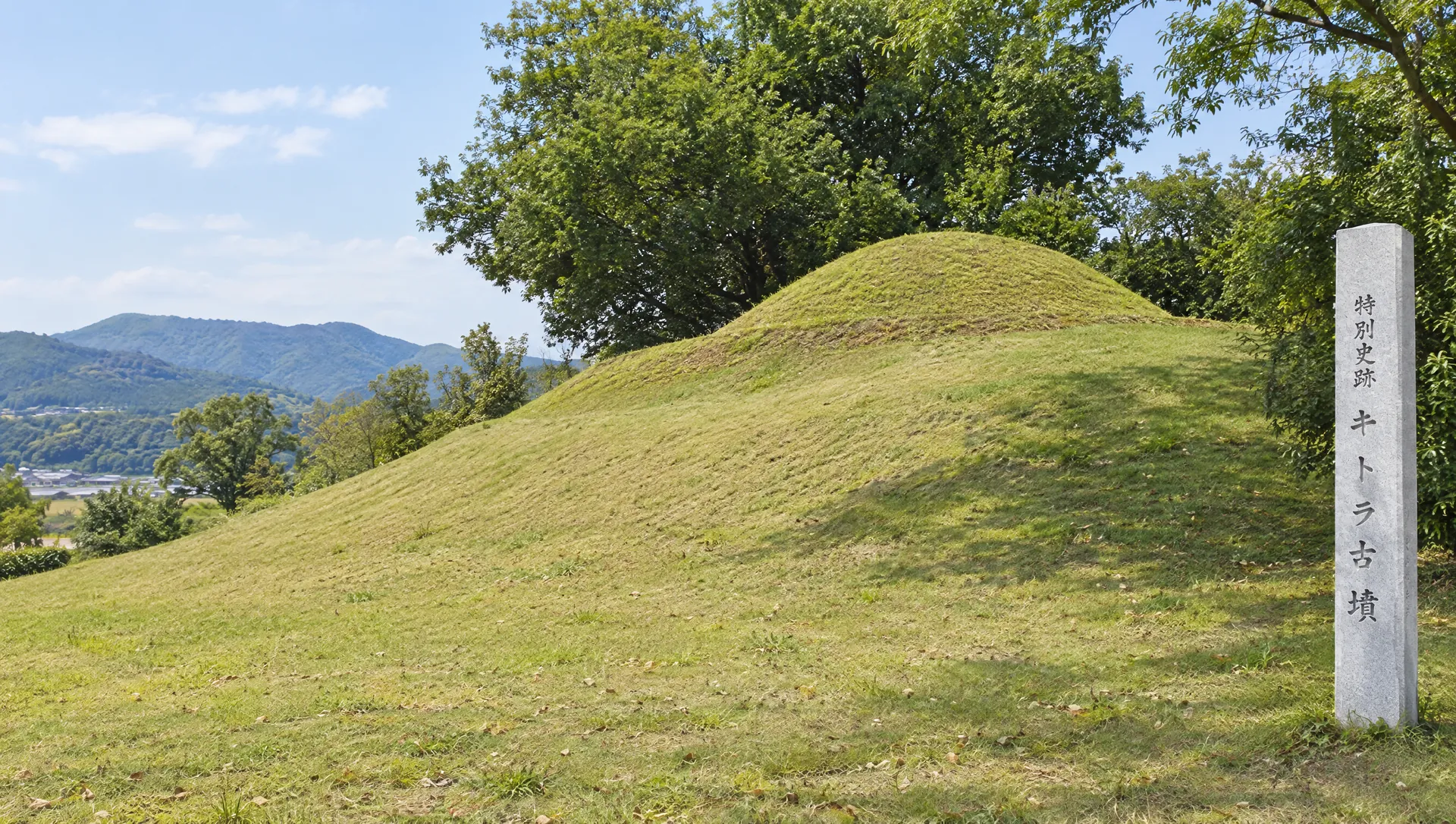 AI-generated visual study · not a documentary photograph
Discover Kitora Kofun: A Painted Tomb Beneath Asuka's Hills
Kitora Kofun sits low on a hillside at the southern end of Asuka's Kitora park district. The mound looks modest today, but its sealed chamber held an unusually rich painted programme: a detailed astronomical chart on the ceiling, four directional guardian figures and zodiac imagery. The paintings were removed for conservation and the chamber was closed and reburied; the outdoor mound is therefore a place to understand the landscape and burial form, not to enter the painted room. Visit the separate Shijin-no-Yakata for a full-scale chamber model and interpretation, and check official announcements if seeing original paintings is important to your trip.
Read the small mound in its hillside setting
The government park describes a two-tiered circular mound: the upper tier is about 9.4 metres across, the lower terrace about 13.8 metres, and the combined height a little over four metres. Excavation findings were reburied and the mound was restored to its ancient outline in 2015. From the viewing area, notice how the compact tomb sits above the surrounding rice fields and village landscape; stay on public paths and do not climb the protected earthwork.
A chamber painted with directions and the night sky
The chamber's plaster walls carried the four guardian figures and zodiac animals, while the ceiling held a detailed chart of stars, the celestial equator and the ecliptic. The paintings' exact creation date and the tomb occupant are not settled. Researchers place construction around the late seventh to early eighth century, and several high-status individuals have been proposed; none is securely identified.
Understand why the originals are elsewhere
The mural-bearing plaster was too fragile to remain safely inside the tomb. The paintings were detached for conservation, and the chamber was sealed and reburied. The mound itself does not offer interior access. Shijin-no-Yakata, a separate free museum in the same park district, uses high-resolution imagery and a full-scale chamber model to explain the tomb. Original murals are shown only during announced, limited periods at the conservation facility, with advance registration; verify the current official schedule before travelling for that purpose.
Keep the two nearby visits distinct
The mound and Shijin-no-Yakata form a natural paired visit, but they are different places with different experiences. The mound is an outdoor archaeological feature; the museum provides the indoor exhibits, rest facilities and visitor services. The park estimates about 12 minutes on foot from Kintetsu Tsubosakayama Station or 22 minutes from Asuka Station to the district. Confirm the current walking route, bus service and opening calendar before setting out.
Plan parking separately from the mound visit
The park's ordinary-car spaces are free but limited; its two current parking pages disagree on the first lot's capacity, so do not plan around a precise space count. From 1 September 2026 through 31 January 2027, tourist buses must reserve the Kitora district's first lot in advance. The operator charges ¥3,000 per booking, in 30-minute units for up to two hours; no reservation means no bus parking. Book through Times up to three months ahead, pay in cash at the Shijin-no-Yakata information counter, and call 0744-54-5105 before reserving two or more buses. This is a parking charge, not a mound or museum admission fee.
Follow current park and heritage guidance
The mound is a Special Historic Site within the national government park. Use marked routes, avoid barriers and treat the surrounding fields as private working land. The reviewed operator page lists no separate admission or staffed hours for the mound itself; museum hours and closures apply to Shijin-no-Yakata, not automatically to the outdoor tomb. Do not assume a photo of a replica or display shows the original chamber.
What to look for
Restored two-tiered mound
See the compact tomb in its original hillside landscape from the park's viewing area.
A rare ancient star chart
Learn how the chamber joined astronomy, directional guardians and zodiac imagery.
Separate museum interpretation
Pair the outdoor stop with Shijin-no-Yakata's full-scale chamber model.
Photo notes
No photograph is currently cleared for MyNara publication. Follow park and cultural-property signage, remain on paths and do not climb the mound. Obtain publication permission before using third-party images.
Make a day of it
Explore guides close to this map point, then check the actual route before travelling. Distances below are straight lines, not walking distances or travel times; map points may not be entrances.


Sources & editorial status
Original MyNara draft based on the linked sources. Sources reviewed 24 October 2026. Opening arrangements, prices and offers may change; use the operator's current information before travelling.
- Asuka Historical National Government Park — mound form, discovery, murals, conservation and visitor approach
- Asuka Historical National Government Park — Kitora district facilities, Shijin-no-Yakata hours and access
- Asuka Historical National Government Park — current park parking inventory and conflicting ordinary-car capacity for the Kitora first lot
- Asuka Historical National Government Park — 2026–27 tourist-bus reservation period, fee, advance booking, cash payment and contact
- Asuka Village — designated cultural property record
- Nara Prefecture — cultural resource record and location
- Nara Archaeological Research Institute repository — Kitora site record and approximate coordinates
- Park operator — tour-bus reservation dates and current parking restrictions