
Ataya Stone Buddhas
Two medieval Buddhist figures carved into a roadside rock face along the old Yagyu–Kasagi route: an Amida and a Jizō associated with local prayers and offerings.
 AI-generated visual study · not a documentary photograph
Discover Ataya Stone Buddhas
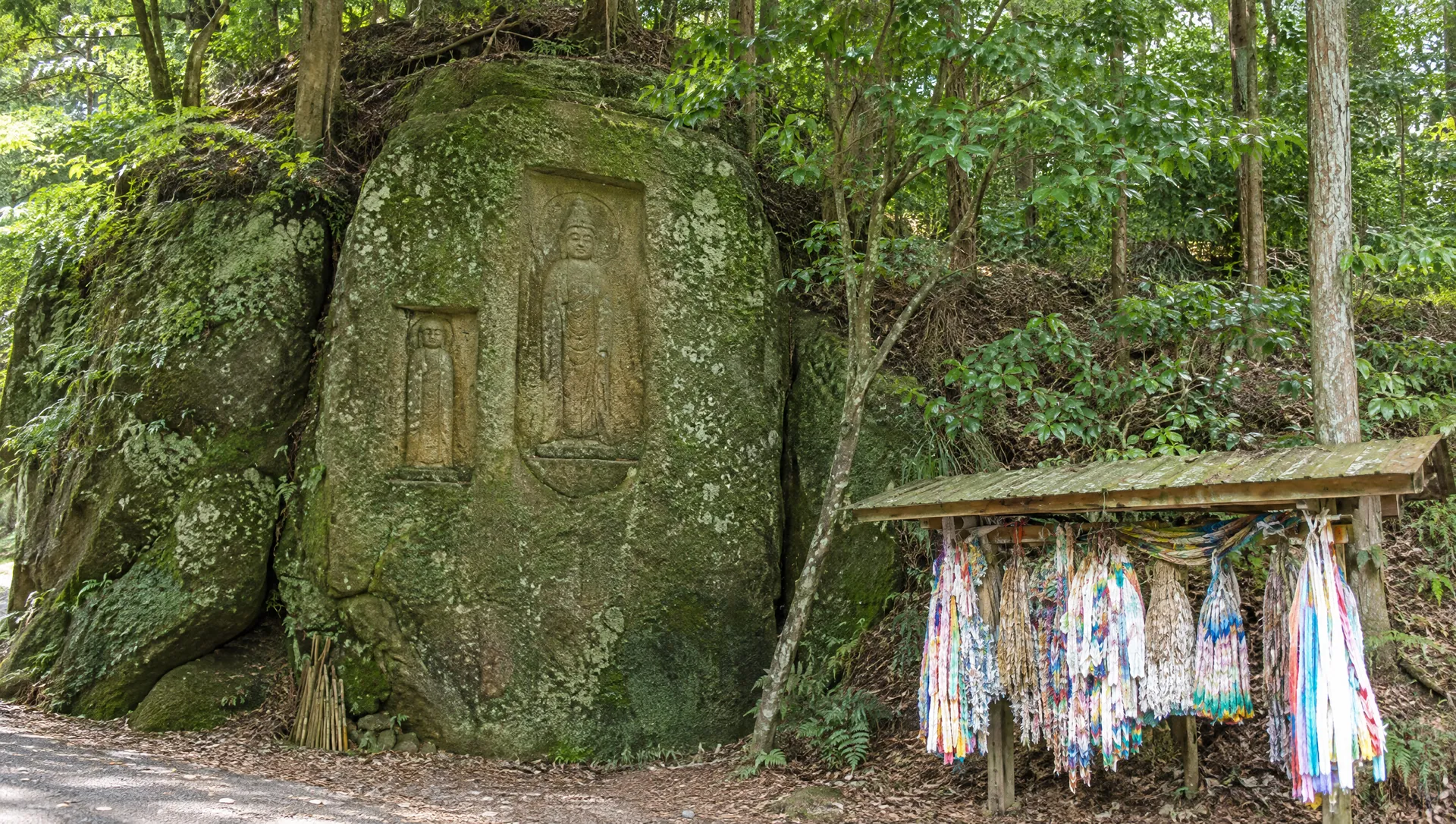
Ataya's rock-cut images reward a slower look at the old road between Yagyu and Kasagi. Nara City's walking guide describes one natural rock about five metres high and three metres wide, with an approximately 1.5-metre standing Amida and a 0.7-metre Jizō carved within a framed panel. It calls the figures Muromachi-period work and says an Ataya Temple is traditionally said to have stood nearby; these are the guide's historical descriptions, not a newly verified archaeological date or excavated temple site. The Yagyu Tourism Association identifies the pair as an Amida and Jizō and records local beliefs connected to protection from epidemic illness and prayers for children. The surrounding landscape and offerings are part of a living sacred place, not a reconstructed attraction.
Look for two figures in the same rock face
Nara City describes standing Amida figures at Ataya, while the Yagyu Tourism Association identifies an Amida on the right and a Jizō on the left. The forms are weathered and can be easy to miss in shade. Do not touch, chalk, trace or climb on the rock.
Notice the scale of the carved panel
Nara City's Yagyu–Kasagi walking guide describes a natural rock roughly 5 metres high and 3 metres wide. Within a rectangular frame, the standing Amida is about 1.5 metres tall and the Jizō beside it about 0.7 metres. The same guide calls the carvings Muromachi-period work and says an Ataya Temple is traditionally said to have stood nearby. Treat these as the city's visitor-guide account: the sources checked here do not provide an excavation report or a separate archaeological dating study for this rock.
Read the stories as local belief
The local association says the Amida is prayed to for protection from epidemic illness. It records a belief that offerings of tofu to the Jizō are associated with prayers for a child, with a thousand beads traditionally offered in thanks; it says folded cranes are now also left. These are local religious traditions, not guaranteed outcomes. Do not add, move or remove offerings unless the caretakers invite you to do so.
Choose a published route through the uplands
The Yagyu Tourism Association's approximately 3.6 km, 45-minute loop starts and ends at Yagyu bus stop and lists Jūbei's Cedar, Yagyu Shimozuka Kofun, Ataya Jizō and Kenzuka. It also lists a one-way Kasagi-to-Yagyu route of about 5.5 km / 80 minutes via Kasagi-dera, Ataya Jizō, Shimozuka Kofun and the former chief-retainer's residence. These are whole-route estimates, not time allowances for this stop, and the association page is not a live trail-condition report. Nara City's current Yagyu Kaidō guide (status dated March 2026) reports a closure on the Takisaka-no-Michi sightseeing branch, between near Tōge-no-Chaya and before the Jigokudani stone Buddhas; that notice concerns a different branch from the Yagyu–Kasagi route on which the association lists Ataya. It does not certify the Yagyu–Kasagi trail's present condition. Check current route maps and local notices, use public paths, and plan onward/return transport; the one-way course ends at Yagyu bus stop.
A roadside shrine with limited visitor information
The site is listed as a place to see on the local route, but no staffed opening hours, admission desk, toilet, parking, step-free access or site-specific photography rules were found. The exact approach surface and current path condition have not been surveyed for this guide. Stay on the signed public route, keep clear of the road and river edge, respect nearby homes and worship, and turn back if access appears closed or unsafe.
What to look for
A pair of rock-cut Buddhist images
The Amida and Jizō are carved side by side into an exposed rock face.
A local sacred landscape
Stories about illness protection, children and offerings remain part of the place's living tradition.
A stop on an old road
Nara City places the carvings on the Yagyu–Kasagi route through the eastern uplands.
Photo notes
No site-specific photography policy was found. Respect this roadside religious site, avoid intrusive photography of worshippers or nearby homes, and ask the local association before publication-oriented photography. Do not touch, chalk, trace or climb on the rock images. No third-party image is licensed for MyNara.
Make a day of it
Explore guides close to this map point, then check the actual route before travelling. Distances below are straight lines, not walking distances or travel times; map points may not be entrances.
Sources & editorial status
Original MyNara draft based on the linked sources. Sources reviewed 24 October 2026. Opening arrangements, prices and offers may change; use the operator's current information before travelling.
- Nara City — Yagyu Kaidō route and Ataya stone images
- Nara City — official Yagyu reconstructed historic map
- Yagyu Tourism Association — Ataya Amida and Jizō, local traditions and walking route
- Yagyu Tourism Association — Yagyu loop and one-way Kasagi–Yagyu course with estimates and listed stops
- Nara Kotsu — Bus Navi for date-specific timetables, fares and bus locations; English, Simplified Chinese and Korean interfaces
- Nara City Tourism Association — Yagyu–Kasagi walking guide
- Nara City — Yagyu–Kasagi route leaflet, dimensions and visitor-guide dating for Ataya's carvings
- Nara City — current Yagyu Kaidō guide and March 2026 Takisaka branch closure notice; closure is for a separate route
- Nara Prefecture — Yagyu Miyaza annual festival and sacred dances