Tōdai-ji Kaidan-dō: Ordination and the Four Guardian Kings
Visit a separate hall west of the Great Buddha to understand where Buddhist monks were ordained and to see four eighth-century clay guardian figures.
 Verified site photographs are being prepared.
Discover Tōdai-ji Kaidan-dō: Ordination and the Four Guardian Kings
The Great Buddha tells one part of Tōdai-ji's national role. At Kaidan-in, the focus shifts to the training and formal ordination of monks. The Chinese monk Ganjin's arrival in 754 is central to the site's origin; the present Kaidan-dō is a much later rebuilt building. Its strongest reason for an art-focused visit is the group of four National Treasure guardian kings. Because the hall has its own ticket and earlier closing time, look up the temple map before assuming it lies on the same route and admission as the Great Buddha Hall.
Understand the ordination ground
Tōdai-ji traces Kaidan-in to 754, when Ganjin brought a lineage of Buddhist precepts and an ordination platform was established in front of the Great Buddha Hall. The temple says that Shōmu, Kōmyō and Kōken received precepts there before the platform was moved to the present western site and a compound was built around it. Many monks later took vows here. This history explains the hall's name; a normal tourist ticket today is a visit to the historic hall and sculpture, not participation in an ordination ceremony.
Separate the rebuilt hall from its ancient images
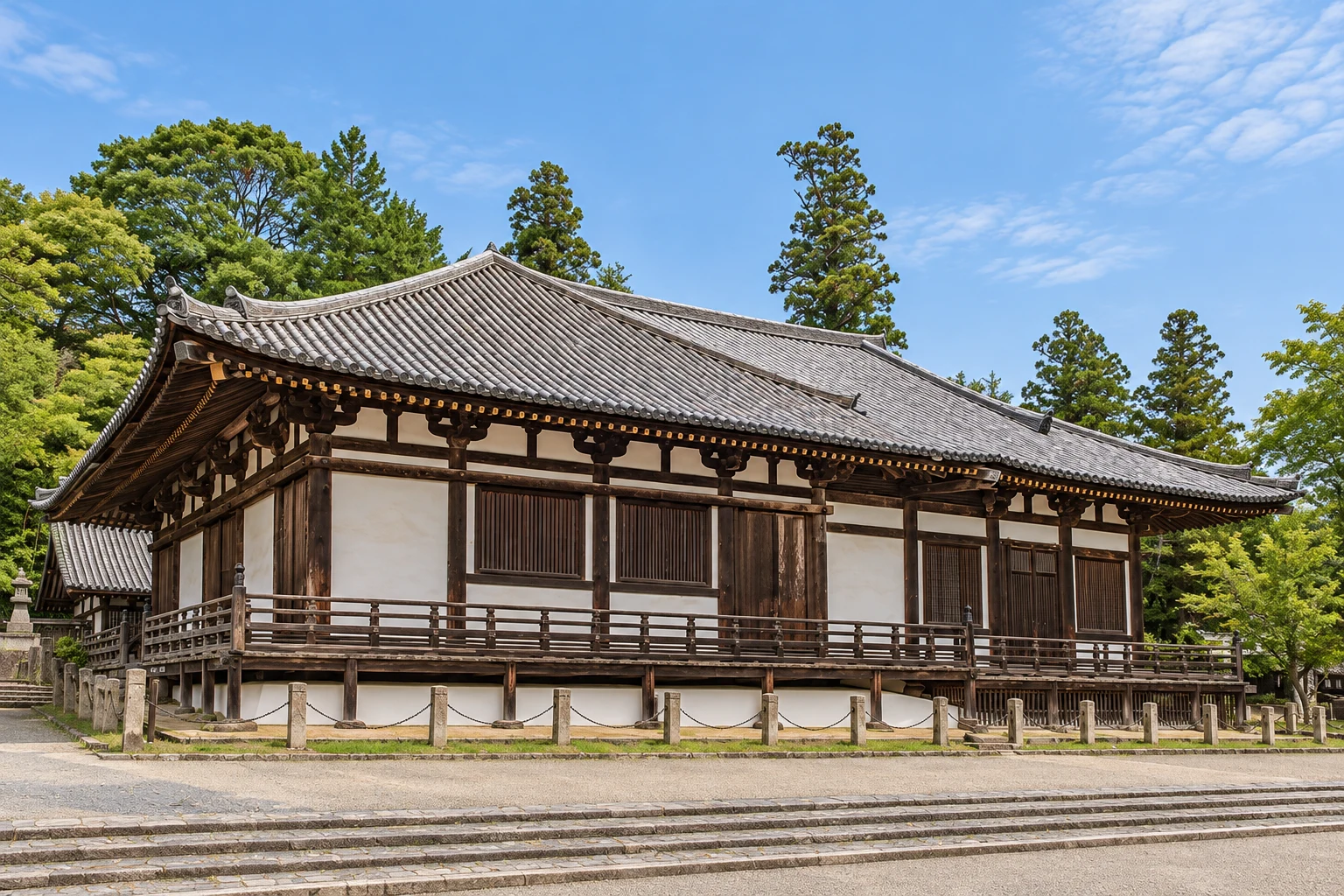
The Kaidan-in compound burned in 1180, was rebuilt in the medieval period and burned again in 1446. The present Kaidan-dō, neighbouring Senju-dō and living quarters are Edo-period successors, not surviving structures from Ganjin's lifetime. Inside Kaidan-dō are the Four Heavenly Kings: Kōmokuten, Zōchōten, Jikokuten and Tamonten. Tōdai-ji identifies them as eighth-century National Treasures guarding the four directions; the Agency for Cultural Affairs lists the four as Nara-period clay sculptures. Their antiquity belongs to the figures, not the present building.
Check the display you are actually visiting
Kaidan-dō closed for seismic work from 2020 and its four kings were temporarily displayed at Tōdai-ji Museum. The temple announced their return for worship in Kaidan-dō from 1 October 2023. A traveller reading an older museum article may therefore head to the wrong building. The adjoining Senju-dō was exceptionally opened during the works, but the temple says that opening ended on 25 September 2023; its Kannon cabinet is ordinarily closed. Do not count Senju-dō as a second currently open admission attraction or assume its images are included in a Kaidan-dō ticket.
Plan a separate ticket and a western detour
The temple charges Kaidan-dō separately from the Great Buddha Hall, Hokke-dō and museum: its current individual table shows ¥800 for age thirteen and older and ¥400 for ages six to twelve. The Japanese temple stamp page lists Kaidan-dō entry and goshuin reception as 8:30–16:00; the English general-hours table omits the hall from its timed rows, so confirm the visit-day opening with the temple. The ¥1,200 Great Buddha Hall–museum joint ticket does not include Kaidan-dō. Use the temple's precinct map to walk west of the Great Buddha Hall rather than following the uphill path to Hokke-dō and Nigatsu-dō.
Respect the hall and check mobility needs
Tōdai-ji prohibits photography, sketching and flashlight use inside Kaidan-dō. Its own web images are not available for unauthorised reuse. The official wheelchair description covers a flat route to the Great Buddha Hall but does not verify a step-free Kaidan-dō door or interior, so ask the temple before making a mobility-dependent visit. From Kintetsu Nara, the temple's roughly 20-minute walking estimate reaches the general precinct, not necessarily this western hall. A city-loop bus stops by the Great South Gate approach; the temple has no dedicated car park.
What to look for
Historic ordination compound connected with Ganjin's 754 arrival
Four Nara-period clay National Treasure guardian kings
Separately charged western hall; the adjoining Senju-dō special opening has ended
Photo notes
No interior photography, sketching or flashlight use. Do not copy the temple's hall or sculpture images into MyNara without permission; respect signs for exterior photos and worship. Drone photography is prohibited throughout the precinct.
Make a day of it
Explore guides close to this map point, then check the actual route before travelling. Distances below are straight lines, not walking distances or travel times; map points may not be entrances.
Sources & editorial status
Original MyNara draft based on the linked sources. Sources reviewed 20 October 2026. Opening arrangements, prices and offers may change; use the operator's current information before travelling.
- Tōdai-ji — Kaidan-in history, hall, four kings and photo restrictions
- Tōdai-ji — current separate paid-hall and joint-ticket rules
- Tōdai-ji Japanese stamp page — Kaidan-dō 8:30–16:00 reception
- Tōdai-ji — 1 Oct 2023 return of the Four Kings
- Tōdai-ji — Senju-dō special opening ended
- Agency for Cultural Affairs — four Nara-period clay National Treasures
- Tōdai-ji — precinct map and limits of stated wheelchair access
- Tōdai-ji — train, bus and parking approach