Autumn Kemari Festival at Tanzan Shrine
Watch a seasonal court-ball offering tied to the story of Kamatari and Prince Naka no Oe.
 Verified site photographs are being prepared.
Discover Autumn Kemari Festival at Tanzan Shrine
At Tanzan Shrine, kemari is remembered as more than a court pastime: shrine tradition says Fujiwara no Kamatari and Prince Naka no Oe first met through a ball game at Asuka-dera, a connection that later became part of the story of the Taika Reform. The autumn festival brings that memory into the shrine's mountain precinct through a ceremonial kemari offering. It is a scheduled rite to observe, not a visitor drop-in game. For 2026, the shrine's current homepage notice and annual calendar, together with the Sakurai-Uda Regional Union's event list, give 3 November at 11:00. Nara Prefecture's date-specific event listing says 8 November, conflicting with the current shrine schedule.
Watch the ball stay in the air
Kemari is played by keeping a light ball aloft with controlled kicks rather than scoring against an opponent. At this shrine, participants in traditional costume perform the offering under the auspices of the Kemari Preservation Society. Watch the spacing, calls and repeated touches as a group ritual; the ceremony is not advertised as a participatory workshop, and visitors should follow the stewards' directions.
Connect the ceremony to Asuka's political history
The shrine's account links the two men through an encounter at a kemari gathering in what is now Asuka. It tells how Kamatari returned the prince's shoe after it came off during play, beginning a relationship that preceded the political changes of 645. This is the shrine's inherited account of their meeting, rather than a claim that the festival reenacts a documented game beat for beat. The setting gives visitors a way to connect court culture, personal alliance and the shrine's memory of Kamatari.
The festival is one part of a larger shrine visit
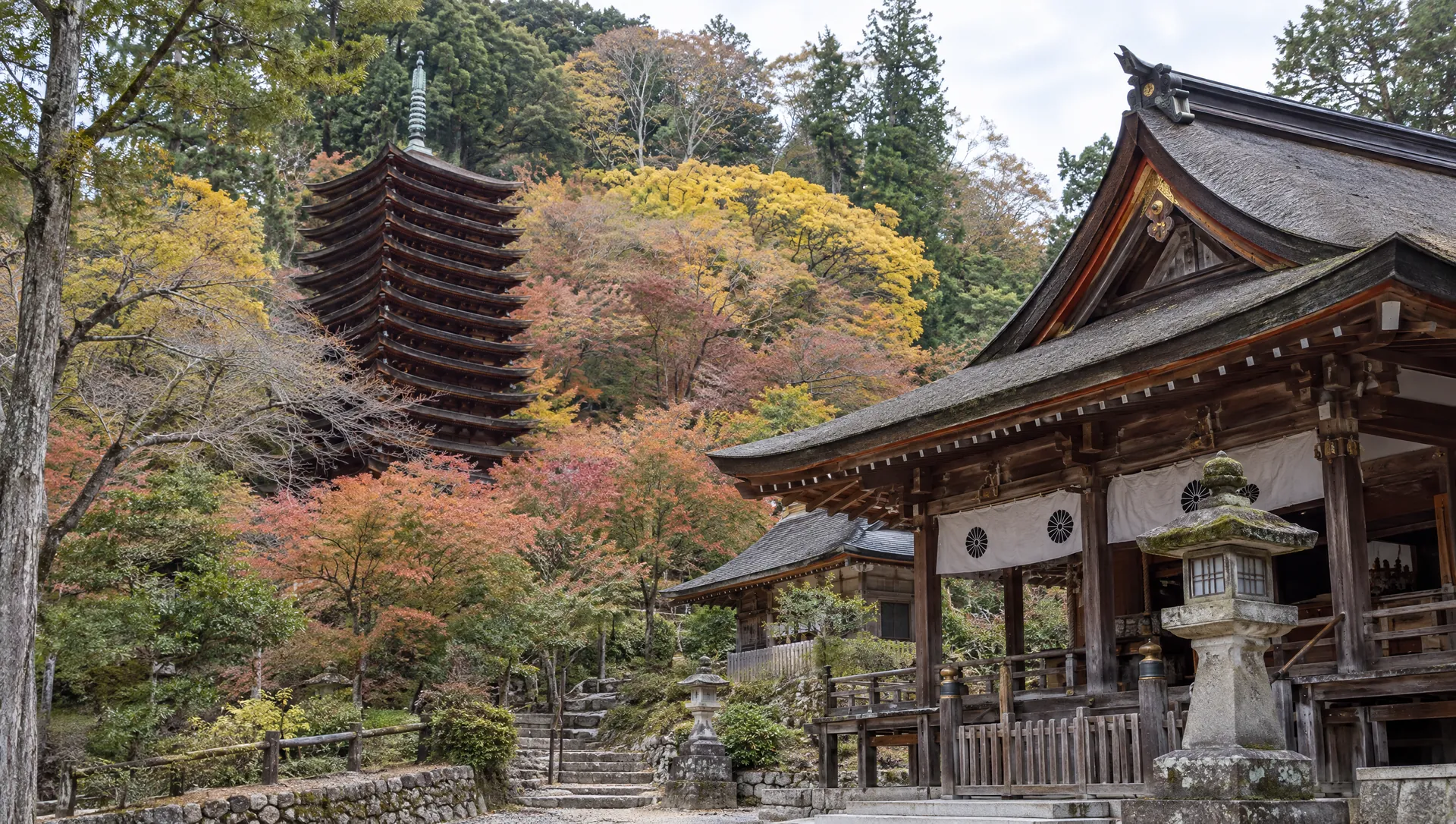
The event takes place at Tanzan Shrine, known for its wooden thirteen-storey pagoda, a hillside precinct and buildings that preserve traces of its earlier Buddhist identity. The shrine's current ordinary admission is ¥700 for adults and ¥300 for primary-school children; preschool children are free. The prefectural event page still shows the former adult price of ¥600. The event listing does not confirm whether an extra event charge, seating or capacity limit applies, so ask the shrine. The shrine separately offers a bookable one-hour kemari experience for ¥5,000 per person (minimum two people, admission extra), subject to availability; this is not part of the festival.
Plan for a mountain bus journey
The shrine's access page estimates about 25 minutes by bus from JR or Kintetsu Sakurai Station and around three minutes on foot from the terminus. Nara's event listing likewise identifies the shrine-bound bus terminus. Nara Kotsu's autumn page lists an adult one-way fare of ¥570 from Sakurai Station, but its displayed timetable is not year-dated. The shrine's ¥500 timetable is explicitly dated 2023 and is stale. Traffic may cause buses to stop at Tonomine instead; check Nara Kotsu's live schedule and return service for the event day. A taxi from Sakurai is listed at about 15 minutes by the shrine.
Check the date and keep ceremony etiquette
The shrine's current homepage notice and annual calendar, along with the Sakurai-Uda Regional Union's page updated 18 September 2026, list 3 November at 11:00. Nara Prefecture's date-specific event page instead lists 8 November and conflicts with the shrine's current notice. Check the shrine's latest notice or call 0744-49-0001 before travelling in case of a later change. The shrine says ceremony times or venues may change in rain. Keep paths clear, silence your phone, follow staff instructions and ask before photographing performers or using a tripod; no blanket commercial photography permission was found.
Ask about step-free access before setting out
The shrine lists a wheelchair loan and priority parking by the west entrance, while Nara Prefecture's event page says no wheelchair loan and no ramp. The official pages therefore conflict on support available, and neither describes a continuous step-free route through the hillside precinct. Contact the shrine about the ceremony viewing area, slope, surfaces and parking for your mobility needs before travelling.
What to look for
Traditional kemari offering in a mountain shrine
A local story connecting Kamatari with Prince Naka no Oe
Autumn visit that can be paired with Tanzan Shrine's historic precinct
Photo notes
The sources reviewed do not grant blanket photography or commercial reuse rights for the ceremony. Keep routes clear, obey staff and posted restrictions, ask before photographing performers or worship activity, and obtain a separate written licence before using shrine or tourism-directory images in MyNara.
Make a day of it
Explore guides close to this map point, then check the actual route before travelling. Distances below are straight lines, not walking distances or travel times; map points may not be entrances.
Sources & editorial status
Original MyNara draft based on the linked sources. Sources reviewed 27 October 2026. Opening arrangements, prices and offers may change; use the operator's current information before travelling.
- Nara Prefecture official event listing — conflicting 2026 date and older admission/accessibility data
- Tanzan Shrine — annual events, 3 November 11:00 schedule and weather caveat
- Tanzan Shrine — current homepage notice for 3 November 2026 at 11:00
- Sakurai-Uda Regional Union — autumn event list updated 18 September 2026, listing 3 November
- Tanzan Shrine — kemari history and current visitor experience terms
- Tanzan Shrine — current ordinary admission, wheelchair loan and visitor facilities
- Tanzan Shrine — Sakurai access and timetable caveat
- Nara Kotsu — autumn route and ¥570 fare (page does not name timetable year)
- Official Nara Travel Guide — Autumn Kemari Festival directory record