
Gango-ji Temple
Follow ancient roof tiles and the remains of a vast Asuka-era temple into Naramachi's present streets.
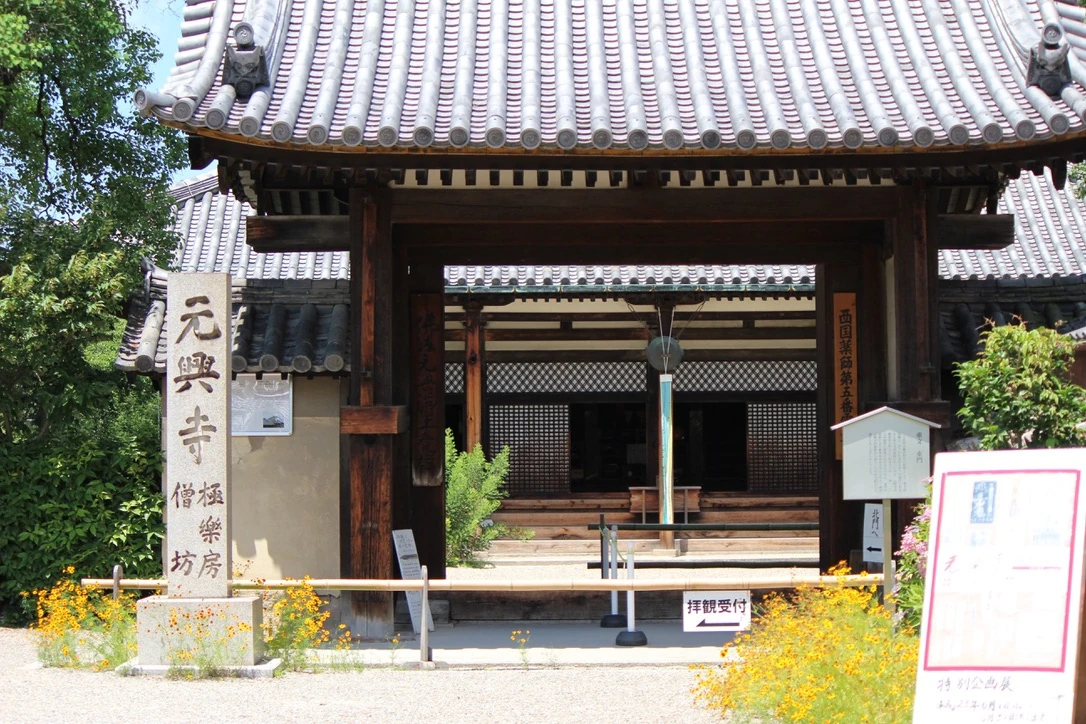 User-provided site photograph · June 2011.
Discover Gango-ji Temple
Gango-ji traces its lineage to Hoko-ji, the temple built at Asuka in the sixth century, and moved to Heijo-kyo when the capital shifted to Nara. The temple that survives in Naramachi is a small protected remnant of a much larger precinct; streets and houses now cover much of the old complex. Inside the surviving precinct, the National Treasure Gokuraku Hall and Zen Room began as monks' quarters, and reused Asuka-period roof tiles remain in their roofs. Gango-ji also preserves a demon story that travelled into Japanese folklore. Visit the Chuincho temple precinct as its own site, then read Naramachi's street plan as part of the temple's later history; the separate Gango-ji Tower Site is at Shibashin'yacho and has a different entrance.
From Asuka to the capital
The temple's own history links Gango-ji to Hoko-ji, also associated with Asuka-dera. When the capital moved to Heijo-kyo, the establishment moved and became an important state temple. The present grounds should be understood as a surviving fragment, not the full footprint of the early complex.
Read the two surviving halls
The National Treasure Gokuraku Hall and Zen Room were once parts of the priests' quarters. The former is now the temple's main hall, with the Chiko Mandala's Amitabha at its centre of worship; the Zen Room preserves a different part of the old living complex. Their UNESCO recognition concerns the surviving historic precinct and its buildings, not the whole area occupied by the ancient temple.
Look for Asuka tiles reused in Nara
The temple identifies old round and flat roof tiles reused on the Gokuraku Hall and Zen Room. It specifically directs visitors to the Zen Room's southeast corner and the west side of Gokuraku Hall, where older tiles are easier to notice. The buildings preserve a material connection with the temple's Asuka origins. Look from permitted paths and do not touch the roof or walls.
A monastery that became a town
Gango-ji's former grounds once occupied much of today's Naramachi. Fires, loss of buildings and later town development reduced the visible temple. A walk beyond the current gate is therefore part of the historical story; other sites, including the separate tower-remains precinct, are not the same entrance or ticket.
Keep the two Gango-ji sites distinct
The temple FAQ explains that two places in Nara City share the Gango-ji name. This guide covers the Shingon Risshu temple at 11 Chuincho, where the former monks' quarters survive. The Gango-ji Tower Site at Shibashin'yacho preserves a different archaeological precinct. Much of the old tower and auditorium remains lies beneath modern streets or private homes; some excavated foundation stones were moved for preservation. Do not use the Chuincho ticket or gate directions for the tower site.
Hear the Gagoze story as a temple legend
The temple tells of a demon that appeared in its belfry and frightened people in the capital. A strong child said to be born from thunder entered the temple, defeated the demon and became associated with Yao-Ikazuchi-no-Kami and Gagoze. The story spread beyond Nara and appears in traditional dramatic literature. It is a religious and folkloric tradition, not a verified event; the temple's account offers one way to understand why Gagoze imagery remains connected with Gango-ji.
The halls and their beliefs
The temple connects the Gokuraku Hall to the Chiko Mandala and Pure Land devotion. Its current guide says the Important Cultural Property painted Chiko Mandala panel is specially displayed during the autumn exhibition period, so do not assume it is on view every day. The precinct also includes a miniature five-storey pagoda recognized as a National Treasure; check the temple's current display information before planning around any particular object.
See the 2026 autumn exhibition
From 24 October to 15 November 2026, the temple's Hōrinkan museum presents 'Deities of Naramachi: Gango-ji's Guardian Shrines and the Gods of the Town.' The temple says the exhibition traces local shrine traditions and their relationship with the former precinct; the Important Cultural Property Chiko Mandala board is specially displayed at the same time. The exhibition admission is included in the temple ticket, which rises to ¥800 for adults, ¥600 for junior/senior high students and ¥400 for elementary pupils during this period. These are dated seasonal terms, not year-round prices.
Plan for separate night openings
The temple also lists a 2026 autumn-night programme on 7, 14, 21 and 28 November, 18:00–20:00, with a temporary closure at 17:00 and last reception at 19:45. The special-entry fee is ¥700 and no reservation is required. The notice describes access to the National Treasure Gokuraku Hall and the first floor of Hōrinkan, with selected objects on view. This separate night programme is not covered by the daytime autumn-exhibition ticket; recheck the temple's notice before travelling.
What to look for
Gokuraku Hall and Zen Room
Reused Asuka-period roof tiles
Former temple grounds now woven into Naramachi
Photo notes
The operator's pages reviewed here do not establish a blanket indoor-photography permission. Follow the signs at each hall, avoid interrupting worship, and request permission before commercial photography or reuse of the temple's own images.
SEASONAL CALENDAR
Events connected with Gango-ji Temple
These records are shared with MyNara’s event calendar, so dates and notices have one source. Recurring patterns are not confirmed dated editions; check the organizer’s latest guidance.
Shūya no Nara Tabi: World Heritage Night Openings (2026)
Nara City Tourism Association's seventh Shūya no Nara Tabi programme brings limited night visits to five World Heritage temples and a separately bookable Mount Wakakusa night-view bus. It began in 2020 and is promoted as a way to experience Nara's historic sites after dark. Each temple has different operating Saturdays, hours and admission; the official schedule below preserves those differences. Temple visits do not require reservations, but the bus does. At Gangō-ji, photography is allowed outdoors only; indoor photography and tripods, monopods or ladders are prohibited. Check the association's current notice for access and transport changes before travelling.
- Time
- Temple openings: Kōfuku-ji Oct 31 and Nov 7, 14, 21, 28, 17:30–21:00; Kasuga Taisha Nov 7, 14, 21, 28, 17:30–20:00; Gangō-ji on those four November Saturdays, 18:00–20:00; Tōshōdai-ji and Yakushi-ji Nov 7 and 21, 17:30–20:30. Optional night-view bus runs Oct 31 and each November Saturday; depart JR Nara 16:10 or Kintetsu Nara 16:15.
- Admission
- Separate admission at each temple: Kasuga Taisha ¥700; Kōfuku-ji adults ¥500, junior/senior high students ¥300, elementary pupils ¥200 (rear chamber costs the same again); Gangō-ji ¥700; Tōshōdai-ji ¥500; Yakushi-ji ¥1,000. Optional reserved round-trip bus: adults ¥2,000, children ¥1,000.
- Booking
- Advance reservation is not required for the five temple visits. The optional Mount Wakakusa bus requires advance booking through Nara Kotsu; check the official campaign page for the booking link and return arrangements. Each temple's session and ticket are separate.
Make a day of it
Explore guides close to this map point, then check the actual route before travelling. Distances below are straight lines, not walking distances or travel times; map points may not be entrances.

Sources & editorial status
Original MyNara draft based on the linked sources. Sources reviewed 24 October 2026. Opening arrangements, prices and offers may change; use the operator's current information before travelling.
- Gango-ji official history, visitor information and admission
- Gango-ji — 2026 autumn exhibition, Chiko Mandala special display and seasonal admission (24 October–15 November 2026; checked 2026-10-24)
- Gango-ji — 2026 autumn-night visit dates, hours, fee and no-reservation terms (checked 2026-10-24)
- Gango-ji official access
- Gango-ji English visitor and access guide
- Gango-ji official architectural map and surviving grounds
- Gango-ji official story of its origins
- Gango-ji FAQ — buildings, tiles and two precincts
- Gango-ji and the development of Naramachi
- Nara Prefecture listing
- JNTO Naramachi guide