
Niu Kawakami Lower Shrine
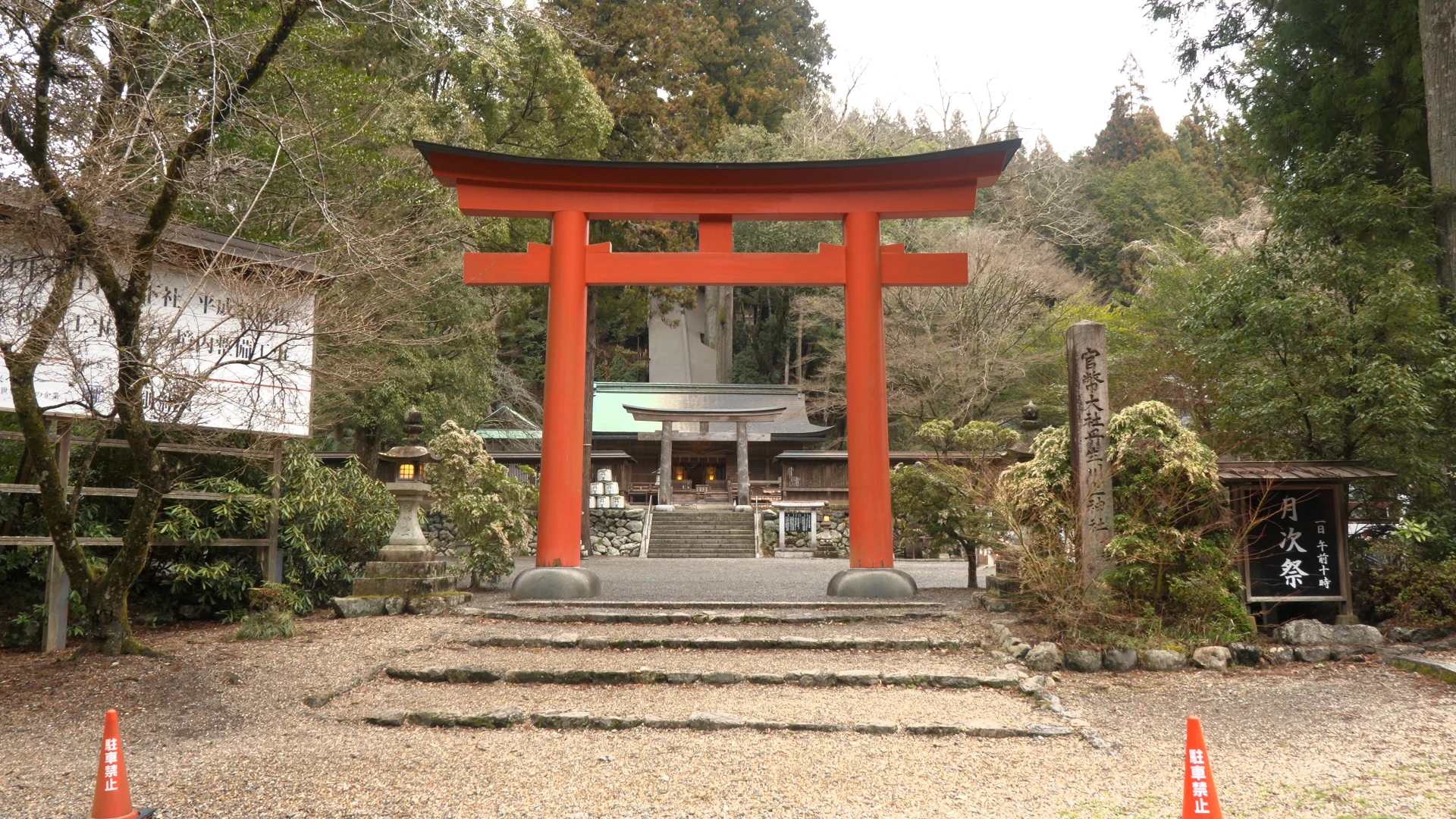
A historic water shrine in the Yoshino hills, approached by a rare covered stairway that links worship hall and sanctuary.
 AI-generated representation · not a verified site photograph
Discover Niu Kawakami Lower Shrine
Niu Kawakami Lower Shrine stands in Nagatani, where the Niu River flows through the southern Yoshino mountains. The shrine worships Kuraokami, a deity associated with water, rain and the life sustained by rivers. The Nara Prefecture Tourism Association describes a distinctive covered stairway of 75 steps rising toward the sanctuary. That approach gives the grounds a strong vertical character, but it is a place of worship rather than a viewing platform: visitors should follow shrine signs and should not assume the stairway or inner sanctuary is open for unrestricted access. A local origin tradition connects the shrine with the reign of Emperor Tenmu; present that as a transmitted foundation account, not a precisely documented construction date.
Understand why the shrine is connected with water
The shrine is one of the places associated with Niu Kawakami worship in the Yoshino region. Its principal deity, Kuraokami, is honoured as a water deity, and rainmaking and the wish for well-balanced rainfall form part of the shrine's historical identity. The prefectural tourism guide introduces it as an old shrine of the water deity and describes the name's association with life-giving water. Read this as a living tradition: people continue to visit and pray here, so keep voices low and give worshippers space.
Notice the covered 75-step stairway
The roofed kizahashi stairway is the shrine's defining architectural feature. The prefectural tourism guide counts 75 steps and describes it as an unusual shrine feature. The shrine's official information says the June 1 annual festival is the traditional occasion for climbing it, while recent years have sometimes used advance-booked, staggered worship through around June 10. The shrine has not published a current year's dates or application terms on that information page, so confirm the latest notice before planning to climb. Do not cross a barrier or treat the stairway as an unrestricted viewpoint.
Meet the sacred stones and old tree with care
The Nara Prefecture Tourism Association highlights Musubi-ishi and a large zelkova tree within the shrine precinct. An older Nara Visitors Bureau itinerary also mentions the ox and frog stones as part of a Lower Shrine visit. These visitor references do not provide a detailed route to every feature or clarify current touching and photography rules. Do not enter the river, cross a barrier or approach an unverified bank. Ask the shrine about the current location and safe visitor route. Treat local sacred traditions respectfully; do not present supernatural effects as verified fact.
Separate the foundation tradition from dated records
The shrine's origin is traditionally placed in Emperor Tenmu's reign. The Nara Prefecture Tourism Association's shrine page gives 675, while Shimoichi Town's current visitor guide gives 676; the one-year difference is a reminder that these are transmitted foundation accounts, not a securely dated construction record. The Japan Heritage Yoshino page also presents 675 as the traditional date. A separate surviving historical reference is the 763 entry in the Shoku Nihongi, which records a black horse offered at Niu Kawakami during a drought-relief prayer. The three present-day sites called Upper, Middle and Lower Shrine are in different towns and have distinct present-day locations; don't assume an easy same-day pilgrimage without checking rural connections.
Distinguish the old shrine tradition from the present buildings
The prefectural tourism account also places this shrine in the upheavals of the late Edo period. It says the Lower Shrine's priest took part in the 1863 Tenchūgumi uprising, that shogunate forces burned the shrine buildings, and that the present main sanctuary dates from the Meiji period. The same account records an 1854 imperial prayer request, a separate event from the 1863 destruction. These dates help explain why a shrine whose foundation is traditionally placed in the seventh century does not preserve a single unchanged set of buildings from that time. Read the 675/676 date as a foundation tradition, the 1854 request as a historical episode, and the Meiji date as the age of the present main sanctuary.
Understand the horse and ema tradition
The Japan Heritage Yoshino account connects the shrine with court prayers for rain, when a black horse was offered, and for clear weather, when a white horse was offered. It also identifies the shrine with the origin tradition of votive horse pictures, or ema. This history explains the horse motif without promising that a live horse will be visible on an ordinary visit or that visitors may enter its enclosure. Stay in the public worship area, follow barriers, and ask shrine staff before photographing animals or restricted grounds.
Use the rural bus stop and check your return
The prefectural visitor listing gives the address as 1-1 Nagatani, Shimoichi Town, and places the Nagatani bus stop beside the shrine. Buses from Kintetsu Shimoichiguchi Station run toward Kasagi or Dorogawa Onsen, but rural services are limited. Check the current Nara Kotsu timetable in both directions before leaving the station, and do not use an old seasonal schedule as a promise of service. The map point is a destination reference, not a guarantee about the exact public entrance or accessible route.
Make sure your map is set to the Lower Shrine
The three shrines now called Upper, Middle and Lower are separate destinations. The official website at niukawakami-jinja.jp gives its address as Ogawa 968 in Higashiyoshino Village and directs visitors to the Aridōshi bus stop; that route is for the Middle Shrine. This Lower Shrine is at Nagatani 1-1 in Shimoichi Town, beside the Nagatani bus stop on the route from Kintetsu Shimoichiguchi Station. Confirm the destination name and bus direction before setting out, especially if planning to visit more than one shrine in a day. The Lower Shrine visitor listing and the Middle Shrine operator site were checked on 23 October 2026.
Keep nearby archaeology in its research context
Shimoichi Town describes a long history of settlement in the Yoshino River basin, with Jōmon-period finds at several sites in the wider town area. The Niu-Kawara Tegakiuchi excavation report concerns work associated with the National Route 309 bypass; Oyodo Town's 2023 regional heritage plan discusses the site's archaeological context and interprets Yoshino as a seasonal hunting-camp area rather than a place of permanent settlement. These records support a deep human history, but do not establish continuous sacred use over 10,000 years. The sources reviewed do not publish a visitor entrance, current access conditions or a safe route to the excavation area, so this guide does not direct visitors there. Do not cross into worksites or private land.
What to look for
A covered 75-step stairway rising through the shrine precinct
A water deity tradition rooted in the Niu River and Yoshino region
Musubi-ishi and a large zelkova tree introduced by the prefectural tourism guide
Photo notes
The official information checked does not state a general visitor photography policy. Follow signs and shrine staff directions, keep worshippers and ceremonies in view only with permission, and do not cross barriers or enter areas closed to visitors. Ask the shrine before commercial photography.
Make a day of it
Explore guides close to this map point, then check the actual route before travelling. Distances below are straight lines, not walking distances or travel times; map points may not be entrances.
Sources & editorial status
Original MyNara draft based on the linked sources. Sources reviewed 24 October 2026. Opening arrangements, prices and offers may change; use the operator's current information before travelling.
- Nara Prefecture Tourism Association — Niu Kawakami Lower Shrine, visitor details and highlights
- Nara Prefecture Tourism Association — current Lower Shrine listing, history, 75-step stairway, hours, fee and bus stop
- Nara Prefecture Tourism Association — current access page, 08:00–17:00 visitor window, free admission, Nagatani bus stop and free parking (checked 2026-10-24)
- Nara Prefecture Tourism Association — detailed Lower Shrine visitor listing, contact number, 08:00–17:00 hours, free admission and Nagatani stop (checked 2026-10-23)
- Shimoichi Chamber of Commerce — grounds access, parking listed without capacity, and one-minute walk from Nagatani bus stop (checked 2026-10-24)
- Nara Prefecture Tourism Association — historical events guide identifying the Lower Shrine annual festival and summit-sanctuary visit; check current-year arrangements
- Niu Kawakami Lower Shrine — official information on its annual June 1 festival and advance-booked staggered ascent around early June
- Nara Prefecture Tourism Association — Tenchūgumi route history: 1854 imperial prayer request, 1863 destruction and Meiji-period present main sanctuary (checked 2026-10-24)
- Nara Prefecture Tourism Association — local reference listing 09:00–17:00; older than the current prefectural visitor listing and retained as a documented time discrepancy
- Shimoichi Town — main sights, including its 676 foundation tradition and Taiko-odori designation
- Japan Heritage Yoshino — Lower Shrine and the rain-prayer horse tradition
- Nara Visitors Bureau — regional itinerary mentioning the ox and frog stones (older reference; access not established)
- Shimoichi Town — history and local foundation tradition
- Shimoichi Town visitor information — grounds-access wording, parking and Nagatani bus stop (checked 2026-10-24)
- Shimoichi Board of Education — February 2021 bulletin reporting renewal of the Tegakiuchi heritage sign; this is not a visitor-route notice
- Kokugakuin University Digital Museum — shrine record and coordinates
- Nara Prefectural Archaeological Institute — report catalogue entry for Niu-Kawara Tegakiuchi site (vol. 151)
- National Cultural Properties Database — Niu-Kawara Tegakiuchi site, first excavation report
- Oyodo Town — 2023 Yoshino regional heritage plan, listing Niu-Kawara Tegakiuchi as an Early Jōmon site; not a visitor-access notice
- Nara Kotsu — Nara Bus Navi Web, multilingual timetable, fare and live-location lookup (checked 2026-10-24)
- Nara Kotsu — route and timetable information hub
- Niu Kawakami Shrine (Middle Shrine) — official access page; address and Aridōshi route are for Higashiyoshino, not this Lower Shrine