
Ryūsen-ji: Water and Shugendō at Dorogawa's Mountain Gate
Visit a working Shugendō temple where a sacred spring, dragon hall and rebuilt main hall frame the route toward Ōmine.
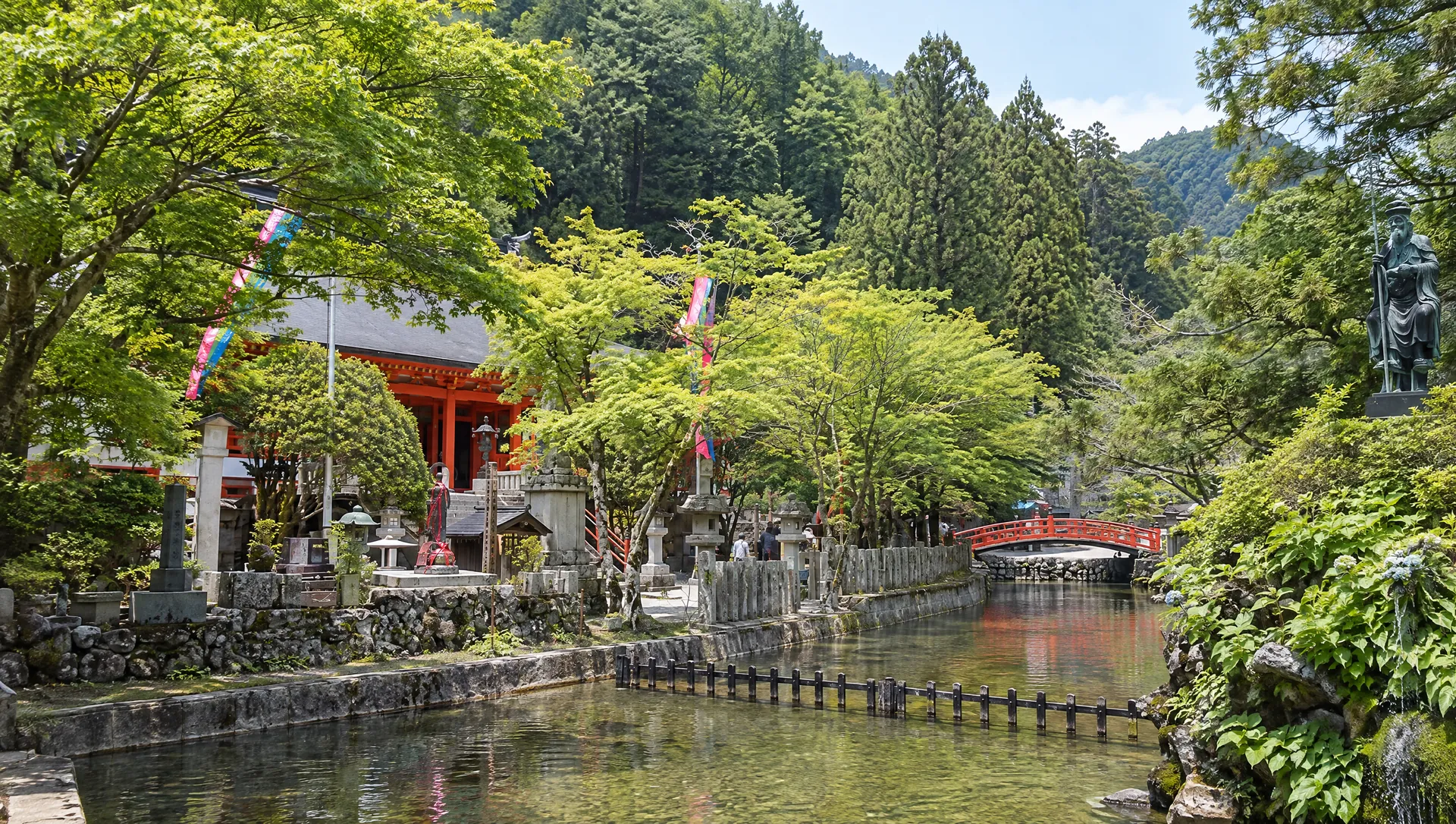 AI-generated visual study · not a documentary photograph
Discover Ryūsen-ji: Water and Shugendō at Dorogawa's Mountain Gate
Ryūsen-ji stands at the edge of Dorogawa's pilgrimage town. Its founding tradition places En no Gyōja at a spring in the rocks during the mid-seventh-century Hakuho era; he is said to have enshrined the Eight Dragon Kings and prayed for the safety of mountain practitioners. The temple is a Shingon Daigo school head temple and one of the guardian temples of Ōminesan-ji on the summit. Here, a spring-fed pond used by pilgrims for water purification sits beside buildings rebuilt after the 1946 Dorogawa fire. A visit can help explain how water and mountain practice are woven through this town, without implying that simply entering the grounds counts as ascetic training.
Follow the water rather than only the main hall
The temple calls the spring Tatsunokuchi, or Dragon's Mouth. Its water fills Ryūō Pond, the first water-purification place for practitioners before they ascend Ōmine. The adjoining Hachidai Ryūō-dō enshrines the Eight Dragon Kings and has a six-metre-square dragon painting on its inner ceiling. The temple says this hall alone survived the 1946 Dorogawa fire; it was dismantled and repaired in 2001. A separate waterfall over ten metres high was prepared as a water-practice site for women after the temple lifted its gender restriction in 1960. The temple asks anyone interested in waterfall practice to consult its office. Neither pond nor waterfall is a public bathing pool or an unsupervised drop-in activity.
Read the buildings against the 1946 fire
The vermilion main hall is not an untouched seventh-century structure. The operator says the fire destroyed it in 1946 and it was rebuilt in 1956 in a style incorporating Kamakura-period forms. It enshrines Miroku Bosatsu as the principal image, together with En no Gyōja, Kūkai, Rigen Daishi and Fudō Myōō. The temple's history page also identifies a bronze vajra and fragments of a carved Zao Gongen image among Nara Prefecture's important cultural properties; the pages do not say these are routinely displayed to visitors. A former imperial temporary residence from Hikone Castle was relocated after the fire, but interior access is unverified. Ask before planning a photograph or a special interior visit.
Understand what is protected nearby
The mixed forest behind the precinct is a Nara Prefecture natural monument, according to the temple and the village's walking route. It is a setting for the temple and a waypoint on Dorogawa's nature-study walk, not a licence to wander into protected ground. From this area the village route continues toward Karigane Bridge and a viewpoint over the settlement. The temple, the adjacent forest and the bridge have different paths and conditions; follow local signs and return to the public route rather than treating the entire slope as temple property.
Try the temple's old stone-lifting custom
The precinct guide introduces a 'nadeshiko' or light-and-heavy stone: visitors first stroke it while thinking 'lovely', then lift it; the temple's traditional account says it feels light. After knocking on the stone while thinking an unkind thought, the same lift is said to feel heavier. The temple connects the practice to old stone divination and uses it to teach gentle regard for living things. Treat this as a temple folk custom, not a scientifically controlled test, and follow any on-site instructions about touching it.
Distinguish a free visit from booked religious services
Visit Nara lists ordinary precinct admission as free and open all year, but the temple publishes no fixed daily visitor hours and does not guarantee every hall is open. Its operator says goma prayers and memorial rites require advance contact and does not accept same-day applications. The temple's annual calendar lists an Eight Dragon Kings festival on the second Sunday in October (with a calendar exception); check its event page for the actual year's details. A separate monthly goshuin rotates through the eight Dragon Kings. The temple posted the October 2026 stamp on 1 October as Banananda Ryūō. Ask the office for current prayer offerings, stamp availability, language support and waterfall-practice conditions rather than assuming a generic ticket covers them.
Arrive through Dorogawa, not the mountain summit
The temple gives 494 Dorogawa and an approximately five-minute walk from the Dorogawa Onsen bus terminus. From Kintetsu Shimoichiguchi, its route uses a Nara Kotsu bus that the temple estimates at about eighty minutes, but actual service and return times must be checked for the day. A 2026 festival notice temporarily closed the temple car park from 31 July to 4 August; it is historical for those dates, not proof of permanent closure or guaranteed parking the rest of the year. The village lists other designated paid parking and advises walking around the compact town. The mountain summit's Ryūsen-ji pilgrimage lodging is a separate seasonal facility and should not be mistaken for this easily reached temple.
What to look for
Tatsunokuchi spring and Ryūō Pond at the first water-practice site
Hachidai Ryūō-dō, the hall that survived the 1946 fire
Rebuilt main hall against a protected forest backdrop
Photo notes
No temple, water-practice, forest or ritual image is licensed to MyNara. Ask before photographing indoor images, worshippers or active practice; never enter a water-practice space for a photograph. No operator permission for commercial photography or reuse of website images has been established.
SEASONAL CALENDAR
Events connected with Ryūsen-ji: Water and Shugendō at Dorogawa's Mountain Gate
These records are shared with MyNara’s event calendar, so dates and notices have one source. Recurring patterns are not confirmed dated editions; check the organizer’s latest guidance.
Dorogawa Gyoja Festival
Dorogawa's Gyoja Festival recalls the village welcoming back En-no-Gyōja, the legendary founder of mountain ascetic practice. Tenkawa Village describes the August 2–3 programme as including oni and comic dances, and Ryūsen-ji lists its annual August 3 programme. The village's 2023 report describes a busy public festival with many performers and tourists but gives no attendance figure. The festival is centred on Dorogawa's streets and approach to the temple, not inside Menfudo Cave or the Eco Museum Center; check the next year's route, times, traffic and weather notices.
Check organizer informationRyūsen-ji Lantern Festival (Tōkae)
Ryūsen-ji's annual calendar places its lantern festival in mid-September. In 2025, the village reported that about 3,500 lanterns illuminated the temple grounds and nearby museum parking area, where visitors viewed and photographed the display. The temple's 2026 schedule set lighting for September 19 at 18:00. The lantern count is not an attendance figure; future dates, routes and transport arrangements may change, so check the next notice before travelling after dark.
Check organizer informationMake a day of it
Explore guides close to this map point, then check the actual route before travelling. Distances below are straight lines, not walking distances or travel times; map points may not be entrances.
Sources & editorial status
Original MyNara draft based on the linked sources. Sources reviewed 20 October 2026. Opening arrangements, prices and offers may change; use the operator's current information before travelling.
- Ryūsen-ji operator — origin tradition, 1946 fire and Shugendō context
- Ryūsen-ji operator — buildings, spring, waterfall and protected forest
- Ryūsen-ji operator — advance-only prayers and memorial rites
- Ryūsen-ji operator — annual festivals and movable dates
- Ryūsen-ji operator — current October 2026 Dragon King goshuin notice
- Ryūsen-ji operator — bus approach and contact
- Ryūsen-ji operator — separate seasonal mountain lodging
- Tenkawa Village — nature-study trail and natural-monument forest
- Visit Nara — ordinary free admission, identity and directory point