
Tamaki Shrine: Ancient Cedars on a Mountain Pilgrimage Route
Walk from a mountain car park into a cedar-filled shrine precinct whose foundation legend and worship history should be read separately.
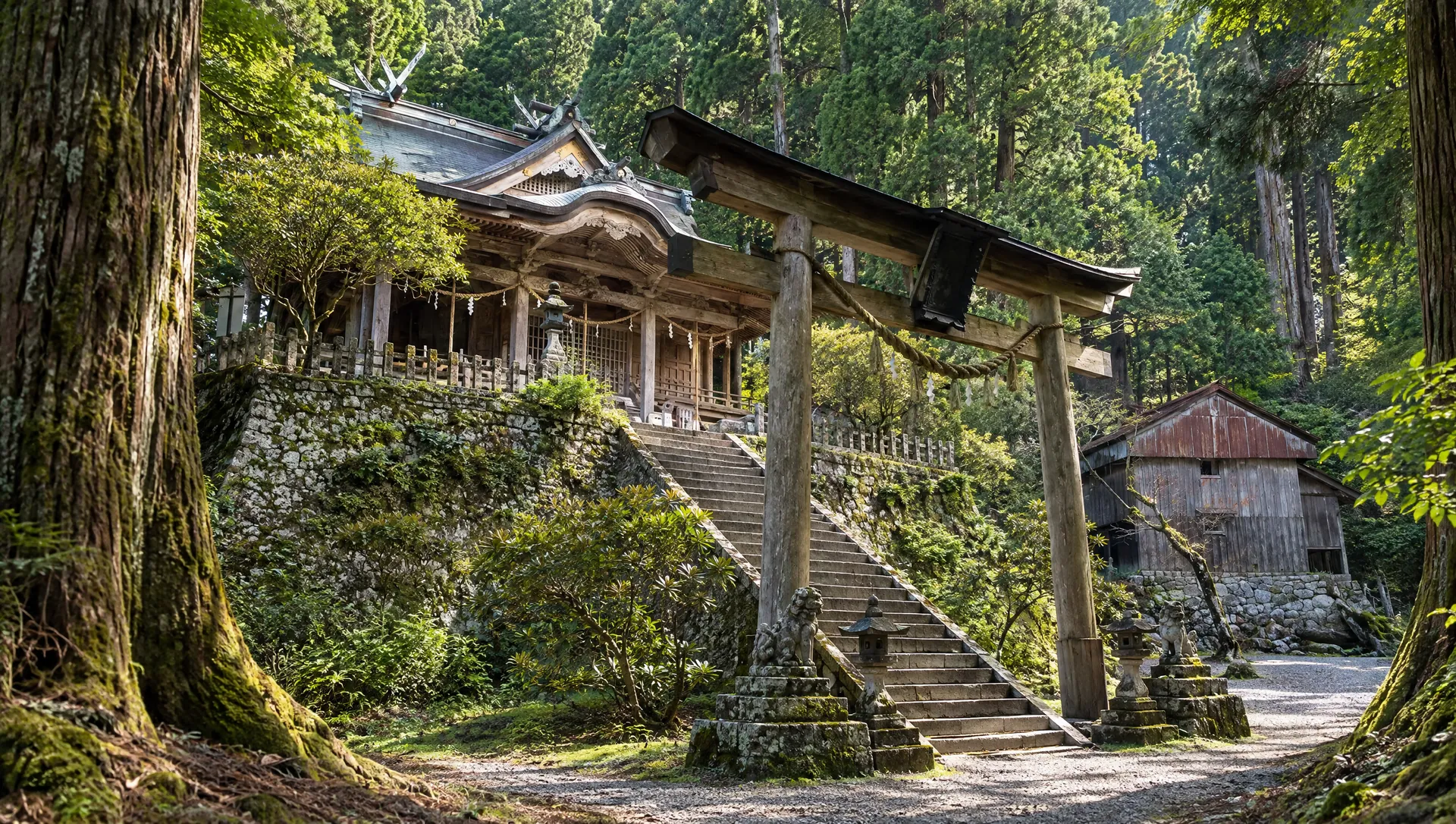 AI-generated visual study · not a documentary photograph
Discover Tamaki Shrine: Ancient Cedars on a Mountain Pilgrimage Route
Tamaki Shrine stands below the roughly 1,076-metre summit of Mount Tamaki, on a mountain route associated with Kumano and Shugendō practice. The shrine itself tells an ancient foundation story linked to Emperor Jinmu; that is a tradition, not an archaeologically established construction date. The visit today combines a forest approach, working places of worship, major old cedars and a protected former temple office. Its access is more demanding than the short map distance from Totsukawa Onsen suggests.
Understand the founding story as tradition
The shrine's overview locates its beginnings in a legend of Emperor Jinmu and an early sacred mountain. Its documented interest also lies in later religious practice: mountain ascetics used routes in the Kii range, and the shrine precinct reflects the long meeting of Shinto and Buddhist institutions. The sacred sites and pilgrimage routes of the Kii Mountain Range received World Heritage inscription in 2004. That designation provides context for the larger landscape, not a guarantee that every tree or building is itself a separate inscribed monument.
Follow the forest route with time to spare
The village estimates 20–30 minutes on the sloping path from the car park to the shrine, before time for worship or looking around. The directory pin should not be treated as the parking entrance or as a wheelchair-accessible drop-off point. Old cedars are an important part of the precinct; the shrine describes the celebrated giant cedar's age as a tradition or estimate, not a measured birth date. Remain on signed paths and avoid touching roots, bark or protected structures.
See the buildings without promising closed displays
The shrine describes its main building and the former Takamuro-in kitchen and office, a nationally protected historic structure tied to the site's syncretic past. A village heritage page describes an extended conservation programme for that building. The shrine also notes that its painted sliding-door works are not presently open for ordinary viewing. Repair and display arrangements can change, so do not travel on the assumption that every listed cultural object, bell or interior will be visible.
Do not continue past the closed summit-side path
The shrine's road-and-path page was updated on 13 October 2026 with a falling-tree hazard. It closes the segment from Tamaishi-sha to the Mount Tamaki summit. Visitors coming from the shrine may reach Tamaishi-sha but must not continue to the summit; walkers at the summit cannot descend through that segment. The shrine says closure signs are posted at three path points. This does not close the shrine precinct, but it invalidates older advice that treats the shrine and summit as an open loop. Check the same page before walking because the restriction may change.
Transport requires a separate decision
The village's 2026 visitor Q&A says weekday taxi and a reservation-based bus on some April–November weekends and holidays are the limited public-transport possibilities. It explicitly warns that a Yagi or Gojo bus connection does not make a same-day round trip to the shrine practical. Its road guidance estimates about 30 minutes from the Hiratani area by narrow mountain road, plus the walk from the car park. The shrine's own access page includes a 2015 bus fare and timetable; those numbers are historical, not current trip advice.
Confirm the day and worship etiquette
A shrine precinct is a living religious place. Ask before photographing interiors, ceremonies or worshippers, and respect any construction barriers. The reviewed current pages do not provide a stable general admission price, opening cut-off, staffed interpretation schedule or accessible route. Check the shrine and village's latest access notices, especially after rain or in winter. A closed mountain road or full car park can change the visit even if the shrine itself remains active.
What to look for
Mountain cedar approach and active shrine precinct
Shugendō and Kii pilgrimage context
Former Takamuro-in building under conservation
Photo notes
No shrine or cedar image is licensed to MyNara. Ask about interior, ceremony and commercial photography; do not reuse shrine, village or prefectural photographs.
SEASONAL CALENDAR
Events connected with Tamaki Shrine: Ancient Cedars on a Mountain Pilgrimage Route
These records are shared with MyNara’s event calendar, so dates and notices have one source. Recurring patterns are not confirmed dated editions; check the organizer’s latest guidance.
Tamaki Shrine Annual Festival
Tamaki Shrine lists its annual festival for October 24. The official Nara travel guide highlights its distinctive forest mikoshi procession and rare dance, and describes the shrine as drawing Shugendō practitioners; it does not give a festival attendance figure. Totsukawa Village confirmed dedication performances by Shintotsukawa Town's Shishi Kagura Preservation Society and Musashi Odori Preservation Society in 2025 only. The shrine's 2026 dated notice welcomed worshippers and listed a 09:30 main ceremony and noon mochi toss, but does not confirm whether the procession or either performance occurred that year. Its notice is not an after-event report. Confirm the current programme, viewing terms and mountain access before travelling.
Check organizer informationMake a day of it
Explore guides close to this map point, then check the actual route before travelling. Distances below are straight lines, not walking distances or travel times; map points may not be entrances.
Sources & editorial status
Original MyNara draft based on the linked sources. Sources reviewed 19 October 2026. Opening arrangements, prices and offers may change; use the operator's current information before travelling.
- Tamaki Shrine — foundation tradition and precinct context
- Tamaki Shrine — buildings and display limitations
- Totsukawa Village — shrine route and parking walk
- Totsukawa Village — current visitor transport cautions
- Tamaki Shrine — 13 October 2026 summit-side path closure
- Totsukawa Village heritage — conservation of former Takamuro-in
- Visit Nara — identity and general location