Manyoshu Poem Stele at Kawaradera
Read an eighth-century poem about life's uncertainty at a modern village monument set across the road from the temple named in its historical note.
 Verified site photographs are being prepared.
Discover Manyoshu Poem Stele at Kawaradera
This roadside monument brings together two different dates and places: Asuka Village erected it in 1992, and the poem's own note says that two verses were written on the face of a Japanese koto kept behind the Buddhist hall at Kawaradera. The stone itself is not an ancient artefact, and the original instrument is not known to survive here. The Nara Prefecture Man'yo database identifies the calligrapher as Takashi Inukai and places the stele opposite Kawaradera across the road. Treat it as a brief literary stop that helps connect Asuka's landscape with the Manyoshu, not as proof that the modern stele marks the original position of the historical koto.
Read the poem as a voice from the Manyoshu
The stone bears the verse catalogued as Manyoshu 16:3850: 「世間の繁き假廬に住み住みて至らむ國のたづき知らずも」. The author is unknown. Nara Prefecture translates it as a speaker who has lived in the troubles of this temporary world and does not know the way to the land ahead; it interprets that land as the Pure Land. The poem is the second of two verses grouped under a heading about weariness with the world's impermanence. This is an attributed reading, not the only possible translation.
Separate the eighth-century note from the modern stone
The poem's left-side note says that the two verses were on the surface of a Yamato koto behind Kawaradera's Buddhist hall. The Prefecture's record places today's stone in front of Kawaradera, across the road, and credits Asuka Village as installer, Takashi Inukai as calligrapher and 1992 as the installation year. The modern stele commemorates a literary association; it is not the original koto, an excavated relic or an ancient marker.
Look across to the temple landscape named in the poem's note
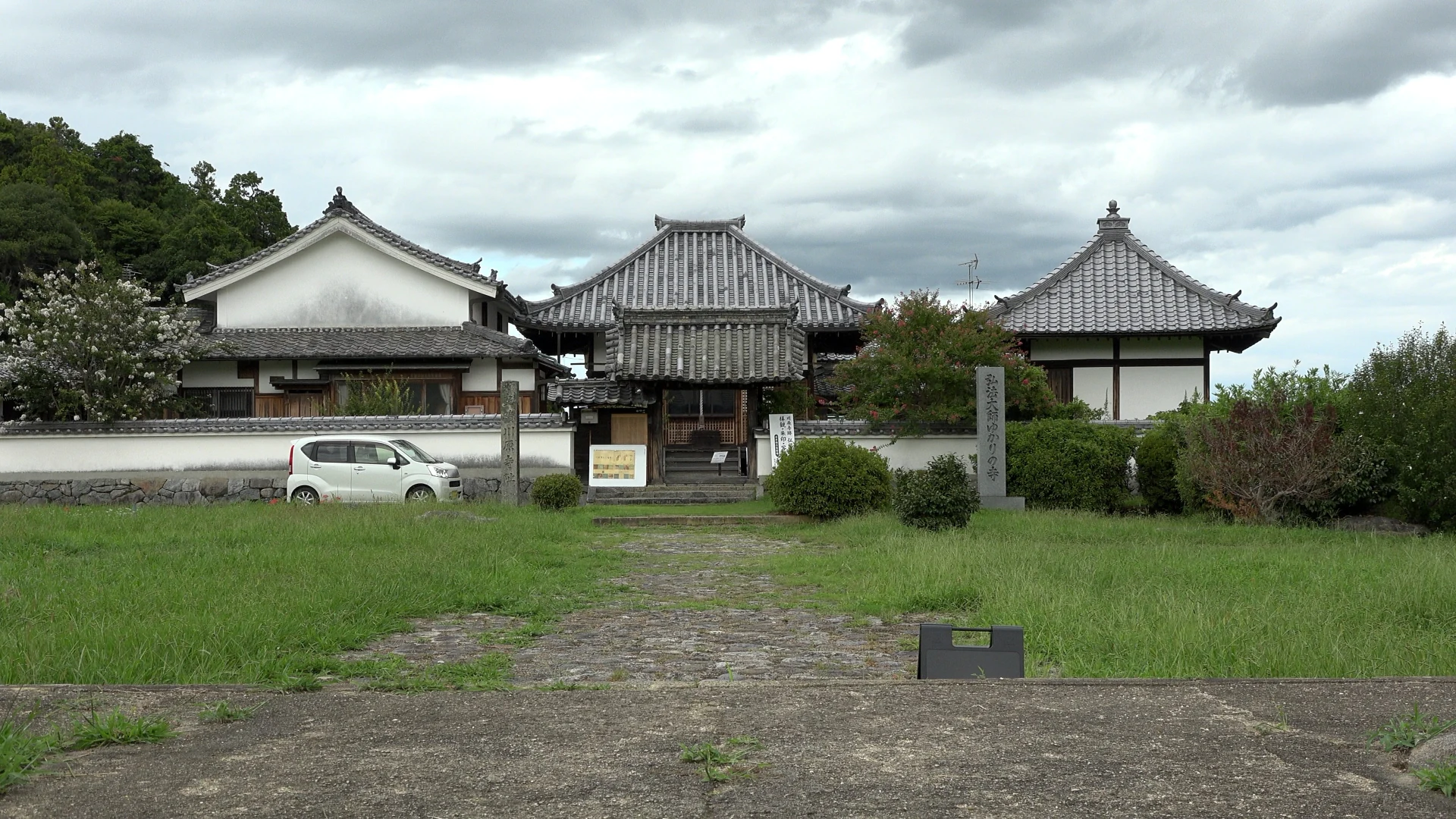
The stele faces the Kawaradera historic site, whose foundation date remains uncertain. Asuka Village's record confirms the temple was functioning by 673, when the Nihon Shoki records the start of a large sutra-copying project there. The heritage account describes 28 distinctive white marble foundation stones and an unusual one-pagoda, two-main-hall layout. These are features of the separate temple grounds, not of the roadside stele; the poem's note connects the verses to a koto behind the temple's Buddhist hall, not to this modern stone's exact position. The official phrase 'across the road' does not establish a safe crossing or permission to enter temple buildings, so use marked public access and check the operator's current visitor rules.
Look closely at the inscription and the setting
The visible calligraphy gives the stop a different scale from the broad temple ruins across the road. Notice the inscription, its arrangement on the stone and the relationship between monument, village road and temple frontage. The official record places the stele opposite the temple, beside the village road. Keep the visit short, stay on public ground, leave space for residents and cyclists, and do not step into traffic to photograph the stone.
Pair the monument with Kawaradera thoughtfully
The stele is separately located from the active Gufukuji temple and the archaeological remains, even though it interprets a poem connected with Kawaradera. The temple is a separate admission destination and has its own visitor rules, hours and activities. Use the official temple access page for current bus information, then cross only at a safe place and check traffic before approaching the roadside monument. The historical association does not establish permission to enter temple rooms or photograph restricted areas.
Know what remains uncertain
The official poem-stele entry gives the village-level address and says it stands across the road from Kawaradera, but it does not publish a postal street number, maintenance contact, toilet, barrier-free assessment, fixed hours or photography policy. The coordinate on this page is an approximate area marker derived from the nearby temple location, not a surveyed pin for the stone. Ask Asuka Village Cultural Properties Division if exact placement, conservation or access arrangements are essential.
What to look for
A poem tied to a temple's musical life
Its Manyoshu note associates two verses with a Japanese koto behind Kawaradera's Buddhist hall.
A clearly dated modern monument
Asuka Village installed the stele in 1992 and records calligrapher Takashi Inukai.
A small literary stop across from Kawaradera
The official record places it across the road; it is a separate outdoor point from the temple grounds.
Photo notes
No third-party image is licensed for MyNara. The stele's location near a road calls for care: photograph from public ground without stepping into the roadway, blocking access or including identifiable residents without consent. Confirm any commercial photography restrictions with the managing authority.
Make a day of it
Explore guides close to this map point, then check the actual route before travelling. Distances below are straight lines, not walking distances or travel times; map points may not be entrances.
Sources & editorial status
Original MyNara draft based on the linked sources. Sources reviewed 24 October 2026. Opening arrangements, prices and offers may change; use the operator's current information before travelling.
- Nara Prefecture Man'yo Authority — poem stele 441: inscription, installer, calligrapher, year and location across from Kawaradera
- Nara Prefecture — history of the two impermanence poems and the koto note
- Kawaradera/Gufukuji — adjacent temple access and bus-stop walking estimates
- Asuka Village — Kawaradera Historic Site: designation, historical record, archaeological layout and Cultural Properties Division contact
- Explore Japan's Cultural Heritage — Kawaradera Historic Site: marble foundations and temple plan