
Kameishi: Asuka's Tortoise Stone
Find a turtle-like carving in the village lanes, while keeping its unknown ancient purpose separate from a later legend.
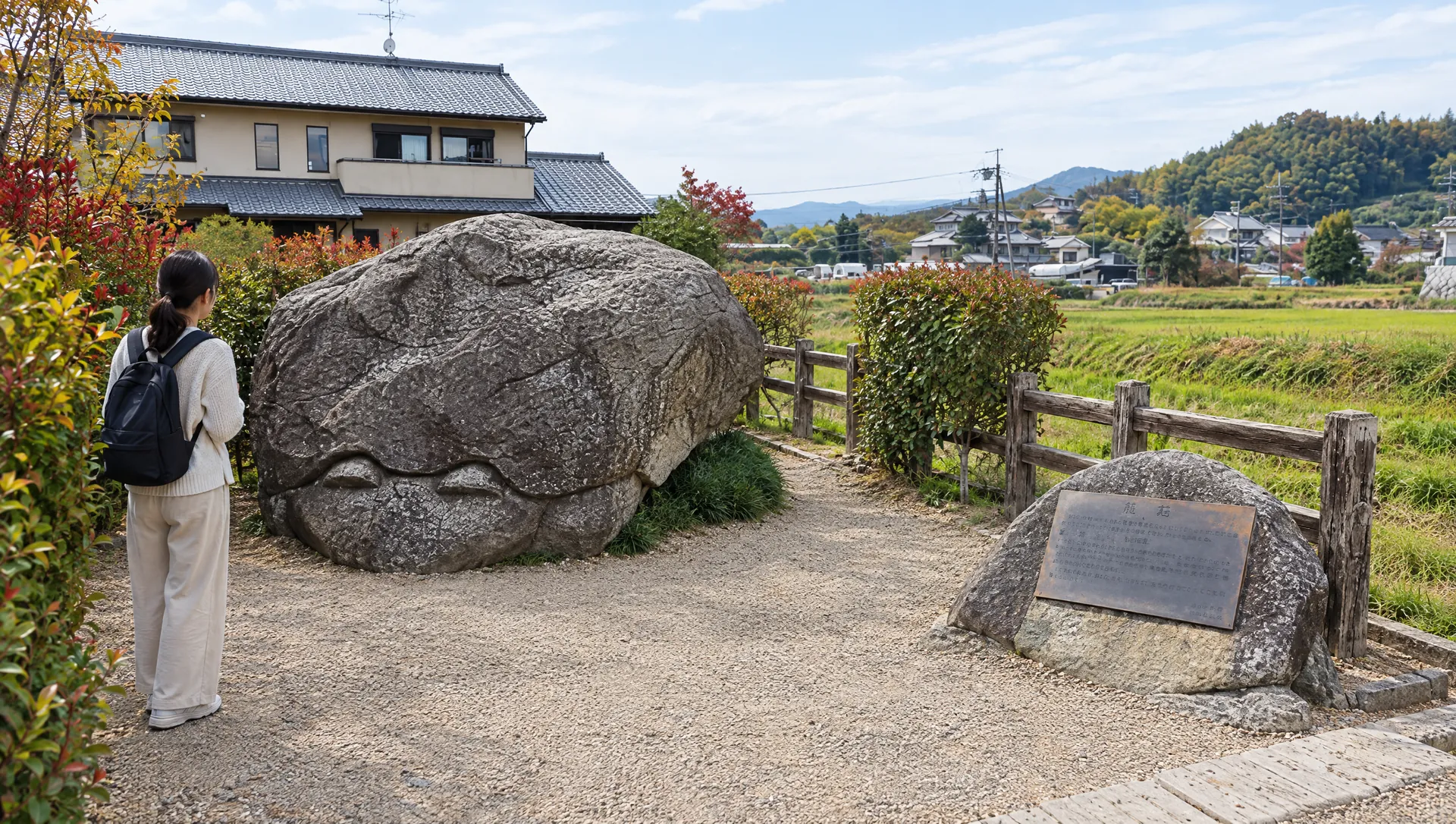 AI-generated visual study · not a documentary photograph
Discover Kameishi: Asuka's Tortoise Stone
Kameishi is a large granite boulder carved to suggest a tortoise. It is an outdoor stone, not a temple building or an excavated tomb that visitors can enter. Asuka's tourism office says its original role remains unresolved. Possibilities such as a boundary marker belong to interpretation, not an established identification. The short stop works best as part of a walk through Kawahara's wider ancient landscape, where several very different stone remains are often mistakenly grouped under one story.
What can actually be seen
The government park describes a large granite stone with a tortoise-like carving. Look from the public approach at the low-relief face and the way the natural boulder supplies the animal's body; do not climb on it or treat neighbouring plots as a viewing platform. Published dimensions differ: Nara Prefecture's tourism bureau gives about 3.6 by 2.1 by 1.8 metres, while an Asuka Village cultural-property summary records 4.26 by 2.72 by 1.94 metres. The sources do not explain whether they measured the same exposed boundaries, so these figures should not be collapsed into a falsely precise single measurement.
What archaeology can and cannot date
The Asuka Village cultural-property research bulletin reviews earlier studies and nearby excavation results. It reports a late seventh-century proposal based on the researcher's reading of surrounding drainage features and a possible garden pond, while also summarizing a broader debate about the dating of Asuka stone monuments. This is a research interpretation, not a secure date carved into or directly established for Kameishi. The preservation foundation still presents its purpose as unresolved, listing possibilities such as a decorative stone associated with Tachibanadera or Kawaharadera, a boundary, or a pre-Buddhist folk object. Keep those proposals distinct from the visible evidence.
Read the turning story as folklore
The Asuka Preservation Foundation records a local warning that the region would sink beneath a sea of mud if the tortoise faced west. This is a later tradition attached to the stone, not archaeological evidence of its purpose or proof that it has turned. Nara Prefecture's cultural-property summary records the related flood version. The story helps explain how people made sense of an enigmatic object; it should not be presented as a historical event.
Notice the separate Jizō nearby
The large roadside Jizō near Kameishi is a different object from the carved boulder. A National Government Asuka Historical Park field-walk record labels it Ōkina Ojizō-san (Komori Jizō, a child-protective Jizō), and Asuka Village's Kawahara landscape plan lists a Jizō near Kameishi among the area's landscape assets. These sources establish the local feature and its relationship to the walking area, but do not document its date, maker, formal designation or a separate visitor facility. Treat it as a respectful roadside feature on the public walking route, not as part of Kameishi or as a reason to enter private property.
Make it a careful village-lane stop
The park puts the stone in Kawahara, about one minute from the Chūō Kōminkan bus stop, and explicitly lists no parking. The prefectural directory instead suggests Noguchi bus stop and roughly five minutes on foot. Those are alternative approaches, not competing site identities; confirm which stop is served on your travel date and check the last return. Asuka Village publishes a dated Akakame loop timetable and route map, while Nara Kotsu provides live timetable and fare search; neither route estimate is a guarantee of current service at the moment you travel. The directory's 108 Kawahara is an address aid, while the broad map pin is not a surveyed doorway.
Allow time for the wider Asuka landscape
The National Government Asuka Historical Park's published 10 km Asuka Capital route includes Kameishi alongside the Oni-no-Manaita and Oni-no-Setchin stones, Tachibanadera, Kawaharadera ruins, Ishibutai Kofun and other sites. The park estimates about 3–4 hours on foot or 1–2 hours by bicycle for that whole route; its separate 15 km kofun route is estimated at 5–6 hours walking. These are whole-itinerary estimates, not time needed at the stone, and should be checked against current path, weather and bus conditions. Kameishi is a village-lane stop, not the entrance to any of those separately managed monuments.
What to look for
Large carved granite stone in Kawahara
Unresolved purpose separated from turning folklore
Short outdoor stop on an Asuka walking route
Photo notes
No photograph of the stone is licensed for MyNara. Photograph from a permitted public position without entering private land, climbing the stone or obstructing residents; ask the village before commercial shooting or drone work.
Make a day of it
Explore guides close to this map point, then check the actual route before travelling. Distances below are straight lines, not walking distances or travel times; map points may not be entrances.
Sources & editorial status
Original MyNara draft based on the linked sources. Sources reviewed 24 October 2026. Opening arrangements, prices and offers may change; use the operator's current information before travelling.
- Asuka tourism association — object, uncertainty and location
- Government Asuka Historical Park — stone, legend, bus and no parking
- Government Asuka Historical Park — 2025 South Course field-walk record, including the separate Komori Jizō near Kameishi
- Asuka Village — Kawahara landscape plan, local landscape assets including the Jizō near Kameishi
- Asuka Village — Akakame loop route map and date-bounded timetable (2026-09-01 to 2027-03-31; rechecked 2026-10-24)
- Nara Kotsu — live timetable and fare search
- Nara tourism bureau — stone dimensions
- Asuka Village — cultural-property summary of stone monuments and Kameishi dimensions / folklore
- Asuka Village — research bulletin 13, review of Kameishi research history and nearby excavations
- Asuka Preservation Foundation — competing interpretations and recorded west-facing legend
- Official Nara Travel Guide — venue identity A00855 and alternative bus approach
- National Government Asuka Historical Park — 10 km and 15 km walking/cycling itineraries