Yoki Tenman Shrine: A Hillside Tenjin in Hase
Climb from Hasedera's approach to a Tenjin shrine beneath Yoki Mountain's protected forest.
 Verified site photographs are being prepared.
Discover Yoki Tenman Shrine: A Hillside Tenjin in Hase
Yoki Tenman Shrine honours Sugawara no Michizane, the scholar later revered as Tenjin. Sakurai's tourism association reports a local tradition placing the shrine's origin in 946, and says Hasedera rebuilt the present shrine buildings in 1818. The surrounding mountain is designated for its warm-temperate forest. It is a short but stair-heavy detour that adds a different strand of Hase's religious history to a Hasedera visit.
Follow the Tenjin story, without treating legend as archaeology
The shrine's worship of Michizane connects it to a Japan-wide tradition of asking Tenjin for help with learning. The association cites the Hasedera engi for a 946 founding story and describes a dated inscription inside a wooden Tenjin image from 1259. Those are distinct kinds of evidence: the inscription dates an object, while the tenth-century origin remains a received tradition. The object was exhibited at the Nara National Museum in 2011; it is not advertised as an everyday display at the shrine.
See the shrine beside a protected mountain forest
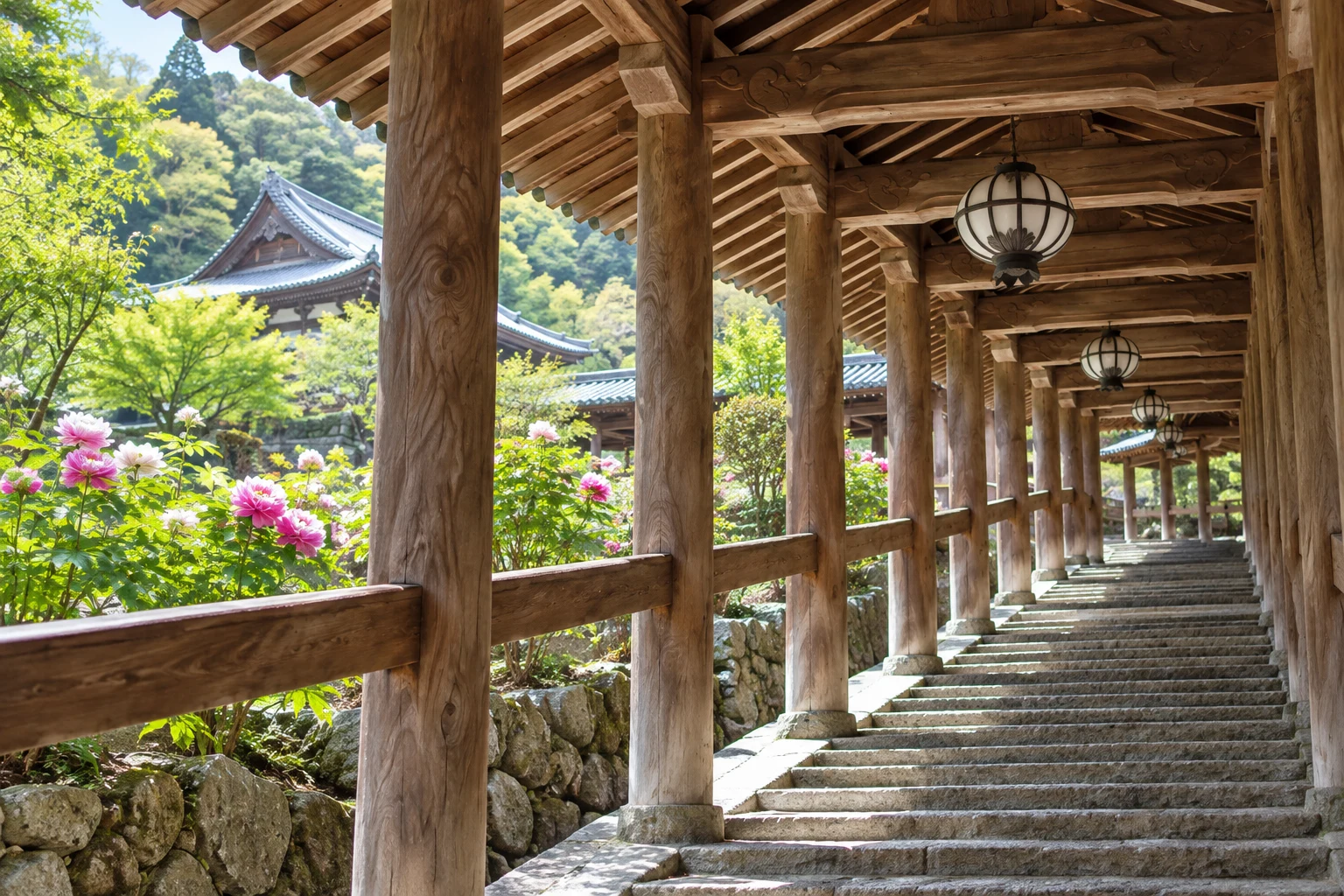
The approach leaves Hase's temple-town street for the wooded lower slope of Yoki Mountain. Sakurai City's environmental plan describes the forest as retaining vegetation with little human disturbance and notes habitat for plants less common in the surrounding area, owls and flying squirrels that use old tree cavities. The plan is a regional ecological account, not a current wildlife survey or permission to enter the woods; keep to the shrine approach and respect forest boundaries. Nara Prefecture also identifies the male-and-female rocks beside the shrine office and Nabekura Shrine, a small sanctuary associated with Ōkurahime. These are features of the same religious landscape, not separate guaranteed services. Seasonal blossoms and leaf colour vary.
Plan for the stair approach
Nara Prefecture's English guide warns of many steps, while its current Japanese access page estimates about 20 minutes on foot from Kintetsu Hasedera Station to the shrine. The sources do not specify where that estimate ends relative to each stair section, and no step-free route is verified. Visitors who cannot use stairs should not assume that the upper worship area is accessible; consider staying on the lower approach and continuing to Hasedera instead.
Use the correct map destination
The prefectural tourist listing identifies Hase 1, whereas Sakurai City's former route page calls the shrine stop Hase 14. The map point here is therefore a guide to the hillside area, not a surveyed gate or a reason to look for a house number. Navigate by the shrine name and signs on the Hasedera approach. The prefecture describes nearby paid parking rather than a confirmed dedicated shrine car park.
What to look for
Tenjin shrine linked to a 946 local foundation tradition
1818 buildings and a documented 1259 image inscription
Protected forest backdrop and a steep stair approach
Photo notes
No shrine, forest or museum-object photograph is licensed to MyNara. Ask before photographing worshippers or rites; follow on-site signs. The tourism association says its images require a separate permission request from each shrine.
Make a day of it
Explore guides close to this map point, then check the actual route before travelling. Distances below are straight lines, not walking distances or travel times; map points may not be entrances.
Sources & editorial status
Original MyNara draft based on the linked sources. Sources reviewed 24 October 2026. Opening arrangements, prices and offers may change; use the operator's current information before travelling.
- Sakurai Tourism Association — history, image inscription and buildings
- Nara Prefecture — access, unrestricted free grounds, nearby parking and toilet listing
- Nara Prefecture — male/female rocks and Nabekura Shrine visitor highlights
- Sakurai City — Second Environmental Basic Plan (regional forest ecology; plan published 2018, ecological sources dated through 2016)
- Sakurai City — city-designated wooden Tenjin image
- Sakurai City — route naming different parcel number
- Official Nara Travel Guide — A00920 directory identity and steps