
Heijo Palace Site
Cross the former capital's grand axis, then distinguish excavated ground from rebuilt halls.
 AI-generated visual study · not a documentary photograph
Discover Heijo Palace Site
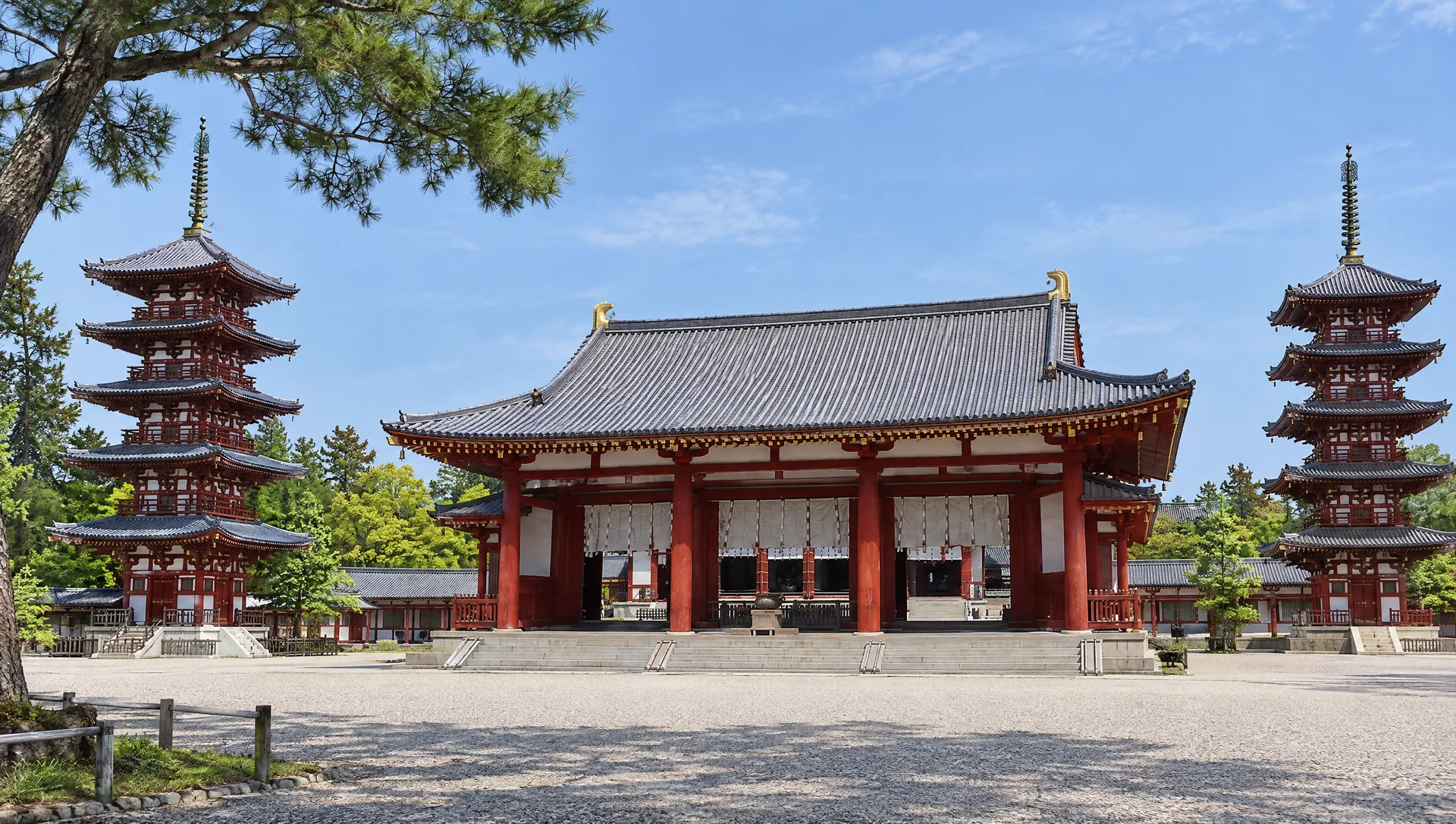
Heijo Palace Site is far larger than one reconstructed gate. The open archaeological ground belonged to the court of Japan's eighth-century capital, while today's Suzaku Gate, First Daigokuden and Daigokumon make parts of its scale visible again. Start in the free Heijo Palace Izanaikan for a model of the entire precinct, then follow the old south–north axis on foot. The grounds, reconstructed buildings, excavation displays and East Palace Garden are managed by different bodies with different calendars, so an itinerary must name its actual stops.
Enter the First Daigokuden compound through Daigokumon
The park identifies Daigokumon as the south gate of the First Daigokuden compound, a court enclosed by a tiled earthen wall and corridors measuring about 317.7 metres north to south and 176.6 metres east to west. The reconstruction opened in March 2022. From the south, read the gate as the threshold to a long ceremonial court leading toward the First Daigokuden, rather than as a stand-alone palace hall. The East Tower stands to its east; the West Tower is still planned. Use the signed public entrance to visit the compound and check current operator notices for closures or restricted areas.
Begin south of Suzaku Gate
The restored Suzaku Avenue and plaza mark the ceremonial approach to the palace. The park says the present Suzaku Gate was reconstructed in 1998. Stand south of it to grasp the capital's axial layout before walking north; a gate photograph alone hides the distance between court spaces. The gate interior has shorter hours than the open plaza.
Use Izanaikan to see what is original
The free guidance museum uses a 1:200 model, finds and interpretive displays to connect the visible landscape to excavation results. Its exhibits also explain work and craft in the Nara-period court. After that orientation, reconstructed timbers can be read as modern evidence-based interpretation, while earthworks and excavation displays mark the remains beneath. Through 29 November 2026, its special exhibition traces the move from the Asuka-Fujiwara capitals to Heijo using about 50 archaeological objects; the venue is Izanaikan's special-exhibition room, not the separate Heijo Palace Site Museum.
Choose between first and second audience-hall zones
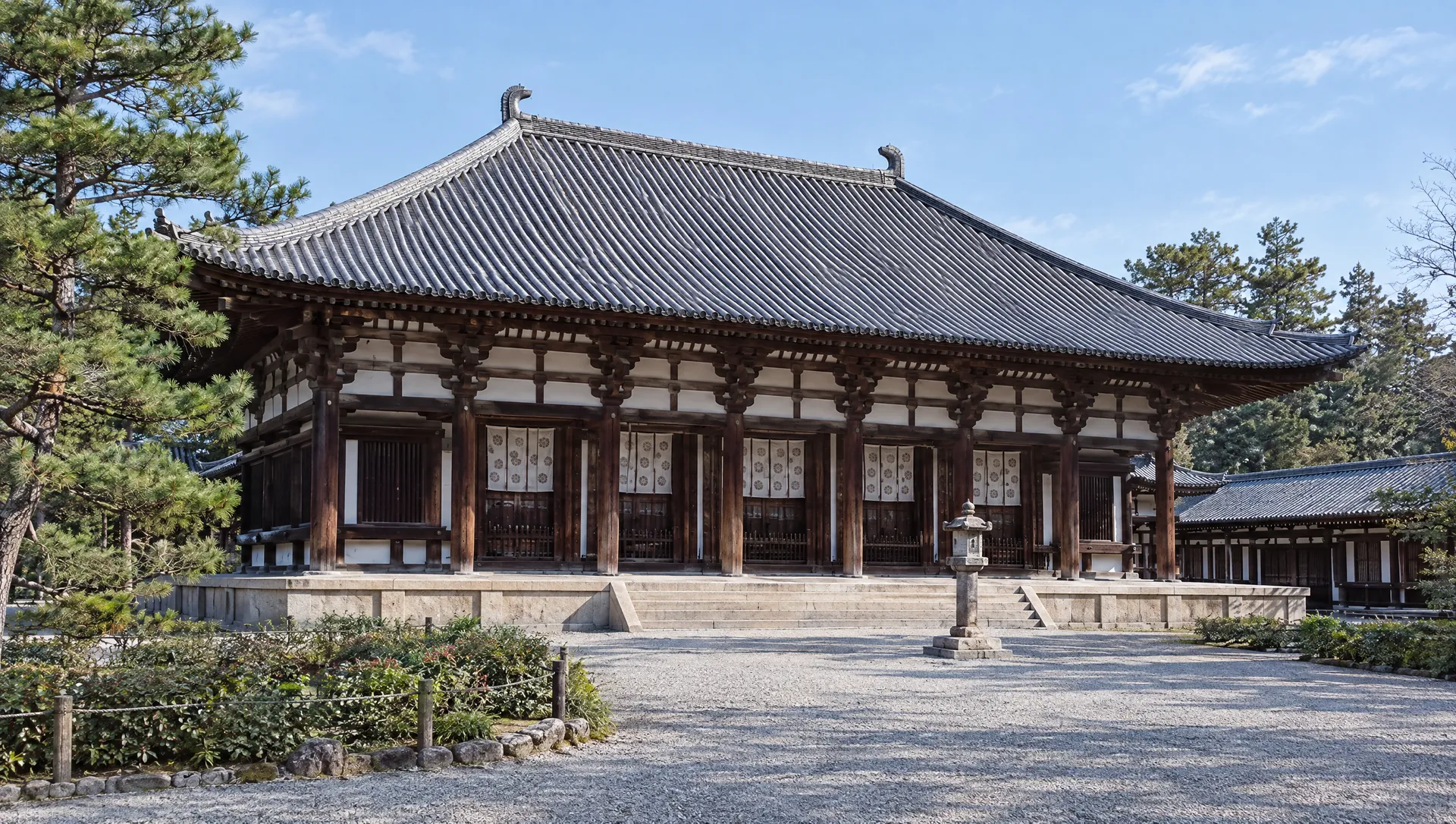
The palace's ceremonial focus shifted within the Nara period, so the park describes a First and Second Daigokuden area. The first has a reconstructed main hall; the eastern area preserves the later hall's base and leads toward the East Palace Garden. They are separate walks across a broad site, not adjacent rooms in one museum. The park map is essential if time or mobility is limited.
Separate the facilities' clocks and managers
The park lists 9:00–17:00 (last entry 16:30) for the Daigokumon and East Tower area and for Izanaikan; the former closes on the second Monday in February, April, July and November and 29 December–1 January. The First Daigokuden, Suzaku Gate and East Palace Garden each have separate listings, generally 9:00–16:30 (last entry 16:00), Monday closures and 29 December–3 January closures. At Suzaku-mon Hiroba, Tenpyō Mitsuki-kan is a visitor-information and rest space, currently listed 8:30–19:00 year-round; Tenpyō Umashi-kan combines the envoy-ship interpretation area with food and shopping services that keep their own hours. These buildings are visitor services within the broad site, not the reconstructed eighth-century palace. Confirm the actual facility and date before travelling; the outdoor precinct and its buildings do not share one opening schedule.
Plan access, mobility and photography
For Suzaku Gate Plaza, the park estimates a 20-minute walk from Kintetsu Yamato-Saidaiji via Tamate Gate. Its FAQ gives bus estimates of about 6 minutes from that station, 16 from Kintetsu Nara and 10 from JR Nara; check the operator's current timetable. Wheelchairs are lent at several facilities, but some must be returned to their lending point, and stroller loans from Izanaikan are limited to the plaza. Personal noncommercial photography follows separate rules from MyNara editorial work: broadly published or commercial location photography requires prior consultation and may need a permit at least two weeks ahead. Management and contacts differ by zone.
Board the restored envoy ship at Tenpyō Umashikan
The reconstructed Kentōshi ship is a specific stop within the Suzaku Gate Plaza visitor area, not a separate distant attraction. The park operator describes an interpretation corner followed by access aboard the restored vessel. This is a modern reconstruction for learning about the dangerous missions that carried people and continental culture between Japan and Tang China; it is not an original eighth-century ship. Confirm access and any temporary closure with the operator before making it the centre of a tight visit.
Treat the Hina festival as a dated event
The event organizer records indoor Hina displays at Tenpyō Mitsuki-kan and Tenpyō Umashi-kan, the visitor-service buildings within Suzaku-mon Hiroba. The inaugural Heijō-kyō Hiina Festival ran 21 February–12 April 2026 and has ended; its staging, indoor displays and operating hours are not permanent park facilities. No later edition is confirmed here, so check the prefecture and event organizer before travelling for it.
Try a reconstructed Nara-period board game on 29 November
The Nara National Research Institute for Cultural Properties lists a public Kariuchi match event at the lawn in front of Heijo Palace Izanaikan on 29 November 2026, 13:00–15:30, with no participation fee. The competitive individual tournament is limited to 32 experienced players and requires advance application; the separate challenge section welcomes walk-ins on the day, subject to space. The event page says spectators may watch freely. These are event-specific arrangements, not daily park activities; check the current organizer notice before travelling or applying.
What to look for
Suzaku Gate and restored avenue
Free Izanaikan model and archaeology interpretation
First and Second Daigokuden areas
East Palace Garden and excavation displays
Photo notes
The park operator says noncommercial individual photography needs no advance application when it follows park rules. That allowance does not cover MyNara guide photography: location photography for broad public release or commercial purposes needs prior consultation and a permit, with the application normally due at least two weeks before the shoot. Authority depends on the management zone; the museum, reconstructed buildings and prefectural areas have separate contacts. The park website's images are not automatically licensed for reuse.
SEASONAL CALENDAR
Events connected with Heijo Palace Site
These records are shared with MyNara’s event calendar, so dates and notices have one source. Recurring patterns are not confirmed dated editions; check the organizer’s latest guidance.
Kakinoha-zushi Fair (2027)
The fair's executive committee has announced a second edition at Tenpyō Mitsuki Hall in Heijō Palace Site Historical Park. It lists January 23–24, 2027 and 10:00–16:00, while saying the detailed programme will follow. The 2026 edition featured tastings, making, a competition and talks, but those activities, prices and participating brands are not yet confirmed for 2027. Check the organizer's latest notice before travelling; Hyōtarō has not yet confirmed participation in this edition.
Check organizer informationKakinoha-zushi Fair (2026)
Thirteen Nara persimmon-leaf sushi brands gathered at Heijō Palace Site's Tenpyō Mitsuki Hall for tastings, hands-on sushi making, a fast-wrapping championship, a history lecture and a makers' panel. A report by participating company and committee member Izasa says about 5,000 people attended; Nara TV independently reported long queues and early sell-outs. The committee's detailed programme reserved hands-on activities and lecture tickets on the day; tasting portions began at ¥100. Hyōtarō and Tokuoka appear on the official 2026 vendor list, but their products were sold at this off-site festival, not at their shops. This first edition has ended and does not alone establish a recurrence.
Check organizer informationMake a day of it
Explore guides close to this map point, then check the actual route before travelling. Distances below are straight lines, not walking distances or travel times; map points may not be entrances.
Sources & editorial status
Original MyNara draft based on the linked sources. Sources reviewed 24 October 2026. Opening arrangements, prices and offers may change; use the operator's current information before travelling.
- Official Nara Travel Guide
- Park operator — facility-specific hours and closures
- Park operator — Izanaikan interpretation
- Park operator — restored Kentōshi ship and Tenpyō Umashikan visitor guide
- Park operator — First Daigokuden precinct and visitor information
- Park operator — South Gate reconstruction viewing deck (special public viewing during construction only)
- Nara City — Heijo Palace World Heritage component and reconstruction history
- Park operator — first and second hall areas
- Park operator — transport, parking, mobility and visitor FAQ
- Park operator — separate parking areas and current charges
- Park operator — filming and publication permissions
- Nara Prefecture — Heijō-kyō Hiina Festival 2026 event listing
- Event organizer — 2026 Heijō-kyō Hiina Festival programme and venue zones
- Heijō-kyō Hiina Festival organizer — 2026 programme and dates
- Nara National Research Institute for Cultural Properties — autumn 2026 Izanaikan exhibition
- JNTO Heijo Palace guide