Naka-senbon: Yoshino's Historic Middle Slopes
Plan a slower walk through Yoshino's middle slopes, where mountain scenery, a historic settlement and the main spring-season bus approach meet.
 Verified site photographs are being prepared.
Discover Naka-senbon: Yoshino's Historic Middle Slopes
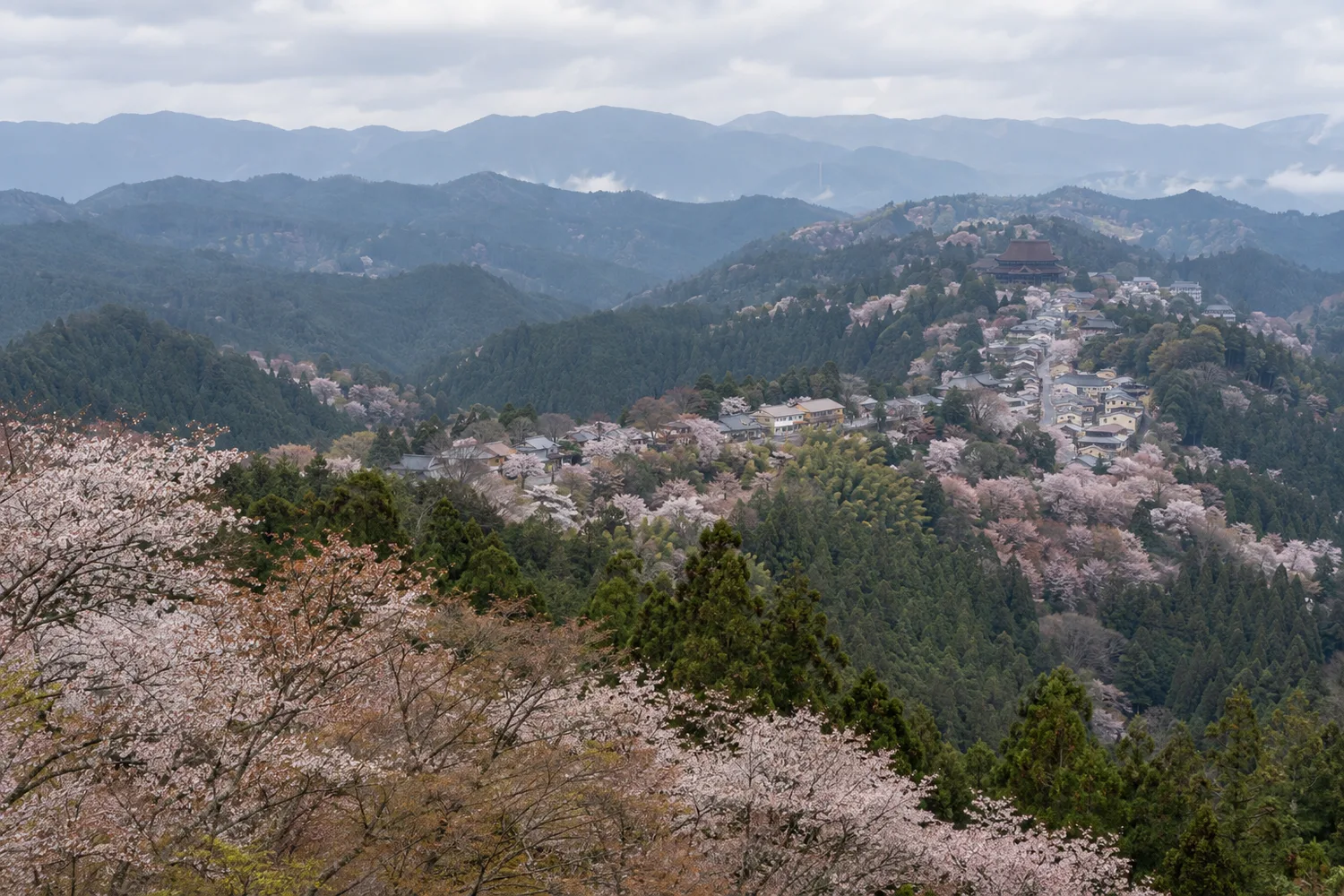
Naka-senbon is the middle band of Yoshino's long mountainside settlement. It sits between the lower approach from Kintetsu Yoshino Station and the higher slopes leading toward Kami-senbon. The zone is not a single park with one gate: it is a network of steep public lanes, worship sites, small businesses, lodging and viewpoints. The town's guide associates the middle band with the area around Nyoirinji, while the tourism association's listings place several historic and religious sites across the district. From Yoshimizu-jinja, the celebrated Hitome Senbon prospect looks across the middle and upper slopes; that particular paid shrine visit is covered in its own guide. This page instead helps visitors understand the middle zone as a walking and transfer area, and how to choose a realistic route through it.
Read the mountain as four rising zones
Yoshino Town and the local tourism association divide the cherry-growing mountain into Shimo-, Naka-, Kami- and Oku-senbon. The town places Naka-senbon around Nyoirinji, with the named zones continuing uphill toward Yoshino Mikumari Shrine and then Saigyo-an. These names describe broad bands of a lived-in mountain, not fenced attraction boundaries. Expect the lanes to climb and descend between separate places; a short-looking map distance can take longer than a flat-town walk.
Build a visit around one slope, not every pin
A useful middle-zone day can focus on one or two sites and leave time for the lanes, a meal and the view. Yoshimizu-jinja, Kinpusen-ji and Nyoirinji are distinct destinations with separate histories, locations and visiting conditions; their individual pages carry the detailed guide information. The tourism association also lists smaller historic markers such as Toyotomi Hanami-zuka, Saruhiki-zaka Jizo and Kohan-no-i. Signage, precise access and visitor facilities at small markers may be limited, so verify the map and keep expectations modest rather than treating every pin as a staffed attraction.
Use the spring bus only as a seasonal tool
The local tourism association says a cherry-season temporary bus links Kintetsu Yoshino Station and Naka-senbon Park, sometimes via Nyoirinji. It publishes a new timetable each year; spring 2026 times and fares are examples for that season only and must not be carried forward. The regular Yoshino Omine route bus and the spring station shuttle are different services. Check the town's current traffic notice and operator timetable before planning a connection, and keep a return option if crowds or road restrictions change the day.
Expect the blossoms to climb, not peak together
The association estimates around 30,000 cherry trees across the mountain and describes the usual progression from lower to higher zones. Naka-senbon therefore often comes into bloom after Shimo-senbon and before the upper slopes, but weather can shift the sequence. Yoshino's celebrated display is a broad mountain landscape and includes mountain cherry varieties; it is not a guaranteed single-day event at a fixed viewpoint. Consult the live annual bloom report, arrive early during peak periods and follow crowd-control directions rather than leaving the path for photographs.
Plan for steep lanes and busy days
This is a hillside town with narrow streets, stairs and uneven surfaces. Comfortable shoes with grip, water and time for pauses help more than trying to maximize pin count. The association recommends early arrival or an overnight stay during the busiest cherry period. Parking, road access, temporary one-way controls, accessible routing and toilet availability can vary by season and exact destination; confirm them with the town or venue before travelling. No single opening schedule or admission applies to the Naka-senbon area as a whole.
What to look for
Middle of Yoshino's four rising landscape zones
Historic lanes between separately operated temples, shrines and businesses
Seasonal shuttle access from Kintetsu Yoshino Station to Naka-senbon Park
Photo notes
No MyNara-licensed Naka-senbon photograph is held. Research photographs from public tourism pages are not reused. Use public paths and designated viewing places, keep narrow lanes clear, do not enter temple or shrine grounds outside their posted visitor areas, and ask permission before commercial or interior photography. Cherry branches and planted slopes are not photo props.
SEASONAL CALENDAR
Events connected with Naka-senbon: Yoshino's Historic Middle Slopes
These records are shared with MyNara’s event calendar, so dates and notices have one source. Recurring patterns are not confirmed dated editions; check the organizer’s latest guidance.
Yoshino Mountain Autumn Foliage Light-Up 2026
The Yoshino Mountain Tourism Association's current seasonal page and dated October 9 notice both schedule the lights for October 23–November 30, 2026, from 16:30 to 22:00. Nara Prefecture's event listing gives October 24; the checked sources do not explain the one-day difference, so October 23 is retained as the association's announced date and the prefectural listing is flagged for verification. No post-event report was found to confirm opening-night operation. The current-edition location list names Shimo-senbon Park, Kuromon, the copper torii, Kinpusen-ji's headquarters courtyard, Myōhō-den, the former Niten-mon gate, Tōnan-in's pagoda, Yoshimizu Shrine's approach, Katsute Shrine, Kizō-in's gate, Sakuramotobō's Niō-mon, Chikurin-in's gate and Daitō-no-miya. Official area guides place Katsute Shrine in Naka-senbon and Daitō-no-miya in Kami-senbon, so both areas are linked as confirmed 2026 light-up locations. The association's standing seasonal guide separately mentions Naka-senbon Park's Ogi-no-Tani and the lower ropeway's Senbonguchi as usual light-up areas; neither appears in the detailed 2026 location list, so do not assume those sites are lit this year. Confirm the exact sites and traffic controls before travelling.
Check organizer informationYoshino Mountain Spring Cherry Blossom Season and Light-Up
Yoshino Mountain Tourism Association describes a spring cherry season across Yoshino Mountain, generally from late March into late April, with blossoms advancing from Shimo-senbon through Oku-senbon. The 2026 light-up itself was held at Nanamagari in Shimo-senbon and Cherry Exhibition Park in Kami-senbon, not at the Hanayagura or Takagi observatories. Those viewpoints are connected as places to understand the wider mountain landscape, not as confirmed light-up venues. Bloom stages, traffic rules and any special access change each year; use the association's dated notice before travelling.
Check organizer informationYoshino Mountain Autumn Festival
Yoshino Mountain Tourism Association describes this as a festival for all shrines on Yoshino Mountain, with three neighborhood futon-taiko floats processing through the town and a rite at Tenman Shrine. Kimpu Shrine is linked as part of that mountain-wide shrine context, not as a confirmed float stop or a separately documented visitor service; its own rite access and time have not been published. Chikurin-in is linked only as an accommodation guide within the mountain-wide visitor area, not as a procession stop or event venue. Although the association lists the third Sunday of October as the customary date, the 2026 procession was described by the official Nara tourism listing as returning after a seven-year gap. Check each year's programme and route. Yoshino dining guides are separate itinerary stops, not event venues or participants.
Check organizer informationMake a day of it
Explore guides close to this map point, then check the actual route before travelling. Distances below are straight lines, not walking distances or travel times; map points may not be entrances.
Sources & editorial status
Original MyNara draft based on the linked sources. Sources reviewed 19 October 2026. Opening arrangements, prices and offers may change; use the operator's current information before travelling.
- Official Nara Travel Guide — Naka-senbon district, local access and seasonal crowd guidance (updated 28 Nov 2025)
- Yoshino Town — Mount Yoshino and the four elevation zones
- Yoshinoyama Tourism Association — Naka-senbon temples, historic markers and addresses
- Yoshinoyama Tourism Association — seasonal model course and transport distinction
- Yoshinoyama Tourism Association — four zones and annual blossom progression
- Yoshino Town — current-year cherry traffic and shuttle notices
- Yoshino Town — listed stops including Naka-senbon Park and Nyoirinji (2025 stop list)
- UNESCO World Heritage Centre — Sacred Sites and Pilgrimage Routes in the Kii Mountain Range