
Koriyama Castle Ruins
Walk a free castle park, then climb the stone-base viewpoint during its shorter opening hours.
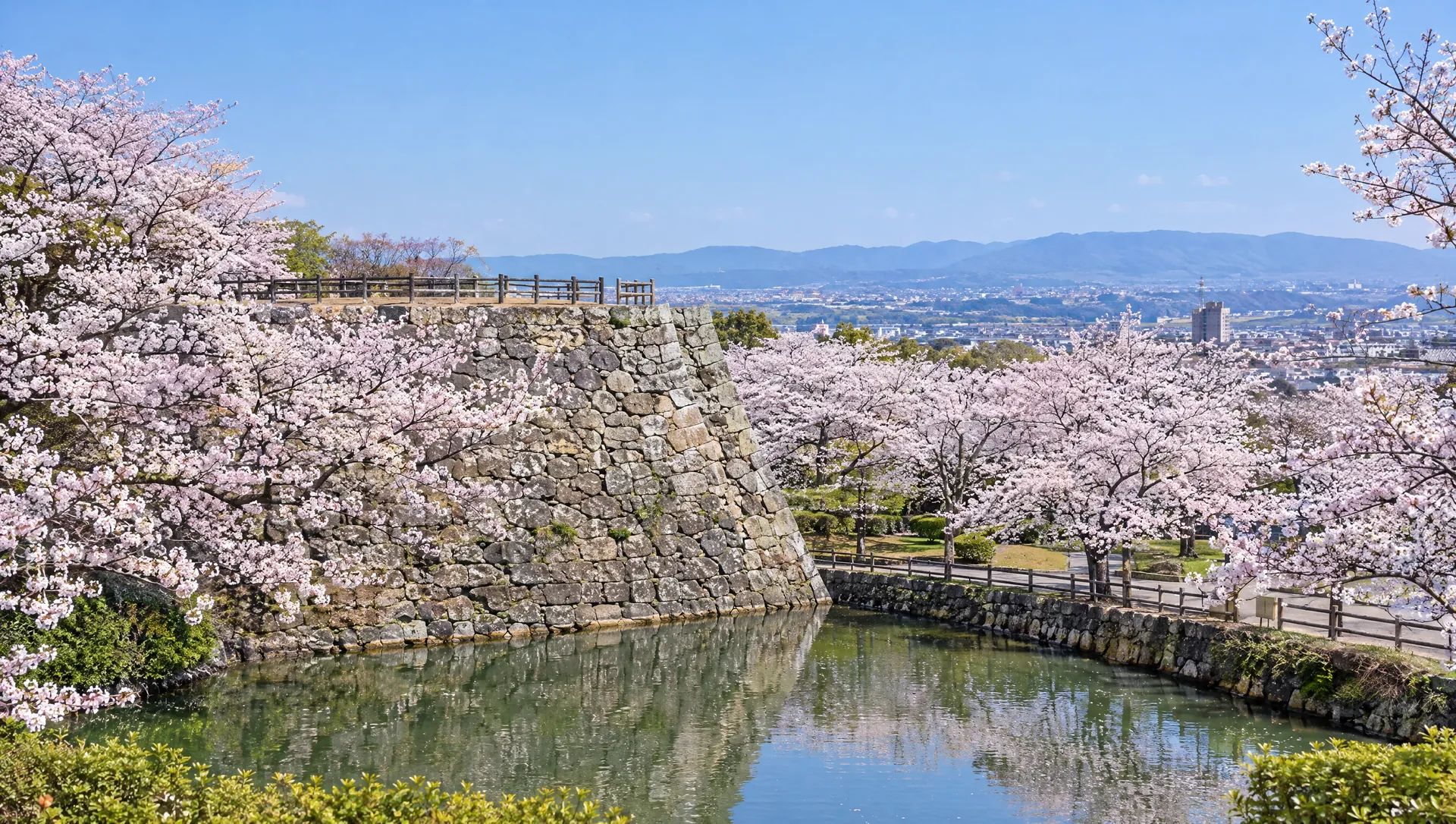 AI-generated visual study · not a documentary photograph
Discover Koriyama Castle Ruins
Koriyama Castle is a broad historic landscape of stone walls, moat lines, reconstructed gates and later buildings; no castle keep survives above the keep-base stonework. Yamato-Koriyama City traces the castle to Tsutsui Junkei in 1580, its major expansion and castle-town formation to Toyotomi Hidenaga from 1585, and the completion of its outer moat to Masuda Nagamori in the 1590s. The inner, middle and outer moats enclosed the castle core, samurai districts and town. Look for reused stones, including an inverted Jizo figure in the keep-base wall. The park is free and open around the clock, but the lookout, information facilities and toilets have shorter hours; the lookout also requires stairs.
Read the castle as a growing town
The city's cultural-property record dates the castle's beginnings to Tsutsui Junkei in 1580. Under Toyotomi Hidenaga, who entered the castle in 1585, the castle and its town took shape on a much larger scale; after Hidenaga's death, Masuda Nagamori developed the outer moat in the 1590s. The three concentric moat lines organized the central castle, samurai residential areas and the castle town. That sequence is more useful than attributing the whole surviving layout to one builder. The present Otemon and other restored gates are modern reconstructions that help visitors read the approach, not untouched sixteenth-century buildings.
Look for stones with earlier lives
The city's castle history explains how builders drew on stones from other structures. On the north face of the keep-base wall, a Jizo figure was incorporated upside down. View it from the designated path without touching or climbing the masonry; the object illustrates the urgency and reuse involved in castle construction, not an invitation to search the wall off-path.
Climb to a viewpoint, not a surviving tower
The municipality repaired unstable stonework and opened the present keep-base lookout in 2017. From the platform, it identifies views across the town toward Heijo Palace, Yakushi-ji and the hills. Reach it through Yanagisawa Shrine and the east-side stairs. There is no standing historic keep to enter, and the stairs make this viewpoint different from the flatter public park paths.
Make a second stop only if it is open
The wider precinct contains Yanagisawa Shrine, the Yanagisawa Bunko historical library, a former prefectural library building and an information hall. Each is a separate institution or facility, with its own access and charges. The city's park page says the information hall, multipurpose square and toilets follow seasonal 7:00 opening hours even though the park itself is open around the clock; do not infer an indoor visit from the open gate.
Use a human guide when available
The city and tourism association list free stone-wall interpreters near the keep base on weekends and holidays, generally 10:00–16:00, to 15:00 in winter, with weather cancellations. They can point out masonry details that are easy to miss. Cherry trees and the spring castle festival are seasonal, but a visit to the historic stonework does not depend on an event date.
Use the current history display to orient yourself
The temporary exhibition Hidenaga and the History of Koriyama is scheduled at the Higashi-Tamon turret through 31 January 2027. It brings together excavated material and a regional chronology to interpret the castle and Hidenaga's role. The tourism association lists 10:00–17:00 opening, last entry 16:30, and ¥300 adult admission; junior-high-age children and younger, qualifying local high-school students, and visitors with a disability certificate enter free. The notice does not list a free companion, so check directly if that applies. The exhibition is separate from the free park and may close during the stated winter/New Year period. A digital navigation display in the venue maps moats, stone walls and town temples and includes a CGI castle reconstruction; treat that image as a modern interpretive visualization, not a surviving tower or documentary photograph. Confirm current dates and access before planning around this dated exhibition.
What to look for
Reused stone and the inverted Jizo in the keep-base wall
2017 lookout over the Yamato basin
Restored gate, moats and separate historic facilities
Photo notes
The city prohibits unauthorised drone use. Organised filming or use of different parts of the ruins may need applications to different managing offices; its park page provides a management-zone map and application routes. Take personal photos only from permitted paths, respect shrine visitors and obtain separate rights before using city or association images.
SEASONAL CALENDAR
Events connected with Koriyama Castle Ruins
These records are shared with MyNara’s event calendar, so dates and notices have one source. Recurring patterns are not confirmed dated editions; check the organizer’s latest guidance.
Yamato-Koriyama Castle Festival
Yamato-Koriyama's main spring festival spreads across the castle ruins and former castle town, with cherry-blossom viewing, a historic procession, a white-fox parade and goldfish displays among its recurring features. The city's 2024 report records about 240,000 visitors to that year's 15-day edition; this is a single-edition figure, not an annual guarantee. The 65th edition ran March 24–April 7, 2026. The next dates and programme are not announced; activities use different venues and may change, so check the city and tourism association's current notice before travelling. The 2026 guide advised weekend visitors about traffic congestion and Park & Ride; future arrangements are unconfirmed.
- Time
- There is no single festival-wide schedule; event times vary by programme. Check the current edition's official programme.
- Admission
- The 2026 tourism-association listing leaves a general festival admission fee blank; confirm any charge attached to an individual activity.
- Booking
- The annual overview does not state a festival-wide reservation requirement. Individual programmes may have separate entry or booking conditions; check the current notice.
Make a day of it
Explore guides close to this map point, then check the actual route before travelling. Distances below are straight lines, not walking distances or travel times; map points may not be entrances.
Sources & editorial status
Original MyNara draft based on the linked sources. Sources reviewed 24 October 2026. Opening arrangements, prices and offers may change; use the operator's current information before travelling.
- Official Nara Travel Guide
- Yamato Koriyama City — park hours, facilities, rules and management zones
- Yamato Koriyama City — keep-base lookout access and hours
- Yamato Koriyama City — history, stonework, buildings and access
- Yamato Koriyama City — current station walk estimates and congestion advice
- Yamato Koriyama Tourism Association — interpreter availability
- Yamato Koriyama Tourism Association — Hidenaga history exhibition dates, admission and hours
- Yamato Koriyama City — digital navigation display and CGI interpretation