
Hōtokuji Temple and the Yagyu Family Cemetery
A Zen temple founded for the Yagyu family, with a wooded cemetery of more than 80 family gravestones behind its main hall.
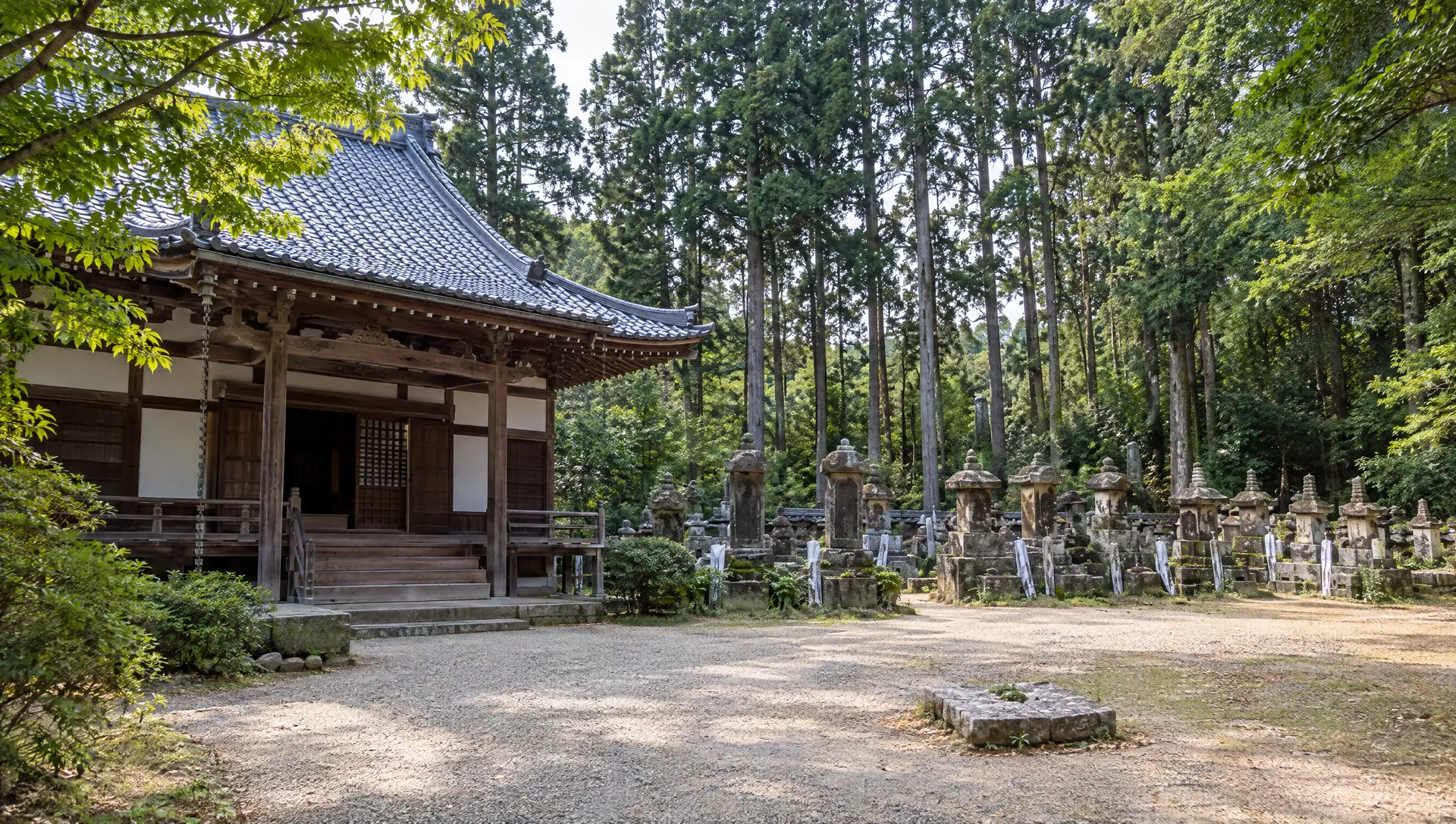 AI-generated visual study · not a documentary photograph
Discover Hōtokuji Temple and the Yagyu Family Cemetery
Hōtokuji is the Yagyu family's family temple in the eastern Nara countryside. In 1638, Yagyu Munenori established it to honour his father, Sekishūsai Muneyoshi. The temple's wooded cemetery preserves the graves of successive generations, giving visitors a way to follow a warrior family's history through a living religious place. A Nara City interpretive plan counts 86 graves and places Munenori's grave at the centre; the city visitor page describes the cemetery as having more than 80 stones. The city designates the cemetery, together with the grave of Hōtokuji's first abbot Retsudō, as a historic site (11 April 1996); it separately designates the Edo-period main hall as a building cultural property (4 March 1992). These are municipal designations, not national ones. The stones are not a display to touch or climb, but a burial ground to approach with care.
Read the cemetery map before the stones
The city-issued interpretation board includes a plan, a family tree and notes on the grave-marker forms. Its English panel counts 86 graves and places Munenori, the family's first daimyō, at the centre. The current visitor page says more than 80, which is consistent as a rounded description. The same board identifies a memorial pagoda for Kamiizumi Nobutsuna, founder of the Shinkage-ryū lineage later inherited by Munetoshi; he was not a Yagyu family member. Use these details to understand the arrangement, without treating the cemetery as an open-air exhibit or touching its stones.
Distinguish the two city-designated cultural properties
Nara City separately lists the Edo-period Hōtokuji main hall as a building cultural property, designated in 1992, and the Yagyu family cemetery with Retsudō's grave as a historic site, designated in 1996. The visitor page describes a Shaka Nyorai image and portraits of Munenori and Takuan inside the main hall, but does not explain which rooms or images are open at every visit. The admission and hours listed by the city do not by themselves establish unrestricted access to every interior; follow the temple's current instructions.
Connect the temple to the Yagyu story
Munenori founded Hōtokuji in 1638 to honour his father Sekishūsai and became the first daimyō of the Yagyu domain in 1636. He served as sword instructor to the second and third Tokugawa shoguns, while his fourth son Retsudō became the temple's first abbot. Their positions connect a family cemetery, a religious house and the military service of the early Edo period. Keep this documented history distinct from later regional legends.
Look from the temple toward the village
The temple sits above the rural Yagyu settlement, and the official route notes views over the village. Pair the visit with the former Yagyu domain sites only after checking their separate opening arrangements and walking times. Local roads are narrow and bus services are limited; plan the return journey before leaving central Nara.
Visit a working religious site respectfully
Hōtokuji remains a temple, and its cemetery is a burial place. Keep voices low, follow signs and staff instructions, do not touch or climb grave markers, and avoid photographing worshippers or private ceremonies. Nara City's visitor listings do not describe step-free access, interior photography rules or an ordinary visitor reservation system. The Yagyu Tourism Association separately requires advance arrangements for cosplay or organised photography at temples; that special rule is not a general statement about casual visitor photography. Ask the temple about the activity you plan.
What to look for
86 graves arranged as a family record
Nara City's cemetery plan counts 86 graves and places Munenori's grave at the centre.
Two separate municipal cultural designations
The cemetery is a historic site; the Edo-period main hall is separately designated as a building cultural property.
Rural views
The temple's hillside setting looks across the Yagyu village landscape.
Photo notes
No third-party photograph is licensed for this guide. The Yagyu Tourism Association requires advance arrangements for cosplay/organised photo shoots at temples; this does not publish the ordinary snapshot policy. Ask the temple about close cemetery photography, interiors and ceremonies.
Make a day of it
Explore guides close to this map point, then check the actual route before travelling. Distances below are straight lines, not walking distances or travel times; map points may not be entrances.
Sources & editorial status
Original MyNara draft based on the linked sources. Sources reviewed 24 October 2026. Opening arrangements, prices and offers may change; use the operator's current information before travelling.
- Nara City — Hōtokuji, visitor hours, admission, phone, walking access and family graves
- Nara City — designated Yagyu family cemetery, address, historic designation and dates
- Nara City — cemetery interpretation board: 86 graves, Munenori's central grave and family map
- Nara City — cultural-property list; Edo-period main hall designation (1992, updated 2026-03-26)
- Nara Prefecture Tourism Bureau — Yagyu route, Hōtokuji history and access
- Yagyu Tourism Association — advance arrangements for cosplay/organised photography at temples