
Kofuku-ji Temple
Follow the Fujiwara family's temple through reconstructed halls, a major Buddhist sculpture collection and a pagoda now hidden by conservation work.
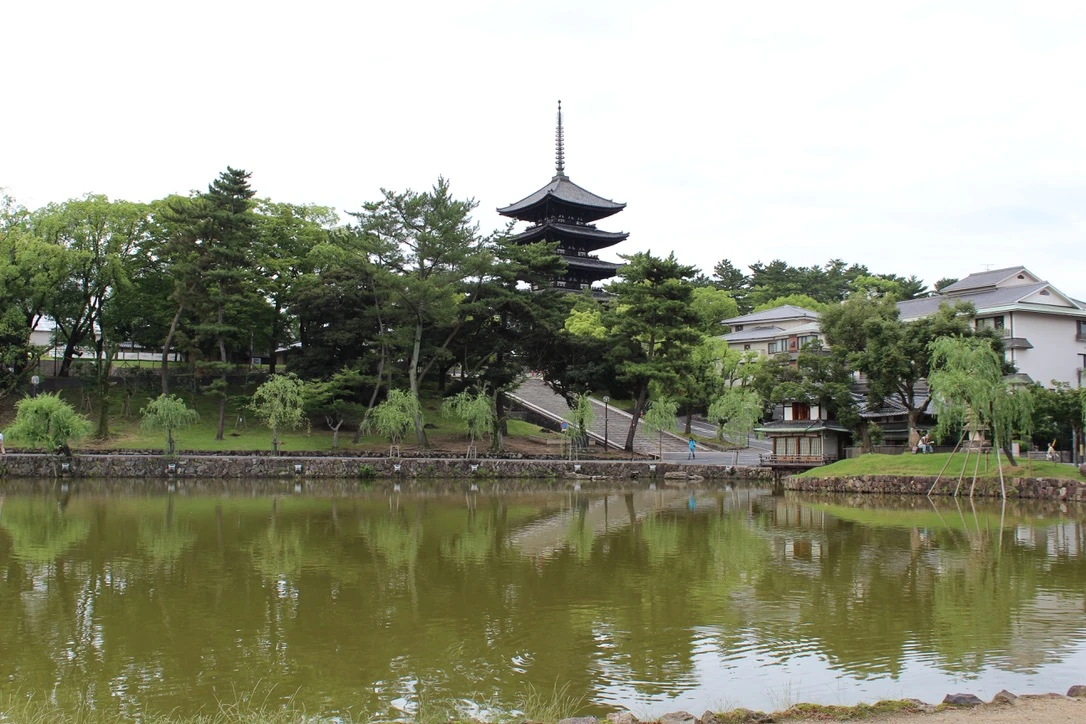 User-provided archival photograph · June 2011 · the pagoda is now concealed by conservation work.
Discover Kofuku-ji Temple
Kofuku-ji began as the Fujiwara family's temple and moved to the new capital in 710. Its historic precinct is part of UNESCO's Historic Monuments of Ancient Nara, but the visit is not one single museum: the Central Golden Hall, East Golden Hall and National Treasure Hall each have their own collection, with individual and combined tickets. The five-storey pagoda is now concealed by a large conservation enclosure, while 2026 brings separate anniversary openings at the East Golden Hall and North Octagonal Hall. Check each building's current calendar before choosing a route.
A Fujiwara temple within the ancient capital
Kofuku-ji traces its origins to Yamashina-dera, established for Fujiwara no Kamatari, and says Fujiwara no Fuhito moved the temple to Heijo-kyo in 710. As the clan's family temple, it grew into a major religious and political complex. Fires and rebuilding repeatedly changed its buildings; in the Meiji period, anti-Buddhist policies removed much of its land. Today it sits beside Nara's streets, but UNESCO includes it as one component of the wider Historic Monuments of Ancient Nara property.
Compare three very different paid interiors
The Central Golden Hall, rebuilt in 2018, returns the principal hall to the centre of the precinct. The East Golden Hall preserves an older building, consecrated in 1415 after its predecessor burned, and its altar brings together images from several periods. The National Treasure Hall opened in 1959 on the site of the former refectory and holds works displaced from halls lost to fire. They are separate visits; the temple's current three-site ticket is the practical option if you plan to enter all three.
Look closely at Ashura and the sculpture collection
The National Treasure Hall's Tenpyo sculptures include the Eight Kinds of Mythological Beings, made in 733–734 using hollow-core dry lacquer. Ashura is the best-known: its three faces and six arms differ from the fierce armoured form many visitors expect of an Indian asura. The hall also displays the Ten Great Disciples, guardian figures, and a Yakushi head cast in 685. That head was brought from Yamadadera in Asuka, hidden inside the throne of the East Golden Hall's replacement image after the 1411 fire, and rediscovered during repairs in 1937. Read the collection as objects that moved between buildings and survived repeated disasters.
Catch the 2026 East Hall anniversary opening
The East Golden Hall was founded in 726, and the temple marks its 1,300th anniversary with an unusual opening of the rear hall behind its main images. The normally closed space contains a wooden Shōryōchi Taishō standing image, opened to visitors from 1–30 November 2026. The East Golden Hall plus rear-hall ticket is ¥1,000 for adults, ¥600 for junior/high-school students and ¥400 for primary pupils; a four-site ticket including the Central Golden Hall and National Treasure Hall is ¥2,000, ¥1,300 and ¥700 respectively. Ticket sales end at 16:45. These are event-period prices, separate from ordinary admission, so use the temple's live notice if visiting on another date.
See the North Octagonal Hall only during its opening
The North Octagonal Hall is among Kofuku-ji's oldest surviving buildings. The temple says the first hall was built in 721 for the memorial of Fujiwara no Fuhito, then rebuilt around 1210 after the 1180 destruction. Its autumn 2026 special opening runs 24 October–8 November, 9:00–17:00 with last entry at 16:45; admission is ¥500 for adults, ¥300 for secondary students and ¥200 for primary pupils, cash only. The small interior may temporarily restrict entry when crowded. A temple visit outside these dates does not include the hall interior.
Expect a changed skyline and follow the signed route
The five-storey pagoda, rebuilt in 1426, is under major conservation; the temple's project notice gives 2031 as the planned completion and says the enclosure hides the tower. The work also changes paths through parts of the precinct, while the Central Golden Hall and National Treasure Hall remain visitable. Allow separate time for the halls, then continue to Sarusawa Pond, Naramachi or the Nara National Museum. From Kintetsu Nara Station, the temple is about a five-minute walk. The Nara tourism association lists one loan wheelchair usable within the National Treasure Hall, a step-free entrance there and an accessible parking space nearby; this does not establish a step-free route through every hall or the precinct.
What to look for
Central Golden Hall and open precinct
East Golden Hall and National Treasure collection
Five-storey pagoda conservation story
Photo notes
The sources checked for this guide do not establish a blanket photography rule for every hall and collection. Follow posted notices and staff directions, avoid interrupting worship or blocking other visitors, and ask before photographing an interior or event. The temple requires separate permission for reuse of its published photographs or footage; do not assume website images are available for republication.
SEASONAL CALENDAR
Events connected with Kofuku-ji Temple
These records are shared with MyNara’s event calendar, so dates and notices have one source. Recurring patterns are not confirmed dated editions; check the organizer’s latest guidance.
Kōfuku-ji Hokuen-dō Autumn Special Opening
Kōfuku-ji's 2026 autumn opening lets visitors see the normally closed octagonal hall and its celebrated Kamakura-period sculptures. The temple lists 09:00–17:00 admission, with final entry at 16:45; tickets are ¥500 for adults/university students, ¥300 for junior/high-school students and ¥200 for elementary pupils. Crowds may cause temporary entry limits.
Check organizer informationShūya no Nara Tabi: World Heritage Night Openings (2026)
Nara City Tourism Association's seventh Shūya no Nara Tabi programme brings limited night visits to five World Heritage temples and a separately bookable Mount Wakakusa night-view bus. It began in 2020 and is promoted as a way to experience Nara's historic sites after dark. Each temple has different operating Saturdays, hours and admission; the official schedule below preserves those differences. Temple visits do not require reservations, but the bus does. At Gangō-ji, photography is allowed outdoors only; indoor photography and tripods, monopods or ladders are prohibited. Check the association's current notice for access and transport changes before travelling.
- Time
- Temple openings: Kōfuku-ji Oct 31 and Nov 7, 14, 21, 28, 17:30–21:00; Kasuga Taisha Nov 7, 14, 21, 28, 17:30–20:00; Gangō-ji on those four November Saturdays, 18:00–20:00; Tōshōdai-ji and Yakushi-ji Nov 7 and 21, 17:30–20:30. Optional night-view bus runs Oct 31 and each November Saturday; depart JR Nara 16:10 or Kintetsu Nara 16:15.
- Admission
- Separate admission at each temple: Kasuga Taisha ¥700; Kōfuku-ji adults ¥500, junior/senior high students ¥300, elementary pupils ¥200 (rear chamber costs the same again); Gangō-ji ¥700; Tōshōdai-ji ¥500; Yakushi-ji ¥1,000. Optional reserved round-trip bus: adults ¥2,000, children ¥1,000.
- Booking
- Advance reservation is not required for the five temple visits. The optional Mount Wakakusa bus requires advance booking through Nara Kotsu; check the official campaign page for the booking link and return arrangements. Each temple's session and ticket are separate.
Kōfuku-ji Tōkon-dō Rear Chamber Special Opening
For the 1,300th anniversary of the Eastern Golden Hall, Kōfuku-ji will open its normally closed rear chamber, including the wooden statue of Shōryōchi Taishō. The 2026 opening runs 09:00–17:00, with final ticket sales at 16:45. The special ticket is ¥1,000 for adults, ¥600 for junior/high-school students and ¥400 for elementary pupils; a four-site combination ticket is also offered. Check current entry and ticketing details before visiting.
- Time
- 09:00–17:00; ticket sales end at 16:45.
- Admission
- Special opening: adults ¥1,000, junior/high-school students ¥600, elementary pupils ¥400. A four-site combination ticket is also available.
- Booking
- The operator directs visitors to buy tickets from the vending machine at the temple's Kanjinjo; its notice does not require advance reservation.
Nara Marathon 2026
The 17th Nara Marathon is scheduled across two days. The 2026 Expo is planned for December 12, 10:00–20:00, and December 13, 07:00–15:30, in a temporary area in front of Rohto Field Nara. The organizer describes food and product sales for runners and general visitors, exhibits, hands-on activities and stage programming; the current notice does not state an admission fee. The mini race starts at 14:00 on December 12. On December 13, the marathon and pair relay start at 09:00 and the World Heritage 10K at 09:30. The official start/finish and runner check-in venue is Rohto Nara Konoike Park. The organizer's 10K route description confirms that runners pass through Nara Park, along the Kasuga Taisha approach and by Tōdai-ji; the full course also meets the park's deer at its early and late stages. The park is route context, not the race's start or event venue. Runner registration windows have passed; Expo attendance is separate from runner entry. Road restrictions are planned on December 13, so check the organizer's traffic-control map before travelling or choosing a viewing point.
- Time
- Expo: December 12, 10:00–20:00; December 13, 07:00–15:30. Race starts: December 12 mini race 14:00; December 13 marathon/pair relay 09:00 and World Heritage 10K 09:30.
- Admission
- No Expo or spectator admission price is stated. Runner entry fees vary by race; marathon entry was ¥13,500–¥15,000, excluding applicable entry fees.
- Booking
- Runner registration closed July 9, 2026. The organizer describes the Expo as open to runners and general visitors but does not state a visitor-ticket or reservation process; confirm with the organizer before making a special trip.
Wakakusa Yamayaki 2027
The 2027 edition is officially scheduled for Saturday, January 23. The sacred-fire procession leaves Tobihino at about 17:05 and passes Mizuya Bridge at about 17:25 en route to Nogami Shrine. The organizer identifies Kasugano Enchi and Ukigumo Enchi among the free public viewing areas in Nara Park; tickets are required for the paid foothill gate and Nara Park Bus Terminal rooftop zones. Free areas are expected to be very crowded, and the organizer prohibits leisure sheets and reserving spaces in all viewing areas. Individual public ticket prices are not yet published and are expected in early November. Mizuya Chaya is by the bridge, but the organizer does not identify the shop as a venue or viewing area; opening and access during the procession are unconfirmed. Weather or safety instructions can change the event. Nara Okuyama Driveway's Shin-Wakakusayama Course will close from 14:00 to 20:00, while the Takamadoyama Course remains open; this is a traffic restriction, not an event at the driveway.
Check organizer informationShiawase Kairō Nara Rurie (2027)
The Nara City Tourism Association lists the 2027 Shiawase Kairō Nara Rurie for February 8–14, 18:00–21:00, across the Nara Park area and names Kasuga Taisha, Kōfuku-ji and Tōdai-ji. The listing describes illuminated routes, evening temple visits, a market, guided lantern walks and a final-day Nara Park birthday fireworks programme; the event committee has not yet published its 2027 programme on its own site, so confirm which activities, sites, fees, booking rules and weather arrangements will operate before travelling. Use public transport because crowding is expected and there is no dedicated event parking. This is an announced schedule, not a claim that the event has occurred.
- Time
- 18:00–21:00
- Admission
- The 2027 listing does not specify event admission, individual temple-entry charges or paid-program prices.
- Booking
- The organizer has not published the 2027 programme or reservation terms. Check its official site for activity-specific booking and access details.
Nara Tokae Lantern Festival
The organizer's official FAQ lists August 5–14 each year, and the Nara City Tourism Association describes this as a summer festival held across Nara Park. The organizer's area guide explicitly identifies Sarusawa Pond and the 52-step approach as one of its venues. In 2026, the nine venues also included Ukimido and Sagi Pond, Nara National Museum's forecourt, Kōfuku-ji, Tōdai-ji, Kasuga Taisha, and other park areas. Some venues open only on specific days; rain, strong wind or other conditions can cancel part or all of the display. Check the current year's venue map, dates and crowd guidance. The general notice does not state an admission charge; optional candle-lighting experiences may have separate terms.
Check organizer informationMake a day of it
Explore guides close to this map point, then check the actual route before travelling. Distances below are straight lines, not walking distances or travel times; map points may not be entrances.
Sources & editorial status
Original MyNara draft based on the linked sources. Sources reviewed 20 October 2026. Opening arrangements, prices and offers may change; use the operator's current information before travelling.
- Kofuku-ji official guide
- Kofuku-ji history timeline
- Kofuku-ji admission and opening guide
- Kofuku-ji pagoda conservation notice
- Kofuku-ji pagoda repair project and planned 2031 completion
- Kofuku-ji 2026 autumn special opening
- Kofuku-ji 2026 East Golden Hall rear-hall opening
- Kofuku-ji English Central Golden Hall guide
- Kofuku-ji English East Golden Hall guide
- Kofuku-ji English National Treasure Hall and collection
- UNESCO — Historic Monuments of Ancient Nara
- Nara Prefecture Tourism — accessibility and access information
- Kofuku-ji — application for film and video use
- Nara Prefecture listing