
Okadera Temple (Ryugaiji)
Climb from Asuka's old village lanes to a hillside pilgrimage temple, a monumental clay Kannon and the pond behind its dragon legend.
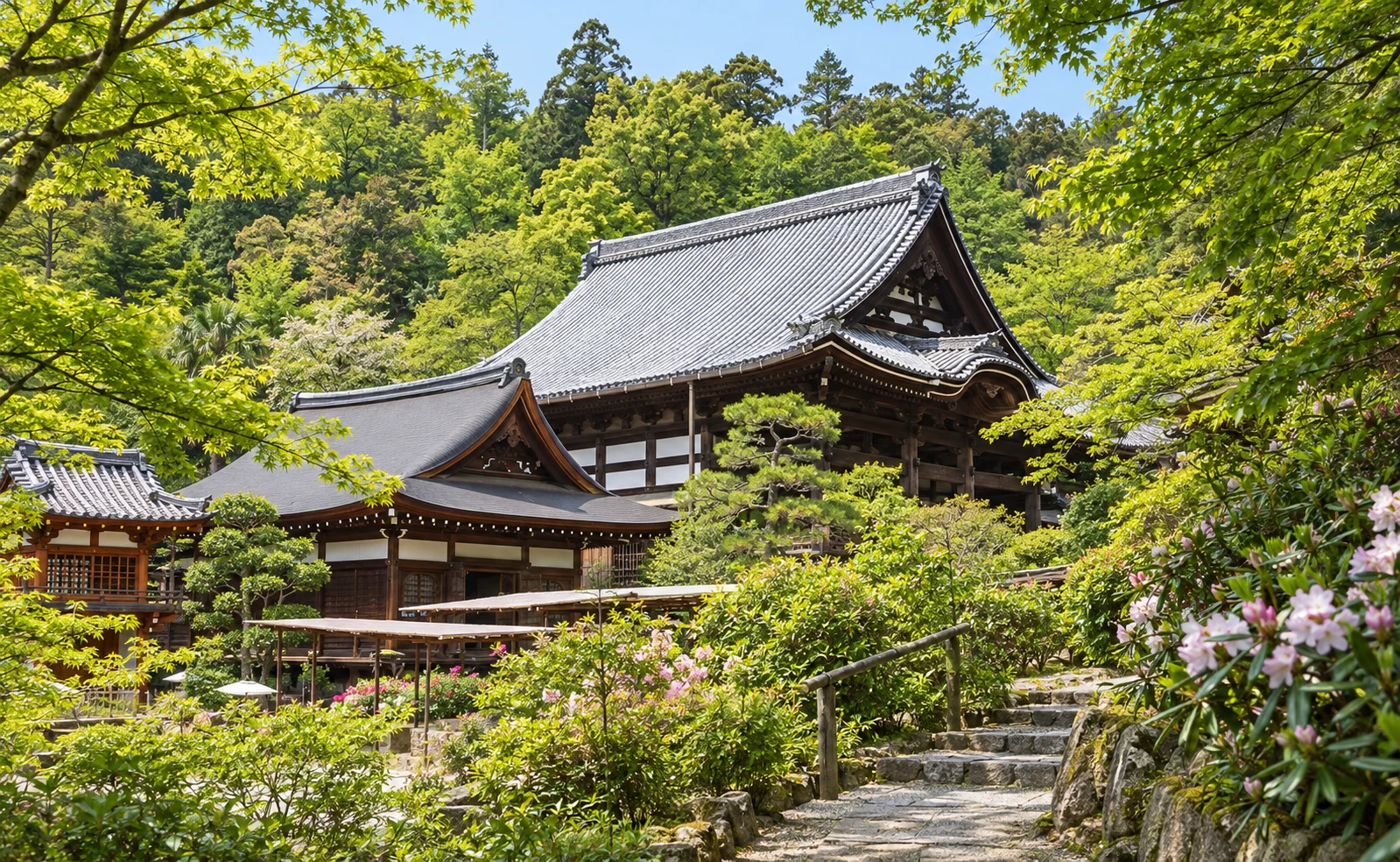 AI-generated visual study · not a documentary photograph
Discover Okadera Temple (Ryugaiji)
The temple familiar to visitors as Okadera stands on the eastern slope of Mount Oka in Asuka. Its historical name is Ryugaiji, and the temple's own account says the legal religious corporation now uses the name Okadera. The foundation story places the monk Gien at the seventh-century court of Emperor Tenji, but the operator distinguishes that temple tradition from surviving documentary evidence: an eighth-century Shosoin record from 740 refers to a Buddhist text held by Ryugaiji, while the temple name itself appears in a document dated 751. This establishes an early documentary footprint, not the exact year when every present building was founded. A separate dragon legend explains Ryugaiji and the Ryugai Pond, where Gien is said to have subdued a dragon beneath a stone. Today Okadera is the seventh stop on the Saigoku Kannon pilgrimage and is known for yakuyoke prayer. Its uphill precinct brings together buildings rebuilt across different periods, a monumental clay Kannon and the pond associated with the legend; allow time to explore beyond the entrance.
Separate dated records from the foundation tradition
Okadera's operator says the temple's foundation is traditionally attributed to the monk Gien under Emperor Tenji. Its historical page points to a Shosoin document dated 740 that mentions a Buddhist text held by Ryugaiji, and to a 751 document that records the temple name. These are early documentary references, not an exact construction date for the surviving buildings. The story of Gien subduing a dragon in the pond is a separate religious tradition; the temple explains that it gave rise to the name Ryugaiji and remains connected with yakuyoke belief. The Ryugai Pond is still part of the precinct, so visitors can see the place associated with the story without treating the legend as an excavated event.
Look closely at the Kannon, and check inner-hall access
The main hall contains the temple's giant clay Nyoirin Kannon, which the operator describes as about 4.85 metres high and a nationally designated Important Cultural Property. Its two-arm seated form differs from the more familiar six-arm depictions. General access to the hall's inner worship area is usually April–December; January–March is reserved for prayer services, and ceremonies may interrupt ordinary entry even in other months. Entrance to the precinct must not be confused with a guarantee of close interior viewing.
Follow the buildings up the slope
At the entrance, the 1612 Nio gate uses reused timber and has carved creatures at its corners. The present main hall was raised from 1805 and took more than thirty years to complete. The three-storey pagoda was rebuilt in 1986, 514 years after its predecessor fell in a 1472 storm; fabric from the unfinished medieval rebuilding was reused in the Nio gate and nearby tower gate. A route toward the inner precinct passes stone monuments and Ruri Well; the temple explicitly says its spring water is not for drinking. The old study building is normally closed to visitors.
Read the marks on the bell
The bell tower is thought to have been rebuilt with the main hall; its bell is dated 1808. Seven holes in the bronze were drilled during the Second World War to test its metal before requisition. It was spared, though the temple says the reason is unknown. Visitors still ring it as a prayer bell, which the operator describes as both a yakuyoke bell and a wish for peace. This is a small, easy-to-miss detail in the hillside precinct, not a reason to strike it outside the temple's current guidance.
Look for the pagoda's painted interior
The temple says the rebuilt tower's door paintings, wall paintings and suspended ornamental koto were completed in 2001. They are normally opened only for the Kaizan-e memorial on the third Sunday of October. The outside tower can be viewed during an ordinary visit; do not promise interior access on other days or treat the annual opening date as guaranteed without checking the current event notice.
A pilgrimage stop that takes planning
Okadera is Saigoku pilgrimage temple number seven, and its year-round protective-prayer service draws worshippers beyond the sightseeing season. It is uphill from the Okadera-mae bus stop through a residential approach. The similarly named Kintetsu Okadera Station is a poor shortcut: the operator warns that walking from that station takes almost an hour and no convenient bus or taxi waits there. Pair the temple with central Asuka only after checking a realistic return bus.
Plan around the 2026 autumn collaboration
The 2026 Yamato Kannon Momiji Corridor runs from 10 October to 6 December across Okadera, Hasedera, Tsubosaka-dera and Murō-ji. Okadera's part of the three-temple Hikari no Junrei night opening is scheduled on five nights only: 21–23 and 28–29 November, 17:00–21:00, with last entry at 20:30 and ¥500 admission (children of elementary-school age and younger free), according to Nara Prefecture Tourism. These dates and terms apply to Okadera; the partner temples publish their own schedules. Confirm the return bus and any day-of changes before travelling.
What to look for
4.85-metre clay Nyoirin Kannon
Dragon-pond legend and Saigoku pilgrimage
Historic Nio gate and reconstructed hillside pagoda
Photo notes
The prefectural 2026 event listing prohibits tripods and similar camera supports in the precinct. It does not settle every still-photography rule, so follow current signs and staff directions, especially in the main hall and during worship. No general licence to reuse the temple's images was found; seek explicit permission before commercial filming or publishing operator photographs.
SEASONAL CALENDAR
Events connected with Okadera Temple (Ryugaiji)
These records are shared with MyNara’s event calendar, so dates and notices have one source. Recurring patterns are not confirmed dated editions; check the organizer’s latest guidance.
Yamato Kannon Autumn Foliage Pilgrimage 2026
The 2026 four-temple autumn pilgrimage connects Okadera, Tsubosaka-dera, Hasedera and Murō-ji from October 10 to December 6. Tsubosaka-dera's notice confirms a free layered-colour stamp rally at all four temples and limited temple-specific kirie goshuin for ¥1,000 each. Its linked Hikari no Junrei night opening runs November 20–29 until 20:00; the notice gives no separate night-entry price. Each temple keeps its own admission and opening arrangements, and the dates do not guarantee that every site will have peak foliage at once. The 2026 edition is dated; check for a new organizer notice before planning another year.
Check organizer informationMake a day of it
Explore guides close to this map point, then check the actual route before travelling. Distances below are straight lines, not walking distances or travel times; map points may not be entrances.

Sources & editorial status
Original MyNara draft based on the linked sources. Sources reviewed 24 October 2026. Opening arrangements, prices and offers may change; use the operator's current information before travelling.
- Temple operator — hours, admission, inner hall and exact bus approach
- Temple operator — foundation tradition, 740 Shosoin reference, 751 temple-name record and dragon legend (checked 2026-10-24)
- Temple operator — buildings, walking route and non-potable spring
- Temple operator — clay Nyoirin Kannon
- Nara Prefecture tourism — 2026 Yamato Kannon Momiji Corridor and Okadera night-opening dates
- Temple operator — current narrow-road parking warning
- Nara Kotsu — Okadera-mae timetable revised 14 March 2026
- Nara Prefecture venue listing for cross-check
- Geoshape historical place point used for approximate map position