Iwayayama Kofun
A low-profile Asuka tomb with a carefully cut stone chamber and a distinctive hidden drainage system.
 Verified site photographs are being prepared.
Discover Iwayayama Kofun
Iwayayama Kofun is a rare Asuka stop where a low-profile square mound opens onto a carefully worked stone chamber. Asuka Village dates the tomb to the first half of the seventh century and says its refined horizontal chamber gave its name to the “Iwayayama-style” found across the Asuka and Sakurai areas. The person buried here is unknown. The village lists the National Historic Site as 1,125 square metres and records its designation on 11 May 1968. It stands at the eastern edge of Mayumigaoka, just west of Kintetsu Asuka Station; the visitor approach is a short walk from the station, not a claim that every nearby mound is open.
Look at the stonework
Notice the fitted surfaces and the shape of the chamber. The Asuka Tourism Association recalls William Gowland's nineteenth-century praise of its finish; the masonry is the reason to linger here.
Place it within Asuka
This tomb is one stop among Asuka's many burial sites. Pair it with a contrasting mound, such as Ishibutai or Kengoshizuka, to see how form and visitor access differ.
Read the mound measurements as different survey results
Asuka Village's older site summary says a 1973 survey inferred a square mound about 54 metres to a side. A separate village account of the 1978 excavation describes a two-tier square mound about 40 metres to a side and 12 metres high, built with rammed earth and a gravelled lower terrace. The two official pages do not reconcile these measurements; treat 54 metres as an earlier reconstruction and 40 metres as the later excavation account, rather than presenting one settled footprint. The burial chamber opens almost due south and is more precisely described than the mound's surviving outline.
Keep the occupant unidentified
The village lists Kibi-hime, Kose no Ogara and Empress Saimei among proposed occupants, but says the identity remains unknown. Its cultural-property account places construction in the first half of the seventh century. Keep those proposals open rather than presenting one as fact.
Recognize the Iwayayama-style chamber
The village says similarly finished horizontal stone chambers occur across the Asuka and Sakurai areas and are grouped under the name “Iwayayama-style.” That term describes a recognizable architectural form; it does not mean every example was copied directly from this tomb. Comparing the finely dressed chamber here with the massive exposed stones at Ishibutai helps show the range of late Asuka burial construction.
Notice the stonework and its drainage design
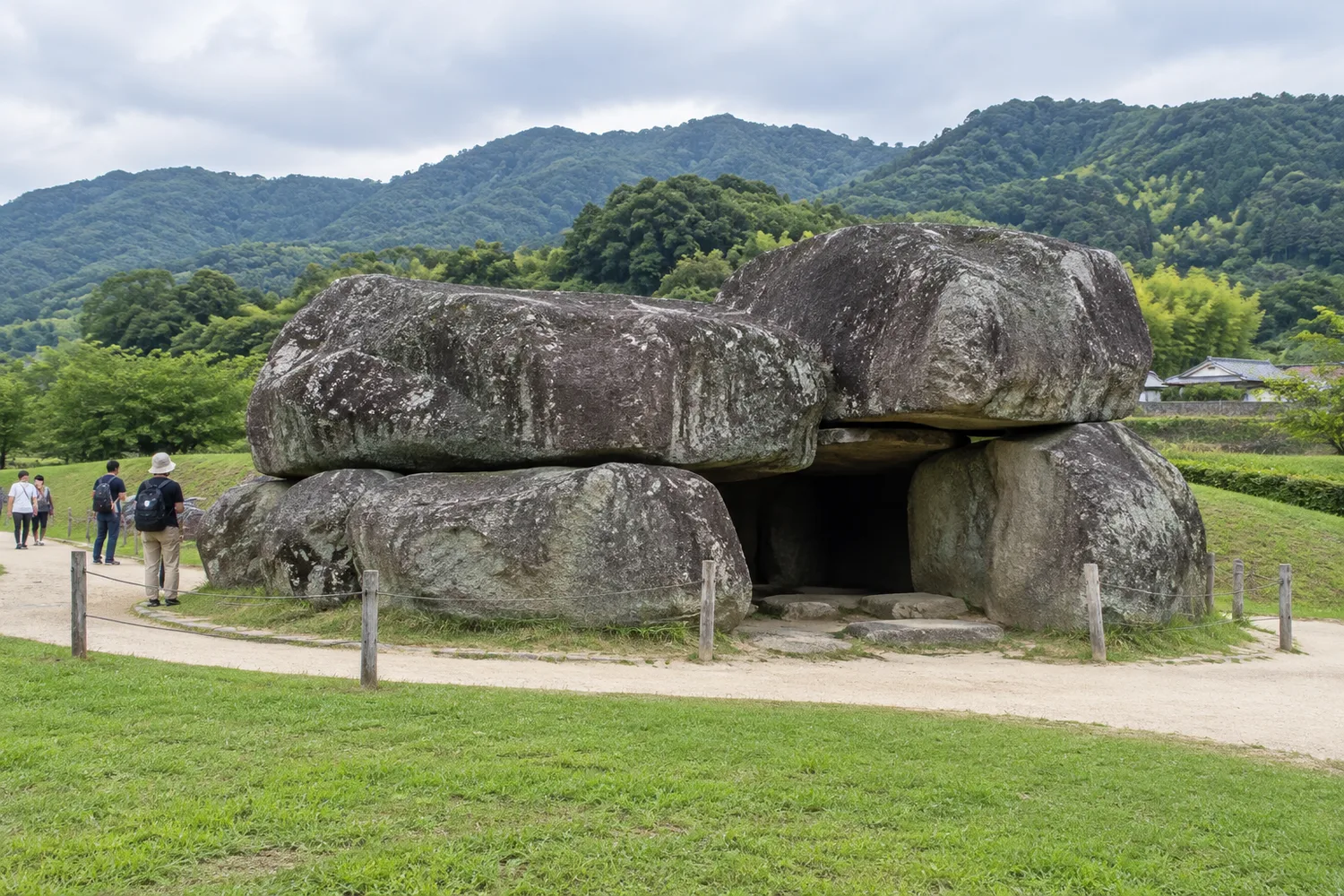
Asuka Village identifies the chamber's blocks as cut quartz diorite, locally called Asuka stone. Its detailed account records a 17.78-metre chamber, with an inner room about 4.86 metres long, 1.8 metres wide and 3 metres high. Gravel laid on the chamber floor led water toward a collection hollow, while a concealed drain carried overflow through the passage; a groove in the outer lintel helped divert rainwater away from the interior. These are documented construction details, not permission to touch, enter a closed area, or inspect the floor closely.
Separate the original tomb from later reuse
The village reports that a roughly two-metre medieval pit grave was found inside the stone chamber, suggesting that it had opened long before modern archaeological work. Pottery, roof tile, ceramics and coins were also recovered, while the village dates the original tomb to the first half of the seventh century. The later burial is evidence of reuse, not proof that the chamber was continuously accessible or that visitors may enter whenever they arrive.
Use the public approach and follow current notices
The Asuka Tourism Association's current visitor page says the chamber interior can be viewed by visitors, and its walking route places the tomb about three minutes on foot from Asuka Station. The page does not publish daily opening hours, staffing, or a separate admission fee. Follow signs and any barrier or closure in effect on the day, and do not touch the worked stone surfaces.
Choose between two station-side walks
The association's short walking course starts at Asuka Station, reaches Iwayayama in about three minutes, then continues via Saruishi, Onino Manaita and Sesshin, the Tenmu–Jitō tomb and the Takamatsuzuka area. It estimates about 2.5 hours for that outing. Separately, its 2026 seasonal, advance-booked volunteer tour follows a 4.4 km route via Iwayayama, Kengoshizuka, Takamatsuzuka and Nakaoyama, taking about three to three-and-a-half hours; the listed guide fee is ¥1,000 per person, with admission and transport extra. Listed dates run through 20 December 2026, subject to booking availability. Neither duration is the visit time for this tomb alone, and the guided route does not change chamber opening rules.
What to look for
Interior stone chamber
The village tourism page currently describes the chamber as open to visitors. Follow any current notices and avoid touching the stone.
Low-profile square mound
Its modest surviving height makes the mound's shape easy to miss from the road.
A contrast with Kengoshizuka
Use the two tombs to compare carefully cut stone with a reconstructed octagonal mound and a separately managed chamber visit.
Photo notes
Neither reviewed village page grants a publication licence for its images or confirms unrestricted chamber photography. Follow current signs, avoid flash or contact with the stone, and ask the village before commercial use.
Make a day of it
Explore guides close to this map point, then check the actual route before travelling. Distances below are straight lines, not walking distances or travel times; map points may not be entrances.
Sources & editorial status
Original MyNara draft based on the linked sources. Sources reviewed 24 October 2026. Opening arrangements, prices and offers may change; use the operator's current information before travelling.
- Asuka Village tourism guide
- Asuka Village — earlier 1973 survey summary and 54 m mound estimate
- Asuka Village — 1978 excavation account: 40 m two-tier mound, Asuka-stone chamber and drainage design
- Asuka Tourism Association short walking course — station-to-tomb distance
- Asuka Tourism Association — current 2026 seasonal guided route, fee, duration and advance booking
- Nara Prefecture ancient-tomb walking route