
Todai-ji Temple
Meet the Great Buddha, then follow the story through a wider temple precinct.
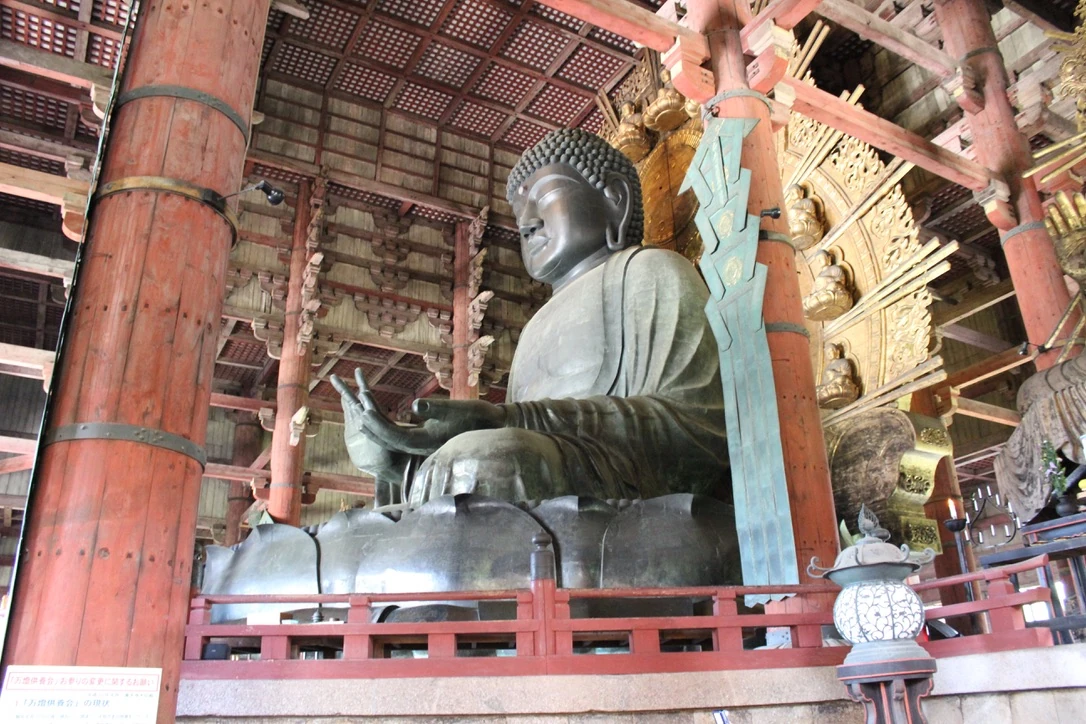 User-provided site photograph · June 2011.
A temple at the heart of Nara
Tōdai-ji began with an eighth-century temple established for Emperor Shōmu's son and grew into a centre of the national Buddhist system. Shōmu ordered a colossal Vairocana Buddha in 743; the image was dedicated in 752 after construction in the capital. A first visit often runs from the monumental Great South Gate to the Great Buddha Hall, but this is a much wider working precinct. The present hall, older eastern buildings, museum and daily worship represent different centuries and different admissions. Choosing among them before buying a ticket makes the temple's story clearer than treating the Great Buddha as a quick photograph.
Why the Great Buddha was built
The temple traces its beginning to Kinshō-ji, founded in 728 to memorialise Crown Prince Motoi. When Shōmu created a national network of temples, this site rose to become its chief temple. His 743 proclamation called for a vast image of Vairocana Buddha, completed in 749 and dedicated in 752. This was simultaneously a religious and national undertaking, not simply a commission for a large bronze object. Inside the hall, look at the Buddha's lotus-petal base: the temple explains that its engraved scenes depict a world of interconnection in Kegon teaching. The carving gives a way to read the image even when its scale dominates the room.
A building with several lives
The Great Buddha Hall visitors enter is not the eighth-century original. Fire destroyed predecessors in 1180 and 1567; the present Edo-period structure was dedicated in 1709. Tōdai-ji says the two earlier halls were eleven bays wide and this one seven bays wide, while retaining their height and depth. At the approach, pause by the National Treasure octagonal lantern, an eighth-century object with musicians and lions on its metal panels. The hall and lantern preserve different layers of the original and rebuilt compound; neither should be presented as a wholly untouched eighth-century building.
A walk beyond the main hall
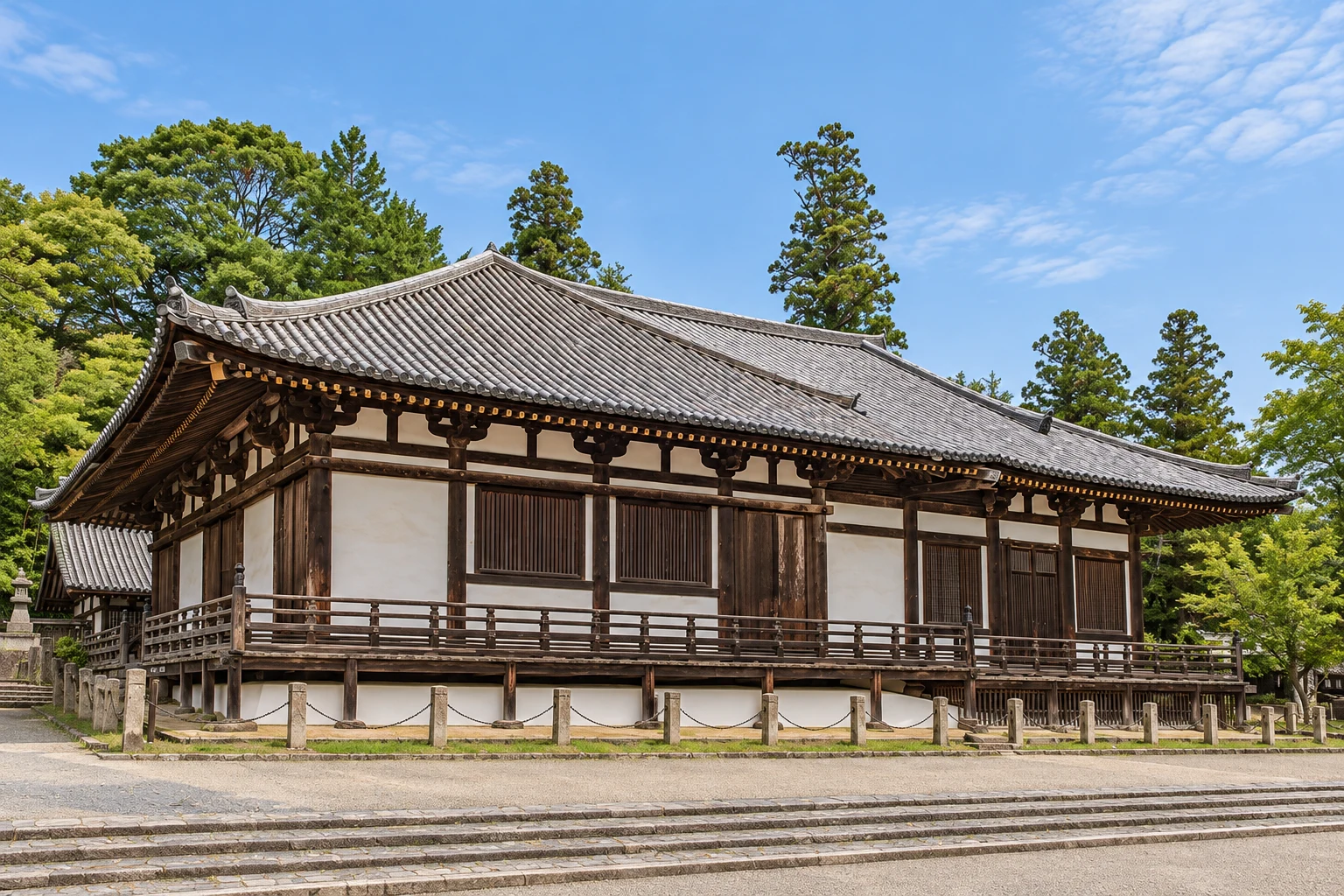
Enter by the Great South Gate, rebuilt by 1203 under Chōgen after the 1180 destruction, and look for its two giant guardian figures. Beyond the Great Buddha Hall, the official map leads uphill to Hokke-dō, Tōdai-ji's oldest surviving building with its own paid ticket and 16:00 close, and Nigatsu-dō, rebuilt in 1669 and still used for Shuni-e. These are not replicas of the main hall's experience: Hokke-dō protects an ensemble of Nara-period sculpture and forbids interior photographs, while Nigatsu-dō is an active ritual hall with a terrace and separate etiquette. Follow the current map and signs rather than assuming every precinct building is open when the Great Buddha Hall is.
Choose a route that fits your mobility
Tōdai-ji describes a flat stone approach from the prefectural parking area near the Great South Gate to the Great Buddha Hall. Wheelchair users enter by a slope at the west side of the hall's front entrance; the temple lends wheelchairs without advance reservation from the security office, where they must be returned. The route toward Nigatsu-dō is uphill and uneven and its upper level is reached by stairs. The adjacent Hokke-dō's interior accessibility is not established by that Nigatsu-dō route description. Decide which part of the precinct suits your group, and confirm the exact accessible doorway if visiting a smaller hall.
Buy the ticket for the spaces you actually want
Tōdai-ji lists separate ¥800 individual adult tickets for the Great Buddha Hall, Hokke-dō, Kaidan-dō and its museum; the 6–12-year-old price is ¥400. Its ¥1,200 adult joint pass combines only the Great Buddha Hall and museum; it does not include Hokke-dō. The museum opens later than the Great Buddha Hall and can close temporarily, so a same-day combination needs a calendar check. A separate ¥500 audio guide can be rented just past the Great Buddha Hall ticket gate, with nine languages including English, Chinese and French; ordinary visitors do not need to reserve, but groups of ten or more do. These are the temple's web terms checked 19 October 2026, not a prepayment or availability guarantee.
What to look for
The Great Buddha Hall
The current hall was dedicated in 1709 after earlier buildings were lost to fires. Pause at the entrance to take in its scale, then look closely at the bronze Vairocana Buddha inside.
Nigatsu-do and Shuni-e
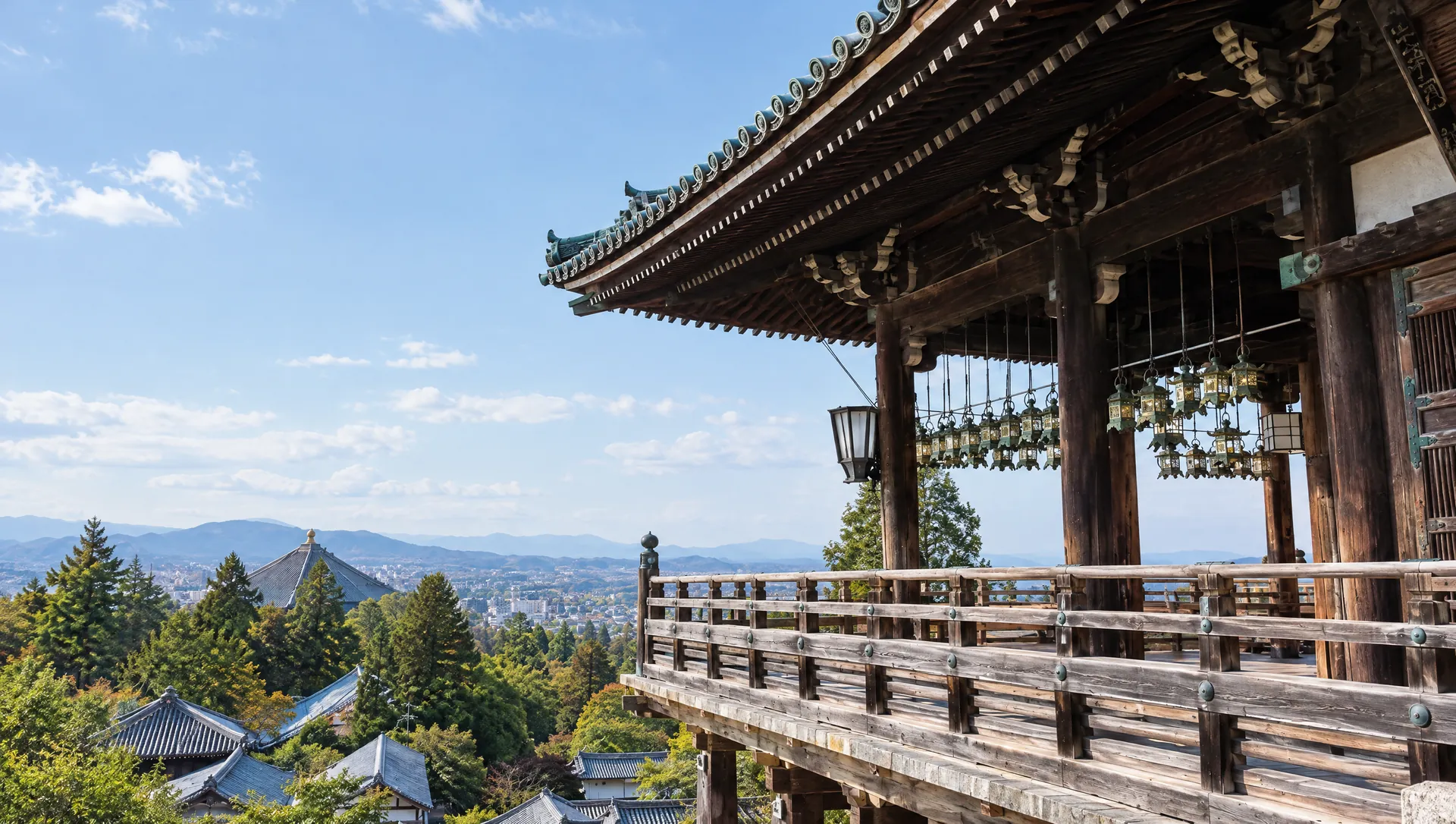
The hillside hall is associated with the long-running Shuni-e rite. Its terrace opens a different perspective over Nara, but photography inside the hall is prohibited.
Beyond the main hall
The South Gate, smaller halls and museum reveal a larger historic precinct. Individual buildings and exhibitions have separate opening arrangements.
Photo notes
The temple permits ordinary commemorative photos in the Great Buddha Hall, but prohibits tripods, group photos, sketching and flashlights there. Photography is prohibited inside Hokke-dō, Nigatsu-dō and the museum. Drone photography is prohibited in the precinct, and the temple bars unauthorised commercial reuse of its own imagery. Respect current signs and worshippers.
SEASONAL CALENDAR
Events connected with Todai-ji Temple
These records are shared with MyNara’s event calendar, so dates and notices have one source. Recurring patterns are not confirmed dated editions; check the organizer’s latest guidance.
Autumn Heijō-kyō Tempyo Procession: Pilgrimage to Tōdai-ji (2026)
The 2026 procession commemorates Emperor Shōmu and Empress Kōmyō, whose era is associated with Tōdai-ji's founding; the organizer expects about 120 participants. The announced route starts at JR Nara Station, follows Sanjō Street and the Kasuga Taisha approach, passes Ukigumo Enchi and Tōdai-ji, then continues via Kasugano Enchi to Nara Kasugano International Forum. A separate Nara-period market and costume experience is scheduled at Ukigumo Enchi from 10:00 to 16:00. The procession participant application has closed. No spectator ticket or reserved viewing area is specified; the notices also do not state the public admission conditions inside the Great Buddha Hall during the procession, so confirm before travel. The Tourism Association says severe weather cancels the programme and there is no event parking. This single 2026 edition does not establish an annual autumn recurrence.
- Time
- Procession approx. 13:00–16:00; Ukigumo Enchi market and Tempyo costume experience 10:00–16:00
- Admission
- No spectator or Ukigumo Enchi experience fee is stated in the reviewed notices. This does not confirm free entry to the interior of Tōdai-ji's Great Buddha Hall.
- Booking
- Applications to join the procession closed in September 2026. The organizer does not specify whether advance arrangements are needed to watch the route or take part in the Ukigumo Enchi experience; reconfirm with the committee.
Kotohogu Nara: A Journey through Time (2026)
Nara City's tenth-anniversary art programme brings contemporary installations, performances and cultural activities into historic and everyday city spaces. The city identifies Tōdai-ji Kannon-in, Tsubai Market, Kitayama Jūhachikendō and Gyōki Plaza among the venues; the full programme also includes separate sessions at Naramachi Center. Viewing is free, but some talks and participatory sessions have their own schedules or application conditions. Check the official programme before choosing a venue or setting out. The individual venue entries are grouped here to keep the destination calendar useful rather than listing every component separately.
- Admission
- Nara City states that programme viewing is free; any separately stated participation or application conditions vary by programme.
- Booking
- The city announcement lists free viewing overall, but individual talks and participatory sessions may have separate application conditions. Check the current programme for each activity.
Nara Marathon 2026
The 17th Nara Marathon is scheduled across two days. The 2026 Expo is planned for December 12, 10:00–20:00, and December 13, 07:00–15:30, in a temporary area in front of Rohto Field Nara. The organizer describes food and product sales for runners and general visitors, exhibits, hands-on activities and stage programming; the current notice does not state an admission fee. The mini race starts at 14:00 on December 12. On December 13, the marathon and pair relay start at 09:00 and the World Heritage 10K at 09:30. The official start/finish and runner check-in venue is Rohto Nara Konoike Park. The organizer's 10K route description confirms that runners pass through Nara Park, along the Kasuga Taisha approach and by Tōdai-ji; the full course also meets the park's deer at its early and late stages. The park is route context, not the race's start or event venue. Runner registration windows have passed; Expo attendance is separate from runner entry. Road restrictions are planned on December 13, so check the organizer's traffic-control map before travelling or choosing a viewing point.
- Time
- Expo: December 12, 10:00–20:00; December 13, 07:00–15:30. Race starts: December 12 mini race 14:00; December 13 marathon/pair relay 09:00 and World Heritage 10K 09:30.
- Admission
- No Expo or spectator admission price is stated. Runner entry fees vary by race; marathon entry was ¥13,500–¥15,000, excluding applicable entry fees.
- Booking
- Runner registration closed July 9, 2026. The organizer describes the Expo as open to runners and general visitors but does not state a visitor-ticket or reservation process; confirm with the organizer before making a special trip.
Tōdai-ji New Year's Eve Bell Ringing (2026–27)
Nara City Tourism Association lists the bell ringing at Tōdai-ji from midnight on January 1, 2027. Its current year-end guide says groups of about eight take turns using four small ropes to ring the bell 108 times. Tōdai-ji's annual instructions say places are first-come and that commemorative printed slips are normally distributed from around 22:30 on December 31; people who leave the queue and fail to reassemble by 23:45 may lose their place. The temple has not published a separate 2026–27 notice in the sources checked, so reconfirm queue, access and timing before travelling. The notices do not state a fee.
- Time
- From 00:00 on January 1, 2027
- Admission
- Not stated in the checked notices.
- Booking
- The temple's current annual guidance describes first-come participation and printed slips distributed from around 22:30 on December 31; it warns that visitors must reassemble by 23:45 after obtaining a slip. Confirm the 2026–27 queue arrangements with the temple.
Wakakusa Yamayaki 2027
The 2027 edition is officially scheduled for Saturday, January 23. The sacred-fire procession leaves Tobihino at about 17:05 and passes Mizuya Bridge at about 17:25 en route to Nogami Shrine. The organizer identifies Kasugano Enchi and Ukigumo Enchi among the free public viewing areas in Nara Park; tickets are required for the paid foothill gate and Nara Park Bus Terminal rooftop zones. Free areas are expected to be very crowded, and the organizer prohibits leisure sheets and reserving spaces in all viewing areas. Individual public ticket prices are not yet published and are expected in early November. Mizuya Chaya is by the bridge, but the organizer does not identify the shop as a venue or viewing area; opening and access during the procession are unconfirmed. Weather or safety instructions can change the event. Nara Okuyama Driveway's Shin-Wakakusayama Course will close from 14:00 to 20:00, while the Takamadoyama Course remains open; this is a traffic restriction, not an event at the driveway.
Check organizer informationNigatsu-dō Setsubun (2027)
Tōdai-ji's Nigatsu-dō is scheduled to hold its Setsubun rites on February 3, 2027. The temple's annual programme and the Nara City Tourism Association's dated notice list the burning of old talismans around 10:00, bean-throwing after the 14:00 service, and a star-protection rite at 18:00. The public bean distribution is from a temporary stage in the plaza in front of Hokke-dō; crowd limits may apply. The published schedule can change, and no separate event fee or reservation procedure is stated. Check Tōdai-ji's latest notice before travelling.
- Time
- Old-talisman burning around 10:00; bean-throwing after the 14:00 service; star rite at 18:00
- Admission
- No event-specific fee is stated in the checked notices; confirm any separate admission arrangements with Tōdai-ji.
- Booking
- No reservation procedure is stated. The temple warns that crowd capacity can limit access to the bean-throwing area; follow current on-site directions.
Shiawase Kairō Nara Rurie (2027)
The Nara City Tourism Association lists the 2027 Shiawase Kairō Nara Rurie for February 8–14, 18:00–21:00, across the Nara Park area and names Kasuga Taisha, Kōfuku-ji and Tōdai-ji. The listing describes illuminated routes, evening temple visits, a market, guided lantern walks and a final-day Nara Park birthday fireworks programme; the event committee has not yet published its 2027 programme on its own site, so confirm which activities, sites, fees, booking rules and weather arrangements will operate before travelling. Use public transport because crowding is expected and there is no dedicated event parking. This is an announced schedule, not a claim that the event has occurred.
- Time
- 18:00–21:00
- Admission
- The 2027 listing does not specify event admission, individual temple-entry charges or paid-program prices.
- Booking
- The organizer has not published the 2027 programme or reservation terms. Check its official site for activity-specific booking and access details.
Tōdai-ji Shuni-e and Otaimatsu (2027)
Tōdai-ji's 1,276th Shuni-e is listed for March 1–14, 2027 at Nigatsu-dō. The Nara City Tourism Association's current notice says Otaimatsu viewing is generally permitted March 1–14 except March 12, but viewing areas have capacity limits: once the main lawn and plaza fill, visitors are directed to a second viewing area, and viewing ends when that area also fills. On March 12, visitors should avoid attending because severe crowding is expected; the second area can close when full and listening inside the hall is limited to authorised people. The temple says schedules and restrictions can change. No booking or event fee is stated in the checked notices; verify the latest temple guidance before travel. Do not photograph or record where the temple prohibits it.
- Admission
- No event-specific fee is stated in the checked notices; confirm any separate admission arrangements with Tōdai-ji.
- Booking
- No reservation process is stated. Viewing is capacity controlled and may stop when both designated areas fill; on March 12 the temple asks people to avoid attendance and limits hall listening to authorised persons.
Light-up Promenade Nara
Nara Prefecture and the Nara City Tourism Association describe an outdoor illumination route linking Kasuga Taisha's first torii, Tōdai-ji, Nara National Museum, Sarusawa Pond, Ukimidō, Heijō Palace and Yakushi-ji. The prefecture says most sites are lit year-round, while Tōdai-ji is seasonal; its 2026 notice gives a separate July–September window for the Great Buddha Hall and Nandaimon. The Tourism Association currently says Ukimidō's lighting is temporarily suspended for LED conversion, but publishes no start date or expected restart; contact Nara Park Office before planning an evening visit specifically for the illuminated pavilion. The illumination shows exterior buildings and landmarks: it does not grant night entry to temple or museum interiors. Times and individual sites can change, so check the prefectural page before setting out. This annual listing is a pattern, not a promise that every site is lit on every night.
Check organizer informationBasara Festival: Nara's Summer Street-Dance Festival
The Nara City Tourism Association describes Basara Festival as a street-dance-led summer festival held in Nara since 1999, with performances, offerings and parades at locations including Tōdai-ji, Kasuga Taisha and Sanjō Street. Nara City's civic plan calls it one of the city's summer features and lists an 80,000-visitor target, which is a target rather than an attendance figure. The organizer confirmed that the 2026 festival took place on August 29–30 and published photos afterward. No 2027 schedule is available yet; check the organizer for routes, viewing areas, access and any updated rules. The organizer says audiences should watch from designated spectator areas; equipment and video-posting restrictions apply to filming.
- Admission
- No spectator fee is stated in the official event and viewing pages reviewed; confirm the next edition's terms with the organizer.
Nara Tokae Lantern Festival
The organizer's official FAQ lists August 5–14 each year, and the Nara City Tourism Association describes this as a summer festival held across Nara Park. The organizer's area guide explicitly identifies Sarusawa Pond and the 52-step approach as one of its venues. In 2026, the nine venues also included Ukimido and Sagi Pond, Nara National Museum's forecourt, Kōfuku-ji, Tōdai-ji, Kasuga Taisha, and other park areas. Some venues open only on specific days; rain, strong wind or other conditions can cancel part or all of the display. Check the current year's venue map, dates and crowd guidance. The general notice does not state an admission charge; optional candle-lighting experiences may have separate terms.
Check organizer informationMake a day of it
Explore guides close to this map point, then check the actual route before travelling. Distances below are straight lines, not walking distances or travel times; map points may not be entrances.
Sources & editorial status
Original MyNara draft based on the linked sources. Sources reviewed 20 October 2026. Opening arrangements, prices and offers may change; use the operator's current information before travelling.