
Asuka Historical Museum
Read Asuka's excavated stones, temples and tombs before exploring the sites scattered across the village.
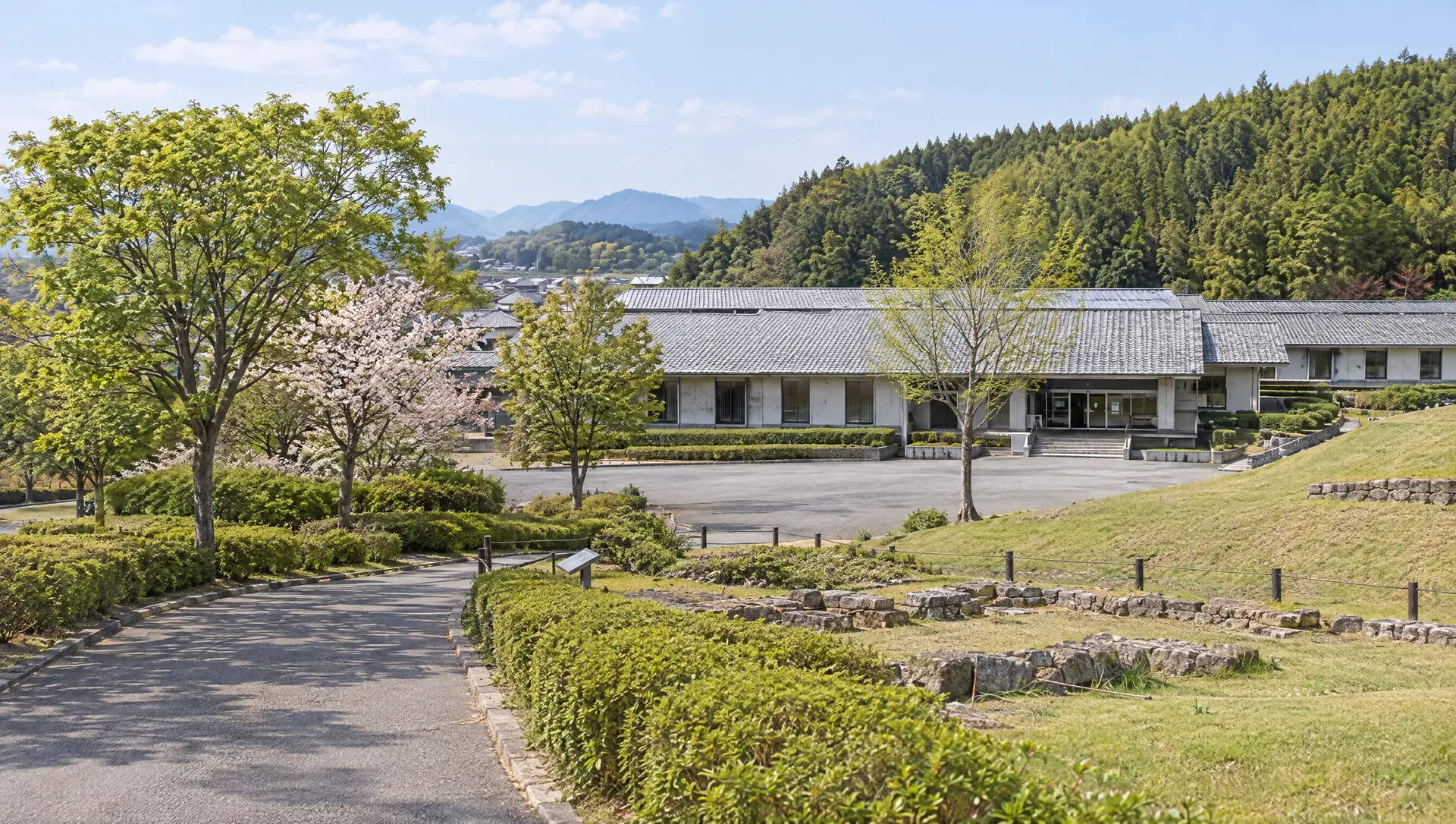 AI-generated visual study · not a documentary photograph
Discover Asuka Historical Museum
The Asuka Historical Museum is a useful first stop when the village's ancient remains feel disconnected on a map. Run by the Nara National Research Institute for Cultural Properties, it brings together excavated objects, models and architectural remains from the centuries before the capital moved to Nara. The indoor galleries and free stone-work garden are separate parts of the visit; exhibitions and what can be photographed may change.
Start with a map of the old landscape
Begin with the lobby's 1:500 reconstructed landscape model and aerial photograph. They let you compare the present countryside with the sites uncovered beneath it, then connect the museum to Asuka-dera, the tombs and former palace locations. It is a useful orientation stop before choosing which widely spaced places to visit; the model is interpretive, not a scale route planner.
Look beyond the famous painted tombs
The first gallery follows Asuka from the sixth-century arrival of Buddhism to the early eighth-century transfer of the capital to Nara. It combines excavated temple and tomb objects with models of the Mizuochi Site, where a water clock was installed, and the Takamatsuzuka and Kitora burial chambers. Check labels to distinguish original objects from models and replicas; the small scale of many outdoor remains becomes easier to read after seeing the archaeological evidence.
See how Yamada-dera was built
The second gallery makes Yamada-dera tangible through the excavated East Corridor. In 1982, archaeologists found the fallen corridor preserved in the position where it collapsed; surviving components were incorporated into a reconstruction so you can read the seventh-century building's scale and timber structure. The display is a scholarly reconstruction using archaeological material, not an intact corridor still standing at the original temple site.
Use the free garden as another exhibit
The garden has its own collection of Asuka stone works and seasonal flowers, including reconstructions of pieces whose original locations are elsewhere. The museum permits garden-only entry without a gallery ticket. Do not mistake a replica displayed here for an original archaeological object; the labels explain what you are seeing. Bloom timing changes with the season.
A dated autumn 2026 special exhibition
From 9 October through 13 December 2026, the museum is presenting a special exhibition on the Asuka-Fujiwara World Heritage property and the research institute's archaeological work. Its official list names finds and materials from Asuka-dera, Kawaradera, the Mizuochi Site, Daikandaiji, Moto-Yakushiji, Yamada-dera, Hinokuma-dera and Takamatsuzuka. The exhibition is included in the museum's posted general admission, but the dates and related talks are a 2026 programme, not a permanent feature; confirm the live calendar before a later visit.
Join a gallery talk during the exhibition
The museum has scheduled no-advance-booking gallery talks for 12 November, 28 November and 12 December 2026, each at 10:00 and 14:00. They take place in the exhibition room and require the normal admission ticket; the operator says no reservation is needed. These are specific 2026 dates, so check the museum's live notice for changes before travelling.
What to look for
Asuka landscape model and archaeological orientation
Yamada-dera east-corridor reconstruction
Free garden with Asuka stone works
Photo notes
The museum permits private photography in the garden and most exhibition areas, except where a no-photo sign is posted. Flash, extra lighting, tripods and selfie sticks are not allowed indoors. That private-use permission does not grant MyNara image-publication rights; obtain separate permission for website images.
Make a day of it
Explore guides close to this map point, then check the actual route before travelling. Distances below are straight lines, not walking distances or travel times; map points may not be entrances.

Sources & editorial status
Original MyNara draft based on the linked sources. Sources reviewed 24 October 2026. Opening arrangements, prices and offers may change; use the operator's current information before travelling.
- Museum operator — visitor information, transport and photography
- Museum operator — galleries and Yamada-dera corridor
- Museum operator — stone-work garden
- Museum operator — autumn 2026 Asuka-Fujiwara special exhibition and gallery-talk dates
- Museum operator — Japanese 2026 opening calendar and year-end closure
- Nara Prefecture directory listing