
Saidaiji: The Western Great Temple and Its Tea Ceremony
Follow the western counterpart to Todai-ji through three halls, the story of Eison and a separately booked giant-bowl tea tradition.
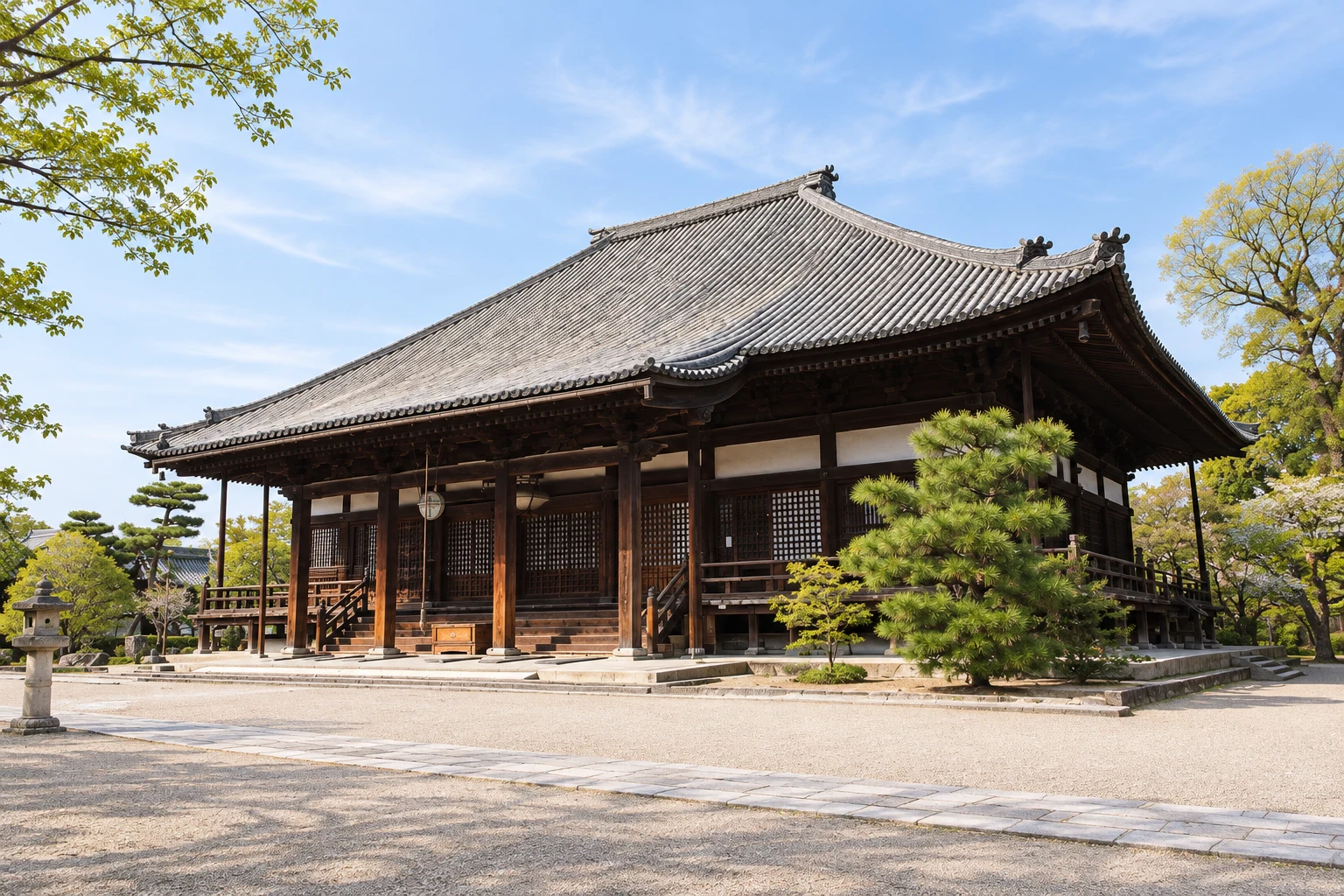 AI-generated visual study · not a documentary photograph
Discover Saidaiji: The Western Great Temple and Its Tea Ceremony
Saidaiji began as a major Buddhist complex west of the eighth-century capital. Its present halls tell a second, medieval story: after decline, the monk Eison rebuilt the temple as a centre for revived precepts and service to people in need. A modern visit is not one undifferentiated admission. The usual ticket covers the Main Hall, Four Heavenly Kings Hall and Aizen Hall; the treasure house opens in specified seasons, while the giant-bowl tea ceremony follows its own event or group-booking rules. Start with the three halls, then decide whether a seasonal opening makes a longer visit worthwhile.
See the two eras behind the name
In 764, former Empress Koken vowed to commission Four Heavenly Kings images during Fujiwara no Nakamaro's rebellion. After returning to the throne as Empress Shotoku, she fulfilled that vow, and Saidaiji grew into the western counterpart to Todai-ji. The temple records an extensive original precinct, but the halls visible today are not an untouched eighth-century ensemble. It declined after the capital moved, and Eison entered in 1235 to revive Buddhist discipline and charitable practice. Fire and later rebuilding changed the site again. Its Shingon Risshu head-temple role comes from this revival, not simply its ancient size.
Use the three-hall ticket deliberately
The common ticket is for the Main Hall, Four Heavenly Kings Hall and Aizen Hall. In the Main Hall, the temple's principal standing Shakyamuni is a thirteenth-century image commissioned under Eison after an earlier Kyoto image; in the Four Heavenly Kings Hall, a nearly six-metre Eleven-Faced Kannon arrived from another temple in 1289. The hall's Four Heavenly Kings have later-replaced upper bodies, while the figures beneath their feet preserve eighth-century forms, according to the temple. Aizen Hall occupies the site of Eison's residence, with a concealed Aizen Myoo image shown only at announced times. These distinct histories reward more than a photograph of one gate.
Separate seasonal treasures from an ordinary day
The temple lists the Shuhokan treasure house as a separate ¥300 admission during three 2026 periods: 15 January–4 February, 20 April–10 May and 25 October–15 November. The current 2026 autumn notice also promises a special display of two restored large Buddhist paintings in the Main Hall from 25 October to 15 November, alongside a special opening of the Aizen image and the treasure house. Those objects are not necessarily visible outside their stated window. For 2027, the operator has already announced different tickets and seasonal dates; check the correct year's notice, not an undated directory summary.
Choose the tea event that an individual can actually join
Daichamori is the temple's oversized-bowl tea practice, connected by temple tradition to Eison sharing tea after an offering in 1239. Routine group sessions in 2026 require at least 30 people and advance contact, so an individual should not arrive expecting an on-demand ceremony. The temple's 2026 autumn Daichamori is a distinct public event on 1 November, with six timed sittings from 9:00 to 14:00, ¥4,000 per person and a request to reserve the desired slot; same-day tickets may not secure a chosen session. That fee and event structure differ from the standard three-hall ticket and regular group tea price. Participation language, allergies, seating and future availability should be confirmed directly.
What to look for
Three-hall route from the Shakyamuni image to the large Eleven-Faced Kannon
Eison's medieval revival and the temple's Shingon Risshu heritage
Seasonal Aizen, treasure-house and large-painting displays; separately arranged giant-bowl tea
Photo notes
MyNara has no licensed image of Saidaiji, its religious objects or ceremony. The operator pages reviewed did not establish general on-site photography permission; follow hall signs and ask before photography, filming or reuse of temple-owned imagery, especially during worship and tea sittings.
SEASONAL CALENDAR
Events connected with Saidaiji: The Western Great Temple and Its Tea Ceremony
These records are shared with MyNara’s event calendar, so dates and notices have one source. Recurring patterns are not confirmed dated editions; check the organizer’s latest guidance.
Saidaiji Autumn Ō-chamori Tea Ceremony (2026)
Saidaiji's 2026 autumn Ō-chamori is scheduled for November 1. The temple moved the annual autumn ceremony to the first Sunday in November from 2026; this distinctive tea rite is associated with Eison and has been held since the 13th century. The main service takes place in Kōmyō-den at 09:00, 10:00, 11:00, 12:00, 13:00 and 14:00. Advance applications request the participant's name, group size, preferred time and contact details; same-day tickets are sold at the Aizendō reception while available, but do not guarantee a preferred session. The participation fee is ¥4,000. The programme also lists a secondary tea service, visits to three halls, a special prayer and talk, and soba; confirm current availability and any changes with the temple.
- Admission
- ¥4,000 per person, payable at reception
- Booking
- Apply in advance with the representative's name, number of participants, preferred seating time and contact details. Same-day tickets may be sold at the Aizendō reception, subject to availability; a preferred time is not guaranteed. Call Saidaiji at 0742-45-4700 to confirm remaining places.
Saidaiji Spring Ō-chamori Tea Ceremony (2027)
The Nara City Tourism Association lists Saidaiji's spring Ō-chamori for April 10–11, 2027, 09:00–15:00 with reception until 14:00. Participants share matcha served in an exceptionally large bowl, continuing a tea rite associated with the 13th-century monk Eison. Saidaiji identifies spring Ō-chamori as one of its two core annual events. The Association recommends booking in advance and says same-day tickets are available; both it and the temple's 2027 price notice list ¥5,000 per person. The 2026 ¥4,000 rate predates the announced 2027 increase. The exact session venue, booking method and capacity are not yet detailed in the dated 2027 notice; contact the temple before making a special trip. The customary spring dates are the second Sunday in April and the preceding Saturday.
- Time
- 09:00–15:00; reception until 14:00 (Nara City Tourism Association listing)
- Admission
- The Nara City Tourism Association lists ¥5,000 per person, matching Saidaiji's announced fee from 2027. The ¥4,000 amount in the 2026 notice is the previous rate.
- Booking
- The Tourism Association recommends advance booking and reports same-day tickets in its general event information. The 2027 edition's application method, capacity and availability are not confirmed in Saidaiji's current dated notice; contact the temple before making a special trip.
Nara–Nishinokyo Lotus Road
The Nara City Tourism Association coordinates a seasonal route linking Saidaiji, Kikō-ji, Tōshōdai-ji and Yakushi-ji, where lotus flowers bloom in temple precincts. Some editions offer a shared admission ticket, limited goshuin and related walking programmes; dates, ticket terms and participating activities vary by year. Check the association's current announcement before planning the route.
Check organizer informationMake a day of it
Explore guides close to this map point, then check the actual route before travelling. Distances below are straight lines, not walking distances or travel times; map points may not be entrances.

Sources & editorial status
Original MyNara draft based on the linked sources. Sources reviewed 19 October 2026. Opening arrangements, prices and offers may change; use the operator's current information before travelling.
- Saidaiji operator — founding, decline and Eison's revival
- Saidaiji operator — three-hall admission and treasure-house dates
- Saidaiji operator — station route and parking
- Saidaiji operator — 2027 ticket and seasonal changes
- Saidaiji operator — 2026 autumn large-painting opening
- Saidaiji operator — 2026 autumn Daichamori terms
- Saidaiji operator — Four Heavenly Kings Hall images
- Visit Nara — independent directory identity A00498