Kikō-ji Temple: Gyōki’s Temple and the ‘Trial Great Buddha Hall’
A temple founded by the monk Gyōki in 721, known for a 16th-century main hall linked by tradition to the design of Tōdai-ji’s Great Buddha Hall and for its summer lotus display.
 Verified site photographs are being prepared.
Discover Kikō-ji Temple: Gyōki’s Temple and the ‘Trial Great Buddha Hall’
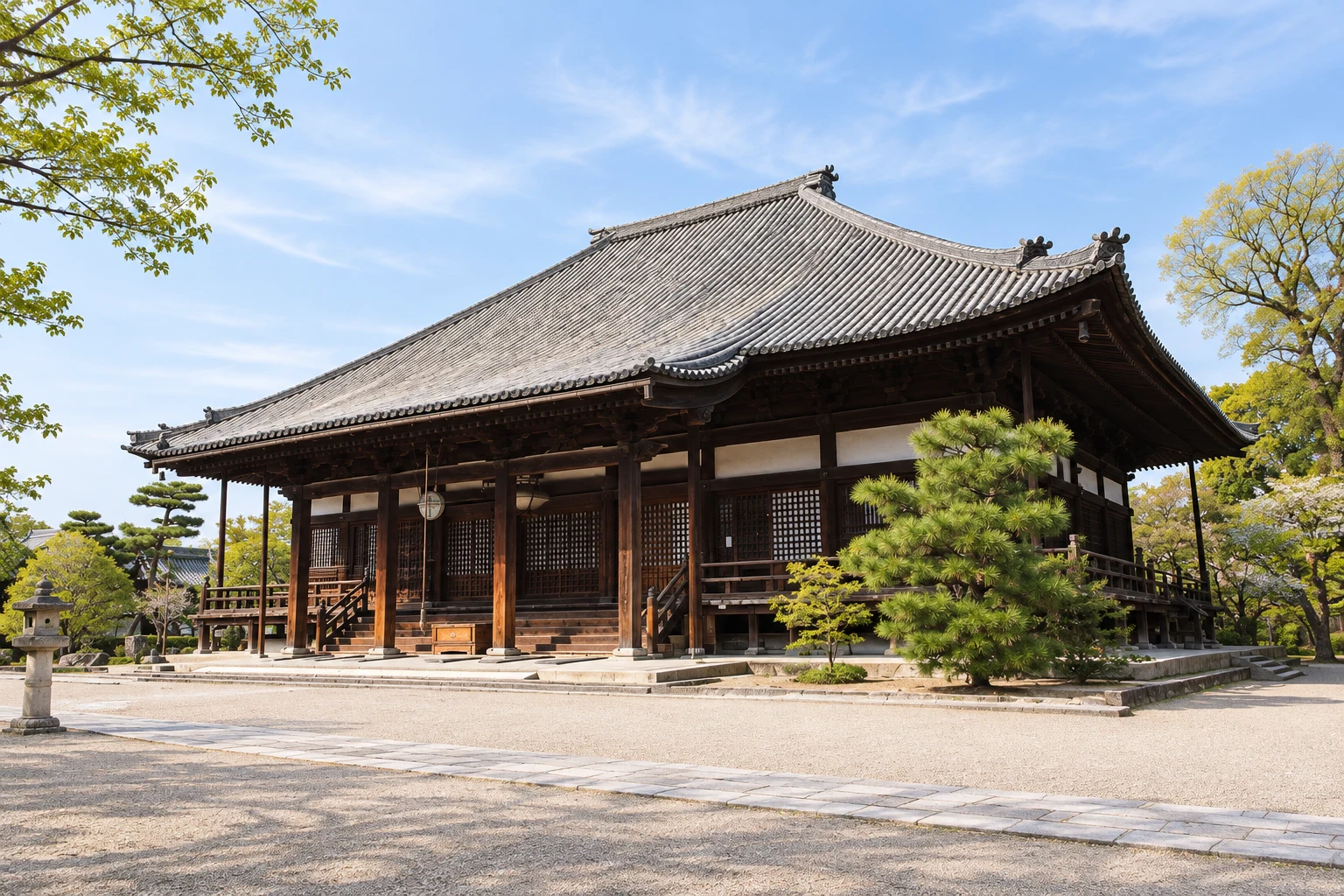
Kikō-ji stands in Sugawara, west of central Nara. The temple's own history records a land donation to Gyōki in 721 and construction of Sugawara-dera the following year; tourism listings conventionally date its foundation to 721. It became a base for Gyōki's teaching and social works. A temple tradition says Emperor Shōmu visited in 748 and renamed it Kikō-ji, or ‘Temple of Joyful Light,’ after a miraculous light appeared from the principal image. Treat this naming story as a transmitted account, not an independently verified event. Gyōki died here in 749. The present main hall is not the original Nara-period building: after a fire in 1499, it was rebuilt in 1544. Its deep hipped roof and lower pent roof create a two-storey appearance, although the hall is one storey with a mokoshi canopy. Tradition calls it the ‘Trial Great Buddha Hall’ because Gyōki is said to have used it as a model for Tōdai-ji’s later Great Buddha Hall. The building is an Important Cultural Property.
Read the hall’s unusual silhouette
From the approach, the broad tiled roof and lower pent roof make the main hall appear taller than its actual single-storey structure. Look for the mokoshi canopy around the hall, then compare the scale and roofline with photographs or official interpretation of Tōdai-ji’s Great Buddha Hall. The connection is a temple tradition; it is not proof that the two buildings are identical in design. The present hall dates to 1544, while archaeological work found it standing on the platform of an earlier Nara-period main hall.
Understand Gyōki’s place in Nara’s history
Gyōki is remembered as a Buddhist teacher who travelled, preached to ordinary people and organized public works such as bridges and water channels. Kikō-ji’s history connects this local temple with the wider movement that supported the construction of Tōdai-ji. The temple’s origin and the 748 renaming story are preserved as tradition in visitor accounts; keep those stories distinct from the surviving 1544 architecture and its documented cultural-property status.
Look closely at the principal image
The main hall houses a wooden Amida Buddha seated figure from the late Heian period, approximately 2.33 metres high, with Kannon and Seishi bodhisattvas beside it. The principal image is an Important Cultural Property. The hall interior is part of the ordinary paid visit according to the cultural-heritage guide, but photography rules and any temporary interior restrictions should be checked with the temple; do not assume permission to photograph sacred images.
Plan for lotus season without relying on a bloom guarantee
The temple says it has cultivated lotus since 1995 and now grows roughly 80 varieties in about 250 pots. Flowers usually open in the morning and close later in the day; the operator gives mid-June to early August as a typical season but warns that timing varies by year. A morning visit gives the best chance of seeing open flowers, not a bloom guarantee. The 2026 Nara–Nishinokyo Lotus Road ran from 18 June to 2 August and its four-temple pass remained valid through 16 August; that programme has ended, and a 2027 date has not yet been confirmed. Check the temple's current notice before planning around lotus or special opening hours.
Add nearby temples as separate visits
Kikō-ji is one of four temples associated with the Nishinokyō Lotus Road, together with Saidaiji, Tōshōdaiji and Yakushi-ji. Each has its own admission, hours, closures and walking or cycling route. The route is a seasonal tourism programme whose dates and ticket conditions can change; do not assume that one temple ticket admits visitors to the others. Sugawara Tenmangū is another nearby stop, but it is a separate shrine.
Try the temple's Iroha sutra-copying practice
Kikō-ji offers Iroha shakyo, a short copying practice based on the Japanese Iroha poem. The temple says the exercise is under 200 characters, takes about 30–40 minutes and costs ¥2,000 including temple admission; its visitor page says it is available at the sutra-copying hall without a general reservation. A separate youth programme takes 60–90 minutes and asks groups to consult in advance. The temple explains the poem through the Buddhist teaching of impermanence; this is a religious practice, so join respectfully and check current availability, language support and group arrangements directly.
What to look for
‘Trial Great Buddha Hall’ tradition
A 1544 main hall whose roofline is linked by tradition to the later Tōdai-ji Great Buddha Hall.
Important Cultural Property
See the distinctive mokoshi canopy and a late-Heian Amida Buddha image in the paid temple visit.
Seasonal lotus display
Around 250 potted lotus plants and 80 varieties are listed by the Nara City Tourism Association; flowering changes with season and weather.
Photo notes
No image has been licensed for MyNara publication. Nara City Tourism Association explicitly prohibits unauthorized reuse of its page images. Obtain permission for any third-party image and follow the temple’s current photography rules, especially inside the hall.
SEASONAL CALENDAR
Events connected with Kikō-ji Temple: Gyōki’s Temple and the ‘Trial Great Buddha Hall’
These records are shared with MyNara’s event calendar, so dates and notices have one source. Recurring patterns are not confirmed dated editions; check the organizer’s latest guidance.
Kikō-ji Gyōki-e Grand Festival
Kikō-ji commemorates Gyōki, who died at the temple on the second day of the second lunar month. The annual programme includes a memorial service, a Shugen-style goma fire rite and a fire-walking ceremony that visitors may join barefoot after the practitioners. The temple lists a morning sutra session, a 10:00 memorial, 11:30 red-bean soup, a 13:00 talk and a 14:30 fire rite; confirm the current programme before travelling.
Check organizer informationNara–Nishinokyo Lotus Road
The Nara City Tourism Association coordinates a seasonal route linking Saidaiji, Kikō-ji, Tōshōdai-ji and Yakushi-ji, where lotus flowers bloom in temple precincts. Some editions offer a shared admission ticket, limited goshuin and related walking programmes; dates, ticket terms and participating activities vary by year. Check the association's current announcement before planning the route.
Check organizer informationMake a day of it
Explore guides close to this map point, then check the actual route before travelling. Distances below are straight lines, not walking distances or travel times; map points may not be entrances.
Sources & editorial status
Original MyNara draft based on the linked sources. Sources reviewed 24 October 2026. Opening arrangements, prices and offers may change; use the operator's current information before travelling.
- Kikō-ji — official temple website
- Kikō-ji — official history, chronology and restoration
- Kikō-ji — official access, hours, admission, parking and large-bus notice
- Kikō-ji — official lotus season and morning bloom notes
- Kikō-ji — official Iroha sutra-copying practice and fee
- Nara City Tourism Association — history, admission, hours, access, lotus and parking
- Nara Prefecture Tourism Association — address, hours, seasonal opening, access and parking
- Explore Japan’s Cultural Heritage — main hall, Amida image and architectural history
- Agency for Cultural Affairs — Kikō-ji main hall record
- Nara City Tourism Association — 2026 Nishinokyō Lotus Road dates and participating temples
- Nara City Tourism Association — 2026 Lotus Road dates, shared-pass validity, and seasonal hours