
Tanzan Shrine
Follow a mountain shrine's layered history from a 1532 timber pagoda to Kamatari's memorial.
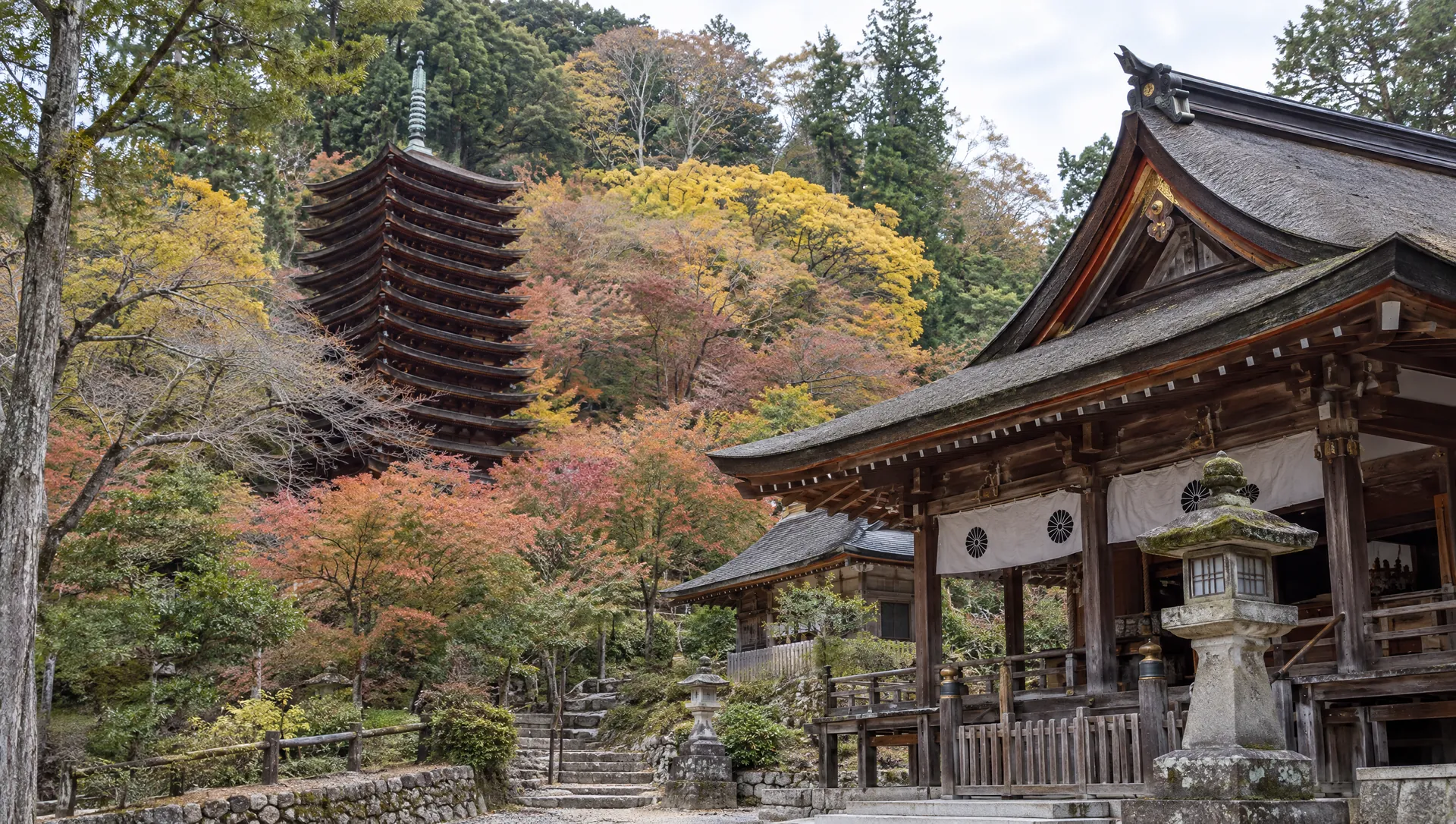 AI-generated visual study · not a documentary photograph
Discover Tanzan Shrine
Tanzan Shrine occupies a wooded slope above Sakurai and enshrines Fujiwara no Kamatari. Its own origin account connects Kamatari and Prince Naka no Oe with a secret discussion that preceded the 645 coup, but the hilltop episode is a transmitted tradition, not something a present-day building proves. The precinct's more tangible chronology is equally compelling: a wooden thirteen-storey pagoda rebuilt in 1532, a former Buddhist lecture hall, later shrine buildings and a hillside walking route show how a mountain temple became a shrine without erasing every earlier layer.
Find the thirteen-storey tower
Kamatari's son Joue is traditionally credited with founding a memorial tower here in 678. The timber structure visible today was rebuilt in 1532, and the shrine calls it the only surviving wooden thirteen-storey pagoda of its kind. View it from more than one angle on the climbing path to see its roof layers rather than compressing it into an isolated postcard image.
Read the hall beside it
The Shinbyo Haisho began as the Buddhist lecture hall of Myoraku-ji, the earlier temple on this slope. The current building was rebuilt in 1668. Pairing this with the pagoda makes the former temple identity legible inside a site now visited as a Shinto shrine; the original seventh-century timber is not what stands here.
Follow the worship buildings
The shrine lists its main sanctuary as an 1850 rebuilding, with a vermilion worship hall and corridors from earlier centuries. Its illustrated course passes the entrance, former lecture hall and tower before continuing among auxiliary shrines. Choose the official precinct map, since paths and steps can make adjacent-looking buildings slower to reach.
Treat the political story as tradition
The shrine's history recounts a meeting of Kamatari and the prince on the hill before the events of 645. It also recounts Joue returning from Tang China and establishing the memorial complex. These accounts explain why the location matters in Japanese historical memory; label them as shrine tradition, while dating the surviving buildings from the shrine's building register.
Try a separately booked kemari experience
The shrine currently advertises an approximately one-hour kemari session in traditional dress, with a priest explaining the shrine's history and the rules before participants kick the ball. The listed fee is ¥5,000 per person for groups of at least two, plus shrine admission. A one-hour costume-only option is ¥2,000 per person and does not include a priest's guide. The shrine says it accepts requests throughout the year, but ceremonies may prevent a session; contact it in advance at 0744-49-0001. These ongoing bookable plans are separate from the 2026 autumn festival's short, reservation-priority ¥1,000 participation sessions.
Plan around the shrine calendar
The shrine says most annual festivals and rites are open for visitors to attend, though rain or other circumstances can change the place or time. For 2026, its calendar lists the autumn kemari rite on 3 November at 11:00, the annual festival for Fujiwara no Kamatari on 17 November at 10:30, and a Gagaku performance of Ranryōō on 28 November at 18:00. The seasonal kemari-experience sessions (31 October–8 November, reservation-priority, ¥1,000) and autumn illumination (14 November–6 December, sunset–20:30) are also dated 2026 programmes. These are separate from the shrine's ongoing ¥5,000 kemari plan. Check the shrine's current notice for visitor access, event terms and whether any separate charge applies; the listed ordinary admission does not by itself confirm access to every programme.
Plan a mountain return, not just an arrival
Nara Kotsu's 2026 autumn access page lists about twenty-five minutes from Sakurai Station South Exit to the Tanzan Shrine stop and an adult one-way fare of ¥570. The shrine is a three-minute walk from the stop, but the bus company warns that traffic can shorten some journeys to Tonomine. Its seasonal timetable is not a year-round guarantee; check the live departure and return service before setting out. The shrine's 2026 fee is ¥700 for adults and ¥300 for primary-school children, with final admission at 16:00; its separate upper-mountain route closes earlier.
What to look for
1532 wooden thirteen-storey pagoda
Former Myoraku-ji lecture hall
Hillside shrine halls and Kamatari history
Photo notes
The operator pages reviewed do not provide a blanket commercial image or filming licence. Follow signs around worship and ceremonies, respect other visitors, and ask the shrine before publishing photographs or video made for a commercial travel service. The shrine's own site images are not licensed for reuse here.
Make a day of it
Explore guides close to this map point, then check the actual route before travelling. Distances below are straight lines, not walking distances or travel times; map points may not be entrances.
Sources & editorial status
Original MyNara draft based on the linked sources. Sources reviewed 24 October 2026. Opening arrangements, prices and offers may change; use the operator's current information before travelling.
- Official Nara Travel Guide
- Shrine operator — current admission and mobility facilities
- Shrine operator — kemari and costume-only experience duration, fees, minimum group and contact
- Shrine operator — transport and old timetable warning
- Shrine operator — pagoda and precinct buildings
- Shrine operator — Kamatari origin account
- Shrine operator — suggested precinct route
- Shrine operator — annual festival calendar, attendee guidance and 2026 autumn rites
- Shrine operator — 2026 Momiji Festival, special exhibition, kemari experience, illumination and shuttle
- Shrine operator — 2026 autumn special exhibition
- Nara Kotsu — autumn bus access and special viewing dates
- Cultural Heritage Online — Tanzan Shrine and former Myoraku-ji architectural complex