
Isuien Garden
Walk two gardens from different eras, with Todai-ji's gate and eastern hills borrowed into the view.
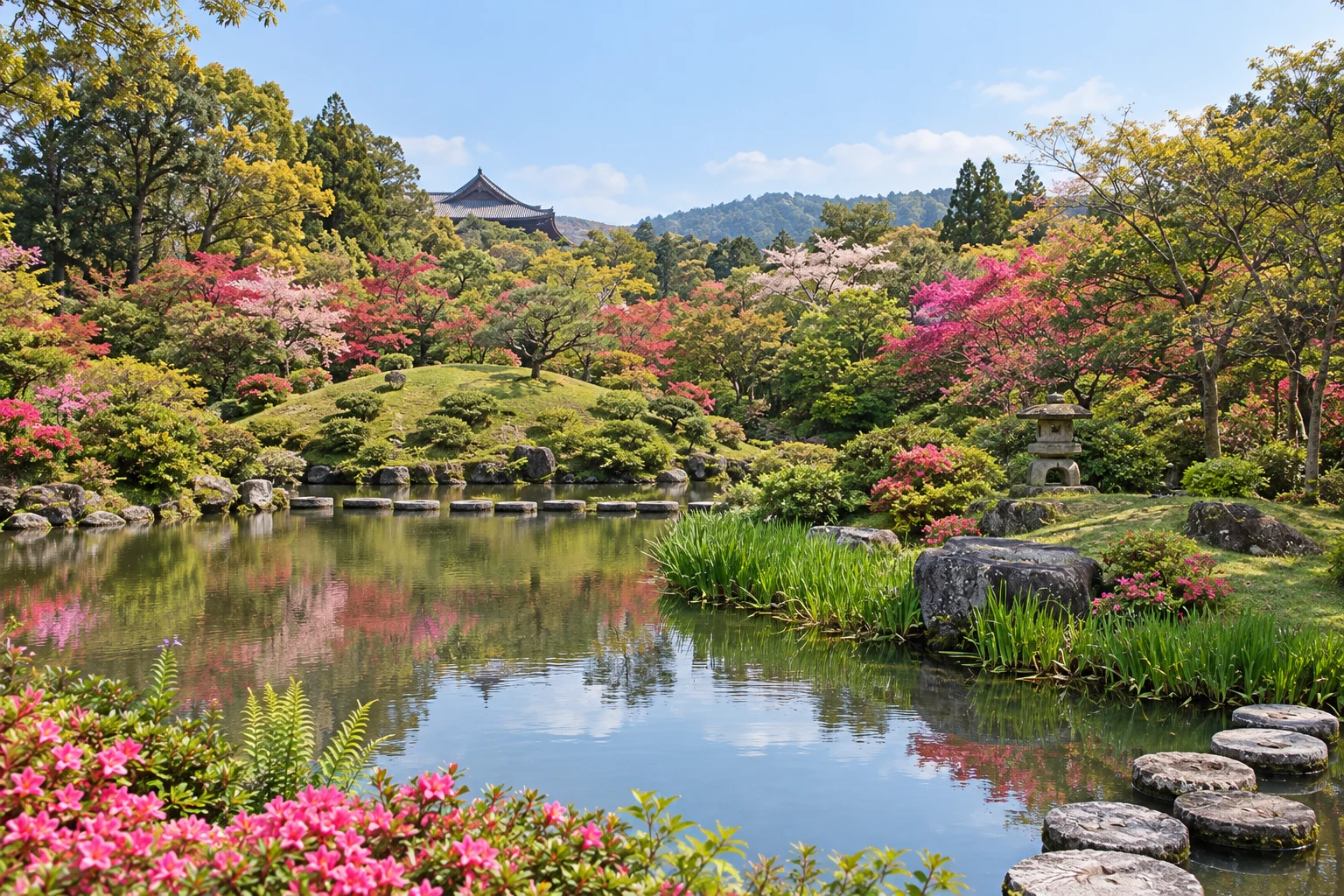 AI-generated visual study · inspired by official Isuien Garden photographs; not a documentary photograph
Discover Isuien Garden
Isuien is a nationally designated place of scenic beauty made of two gardens from different periods. The seventeenth-century Front Garden creates a contained view around a pond and tea houses; a narrow passage then opens into the Meiji-era Back Garden, where ponds frame Todai-ji's Great South Gate and Nara's eastern hills. Its design is a lesson in borrowed scenery, but the details are unusually tangible: a stone from Todai-ji's former western pagoda is built into a pond wall, and old grinding mortars have become steppingstones. The included Neiraku Museum adds a separate East Asian art collection whose displays change over time.
Start in the Front Garden's enclosed world
The operator dates the Front Garden to the 1670s and links it to Kiyosumi Dosei, a merchant and shogunate official associated with Nara-zarashi linen. Its pond, small island and Sanshutei tea house make a deliberately close setting. The island evokes a crane and turtle, traditional symbols of longevity. The operator says light meals and powdered green tea are available at Sanshutei, but its English guide does not give a current menu, price or service schedule; check before relying on it for lunch. Pause here before crossing the narrow stone passage into the Back Garden; the change in scale is part of the design.
Watch the landscape open in the Back Garden
Seki Tojiro developed the Back Garden in the Meiji era for tea gatherings and poetry. Moving from the narrow approach, the view opens over water and low artificial hills toward Mount Mikasa, Mount Wakakusa, Mount Kasuga-Okuyama and Todai-ji's Great South Gate. This is shakkei, or borrowed scenery: landmarks beyond the garden boundary become part of the composition. Walk the pond paths and look back from several points; the scene shifts as the designer intended.
Find Nara's earlier architecture in the garden wall
The operator identifies a large fragment of the central base stone from Todai-ji's former western pagoda in the Back Garden's pond wall. The original temple complex had eastern and western seven-storey pagodas; both were lost and never rebuilt. A relocated fragment has remained near Todai-ji for more than a century. Elsewhere, old stone mortars were reused as steppingstones, turning practical objects into part of the garden's surface.
Look closely at the tea-house details
The grounds include structures from both garden periods. Hyoshintei, a Meiji-era tea house, uses reused wooden boards from Shin-Yakushi-ji and thin hand-crafted glass windows; the official guide notes that its glass can make the garden view feel subtly different. The roofs also carry abalone shells. The garden explains them both as protection from crows and, symbolically, as water-associated fire protection. Observe from the public path; do not enter rooms unless they are open to visitors.
Use the included museum visit for a second perspective
The Neiraku Museum holds more than 2,000 East Asian works, including Chinese bronzes and seals, Korean ceramics, tea utensils and Japanese objects. The collection cannot be shown all at once, so displays rotate. The museum currently lists a special presentation of the painting 'Peony' from 21 October to 12 November 2026. Its same page pairs a 2026 exhibition title with an overall closing date written as Reiwa 11 (2029), so confirm the schedule directly if planning around the wider exhibition period. Admission to the garden includes the museum.
Choose your season and mind the uneven paths
The operator's seasonal guide lists flowers and foliage across the year, including spring blossom, summer water lilies and autumn foliage. These are seasonal indications, not bloom guarantees. Some steppingstones are rounded and difficult to walk; the operator says the garden is not wheelchair accessible and asks visitors using sticks to consult staff at the entrance. Take care on the paths even when looking up at the borrowed view.
What to look for
Seventeenth-century front garden
Borrowed views of Todai-ji and eastern hills
Neiraku Museum and reused historic stonework
Photo notes
The garden publishes a photo gallery but the reviewed visitor guide does not grant reuse rights or establish all on-site camera rules. Use paths without blocking others, follow signs at the museum and tea houses, and ask the operator before commercial photography or using its photographs.
Make a day of it
Explore guides close to this map point, then check the actual route before travelling. Distances below are straight lines, not walking distances or travel times; map points may not be entrances.
Sources & editorial status
Original MyNara draft based on the linked sources. Sources reviewed 25 October 2026. Opening arrangements, prices and offers may change; use the operator's current information before travelling.