
Hasedera Temple
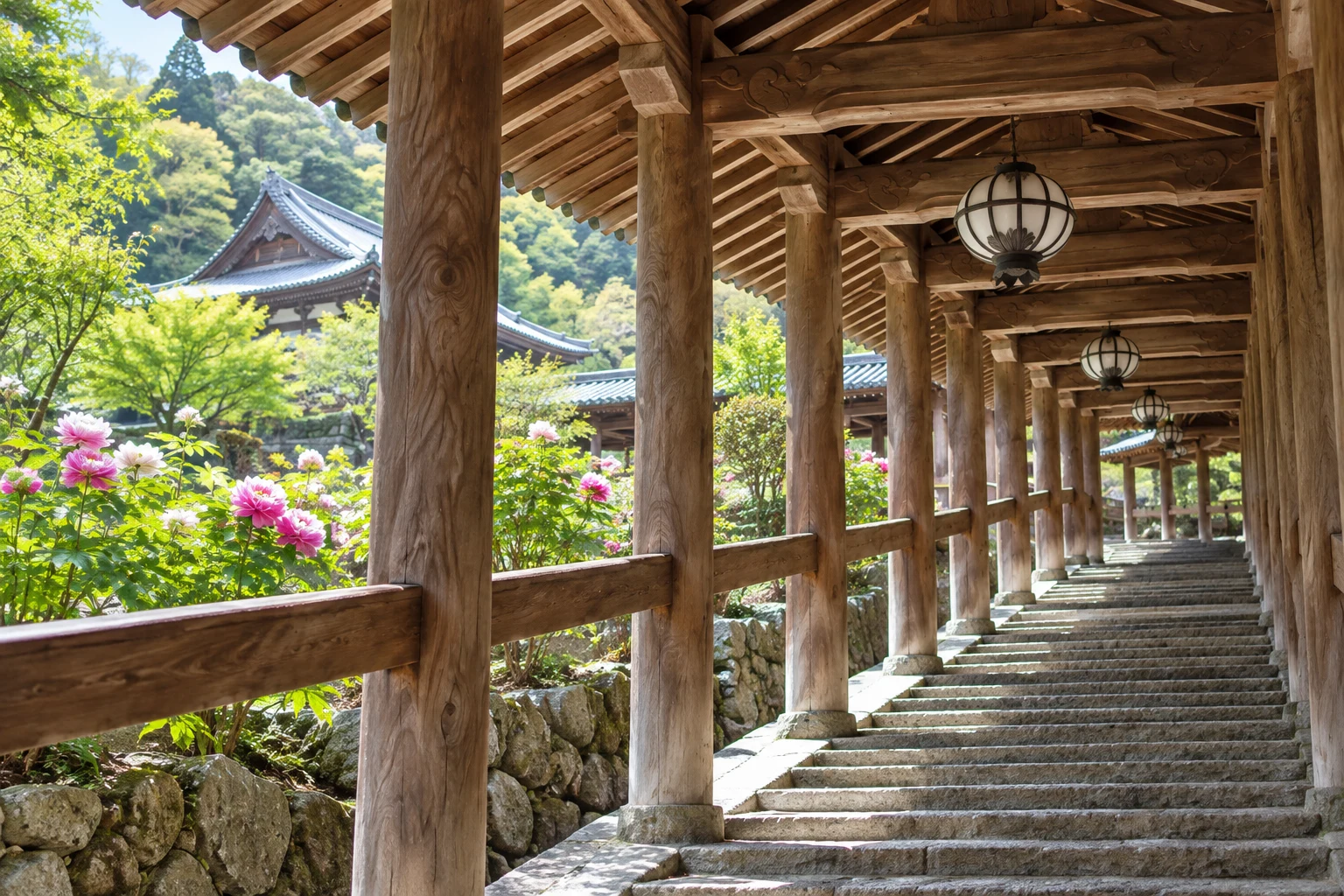
Climb 399 roofed steps to a cliff-side National Treasure hall and the great Eleven-faced Kannon.
 AI-generated visual study · not a documentary photograph
Discover Hasedera Temple
Hasedera's route is the experience. From the gate, a covered corridor rises in three stages to the cliff-side main hall, where a large wooden Eleven-faced Kannon remains a focus of worship. The buildings visitors see belong to different centuries, and spring peonies or autumn foliage change the setting without changing the effort of the climb. The temple offers a limited internal vehicle transfer for people who cannot manage the ascent; it is a request service rather than a guaranteed ordinary shuttle.
The covered ascent is an architectural visit
The operator counts 399 steps along the Noboriro, divided into lower, middle and upper corridors with hanging lanterns. Its tradition connects the first corridor to a 1039 thanksgiving offering; the lower and middle structures now standing were rebuilt in 1889. Give the climb time, and read the current timber and the older story as different layers.
Arrive at the hall, then look back
The main hall is a National Treasure building set into the steep slope with a stage-like exterior. Its worship space holds the great Eleven-faced Kannon. From the stage the valley, roofs and rising corridors become visible together; a wide view is available on an ordinary visit, while a closer inner-hall encounter is subject to separate announced special openings.
Distinguish old foundations and later buildings
The temple dates the present Nio gate to 1889 and describes the five-storey pagoda as a 1954 post-war construction. Its original Hase-dera precinct and later main-hall complex carry different foundation stories. The treasury opens collections in spring and autumn, not as a year-round promise, so confirm the actual exhibition before making it your principal reason to travel.
Flowers, ceremonies and closed activities
Peonies and other flowers are part of Hasedera's reputation, but bloom times and viewing windows change. The temple's own account connects its peony tradition with Bato-bonin: it says seeds she offered are believed to be the origin of today's peony garden. Treat this as temple tradition, not a documented botanical history or a promise of a particular bloom. The 2026 operator homepage advertises autumn inner-hall and treasury programmes with fixed dates; these are not normal admission. The temple's sutra-copying hall page still carries a temporary-closure notice even though it lists former first- and third-Sunday sessions below it. Do not plan a walk-in copying experience until the operator confirms reopening.
Plan the climb and the camera
The operator provides an internal vehicle for visitors who have difficulty reaching the main hall, subject to availability and ceremonies; ask at parking or reception. Tripods, monopods, stepladders and drones are prohibited on the grounds, and photographing Buddhist images or monks is discouraged. The operator also has a separate permission route for publication of images made on-site, relevant to a commercial travel guide.
A dated autumn 2026 visit
For the temple's 1,300th-anniversary year, the operator's 2026 Momiji (autumn-leaf) Festival runs from 10 October to 6 December. The Great Kannon special viewing lets visitors enter the main hall and touch the statue's feet; it runs 09:30–16:00 and costs ¥1,000 in addition to the ordinary entry fee. The freely viewed Nishikiaki Kiku Corridor on Arashi Hill displays around 300 pots of chrysanthemums from 09:00–16:30 over the same dates, with temple entry charged separately. The anniversary programme also lists a Noh-and-Buddhist-chanting performance on 25 October that requires advance tickets, a pagoda restoration-completion service on 7 November, and free-to-view Imayō performances on 14–15 November (temple entry still applies). These are date-limited events, not year-round access; check the operator's current notices before travelling.
What to look for
Three-stage Noboriro with 399 steps
Cliff-side National Treasure hall and Kannon
Seasonal flower route and separate special openings
Photo notes
No tripod, monopod, stepladder or drone is allowed on the grounds; the operator asks visitors not to photograph Buddhist images or monks. It publishes an application process for use of temple-owned images and photographs taken in its grounds. Personal shooting rules do not grant MyNara a publication licence; obtain permission before using such images.
SEASONAL CALENDAR
Events connected with Hasedera Temple
These records are shared with MyNara’s event calendar, so dates and notices have one source. Recurring patterns are not confirmed dated editions; check the organizer’s latest guidance.
Yamato Kannon Autumn Foliage Pilgrimage 2026
The 2026 four-temple autumn pilgrimage connects Okadera, Tsubosaka-dera, Hasedera and Murō-ji from October 10 to December 6. Tsubosaka-dera's notice confirms a free layered-colour stamp rally at all four temples and limited temple-specific kirie goshuin for ¥1,000 each. Its linked Hikari no Junrei night opening runs November 20–29 until 20:00; the notice gives no separate night-entry price. Each temple keeps its own admission and opening arrangements, and the dates do not guarantee that every site will have peak foliage at once. The 2026 edition is dated; check for a new organizer notice before planning another year.
Check organizer informationMake a day of it
Explore guides close to this map point, then check the actual route before travelling. Distances below are straight lines, not walking distances or travel times; map points may not be entrances.
Sources & editorial status
Original MyNara draft based on the linked sources. Sources reviewed 24 October 2026. Opening arrangements, prices and offers may change; use the operator's current information before travelling.
- Official Nara Travel Guide
- Temple operator — seasonal opening, admission, discounts and parking
- Temple operator — current 2026 autumn festival and special viewing
- Temple operator — peony season and Flower Temple description
- Temple operator — Bato-bonin peony-origin tradition
- Temple operator — buildings, toilets and the 399-step corridor
- Temple operator — toilet locations, support equipment and changing tables
- Temple operator — rail and bus approach
- Temple operator — sutra-copying closure notice
- Temple operator — image-publication permission
- Temple operator — 1,300th anniversary events and pagoda restoration milestones
- JNTO Hasedera guide