
Ishibutai Kofun
Walk beneath 2,300 tonnes of exposed stone and read the excavated tomb without mistaking its likely owner for a proven identity.
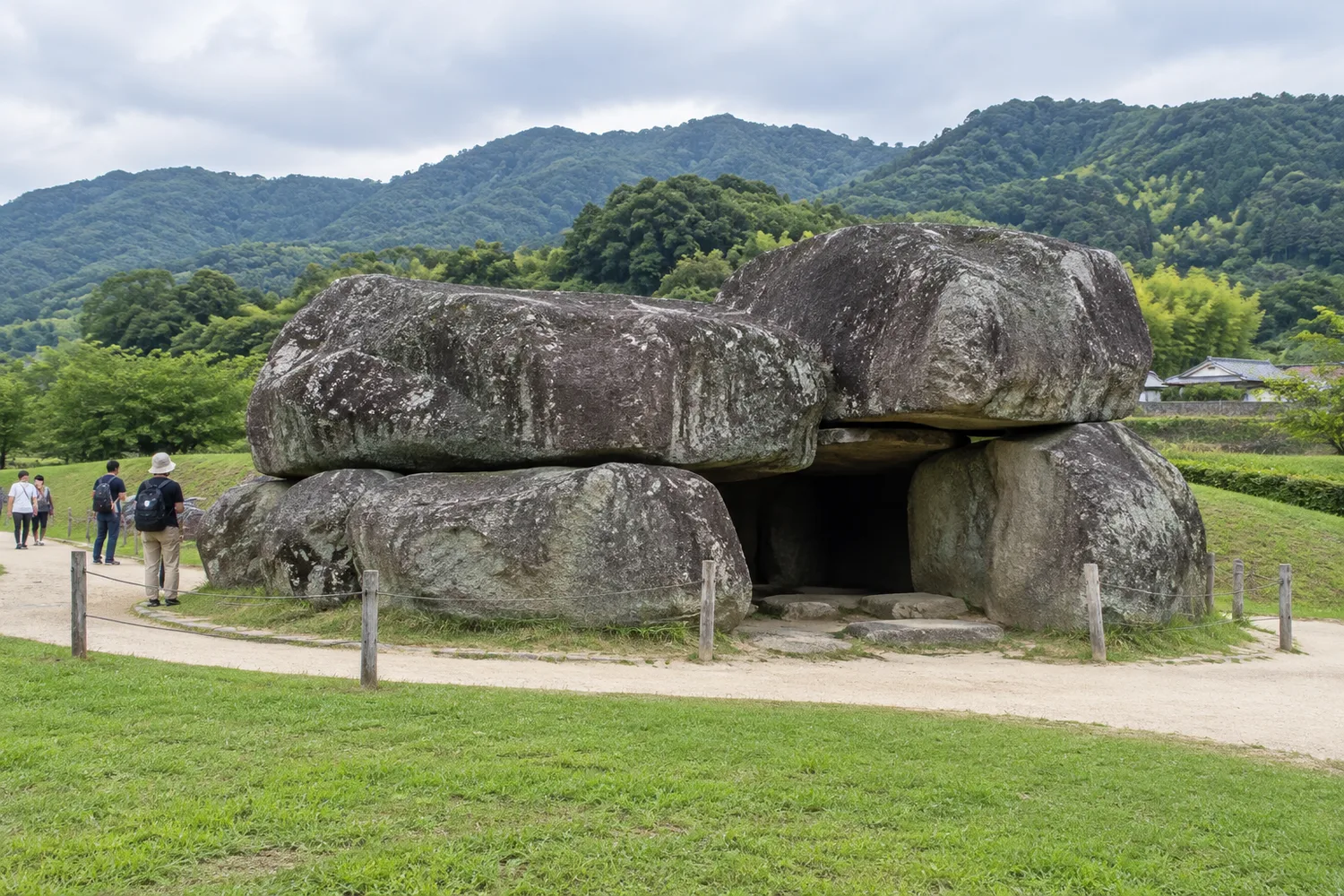 AI-generated representation · not a verified site photograph
Discover Ishibutai Kofun
Ishibutai is one of Japan's largest megalithic burial chambers. The earthen mound that once covered it has disappeared, exposing the broad roof stones that gave the tomb its stage-like name. Excavations found that it was originally a square mound with a moat and outer bank, built over and destroying a smaller sixth-century tomb. More than 30 stones weigh about 2,300 tonnes in total; the largest roof stone is estimated at about 77 tonnes. The tomb dates to the early seventh century, but no inscription names the person buried here. Soga no Umako is a persuasive theory supported by historical context, not a confirmed identification.
Read the missing mound from the ground plan
The exposed chamber is only the surviving core of a much larger funerary structure. Excavations in 1933–35 identified a square mound, moat and outer moat; researchers concluded that construction in the early seventh century cut into and removed an earlier sixth-century tomb. The park now presents the site as a Special Historic Site. Look across the open approach and imagine earthworks and banks around the stones rather than treating the chamber as an isolated dolmen.
Look at the engineering in the roof stones
The park counts more than 30 stones with an estimated combined weight of about 2,300 tonnes; the largest roof stone weighs about 77 tonnes. From the outside, notice how the enormous capstones sit across the chamber walls. These figures describe estimates of the surviving stone structure, not the full weight of the vanished mound or an explanation of exactly how each stone was moved. Stay on the visitor path and do not climb onto the stones.
Enter the two-sided stone chamber
Ishibutai is a corridor-style stone chamber with paired projecting stones at the entrance and a large burial room beyond. The exposed passage lets visitors see the construction from outside and then walk inside beneath the roof slabs. Mind the uneven, potentially damp stone floor and the low, narrow entrance; this is an ancient tomb, not a reconstructed gallery. Do not touch or climb the stones, and follow the staff's route through the chamber.
Keep the Soga no Umako theory in proportion
The park and Nara Prefecture say the person buried here is unknown but identify Soga no Umako as a leading possibility. The argument draws on the early-seventh-century date and the site's location near the Soga family's base at Shimasho; the prefecture also compares the tomb with the '桃原墓' associated with Umako in the Nihon Shoki. The evidence does not constitute a direct identification. Present it as a historical theory, not as a fact on a family itinerary.
The 'stage' name is about the roof's shape
The broad, unusually flat top of the exposed capstone was likened to a stage, giving the site its familiar name. The park notes that the stones were already exposed in early-modern accounts, including Motoori Norinaga's 1772 diary. That record shows the ruin's long place in local travel and writing, while the excavations later revealed the buried square plan beneath it.
Use the surrounding park as part of the visit
The Ishibutai district has a lawn shaped around existing terraced-field contours, the Asukakazebutai multipurpose rest and event structure, a rest area, water fountain and accessible toilet with baby-care facilities. Asuka no Yumemichi shop is nearby. These free park facilities are separate from the paid tomb entrance. Continue to Asuka-dera, the Soga family sites or other village stops to understand the tomb in its seventh-century political landscape; check each site's separate schedule and transport.
What to look for
Exposed roof stones and former mound footprint
Walk-in stone chamber
Early-seventh-century Asuka context
Photo notes
The reviewed operator and village pages do not state a blanket indoor photography policy. Stay on the visitor route, do not climb or touch the stones, keep the chamber entrance clear and follow any on-site signs or staff directions. Obtain permission before commercial filming or reusing any source photographs; no image rights are assumed.
SEASONAL CALENDAR
Events connected with Ishibutai Kofun
These records are shared with MyNara’s event calendar, so dates and notices have one source. Recurring patterns are not confirmed dated editions; check the organizer’s latest guidance.
Asuka Half Marathon 2027
The organizer confirms a 21.0975 km half marathon from 09:00 to 12:30 on March 14, 2027, with a first-come capacity of 3,000 runners. The general entry filled on October 9, 2026, well before its original December deadline; the organizer's notice thanks applicants but does not publish the final number of accepted runners. The course starts and finishes at Kitora Tumulus Shijin-no-Yakata and passes the Tenmu and Jitō tombs, Kawaradera, Tachibanadera, Ishibutai, the Inabuchi terraces and Takamatsuzuka-area roads. This is useful to spectators and anyone planning to visit these sites that day, not an invitation to enter. The start/finish is a 20-minute walk from Kintetsu Asuka Station; there is no participant parking, road restrictions begin near the venue at 08:00, and station-area congestion is expected. A free general-visitor shuttle runs from the venue back to Asuka Station from 10:00 to 14:00, but not before the race. Check the organizer's latest access and course notices before travelling.
- Time
- Race: 09:00–12:30; roads near the main venue restricted from 08:00
- Admission
- Runner entry was ¥6,000; the general entry reached its 3,000-person cap and closed October 9, 2026. No spectator admission fee is stated.
- Booking
- General runner entry is closed after reaching capacity. The organizer does not publish a spectator registration process; follow its visitor-access guidance and do not enter the course.
Make a day of it
Explore guides close to this map point, then check the actual route before travelling. Distances below are straight lines, not walking distances or travel times; map points may not be entrances.
Sources & editorial status
Original MyNara draft based on the linked sources. Sources reviewed 24 October 2026. Opening arrangements, prices and offers may change; use the operator's current information before travelling.
- Asuka Historical National Government Park — excavation history, chamber, hours and current admission
- Asuka Park English visitor page (helpful route context; its displayed fees are outdated)
- 2026 ticket-price change notice (official park operator)
- Asuka park district — facilities, accessible toilet and free parking status
- Asuka Village — current paid parking reservation periods and prices
- Asuka Village tourism guide — tomb admission, parking and visitor cautions
- Nara Kotsu — Asuka bus routes and live timetable links
- Kintetsu — access from Kashiharajingu-mae Station
- Nara Prefecture cultural heritage record
- Nara Prefecture listing