
Fujiwara Palace Site: Read the First Planned Capital
Walk the open ground and reconstructed red pillars where an imperial palace once organised Japan's first large planned capital.
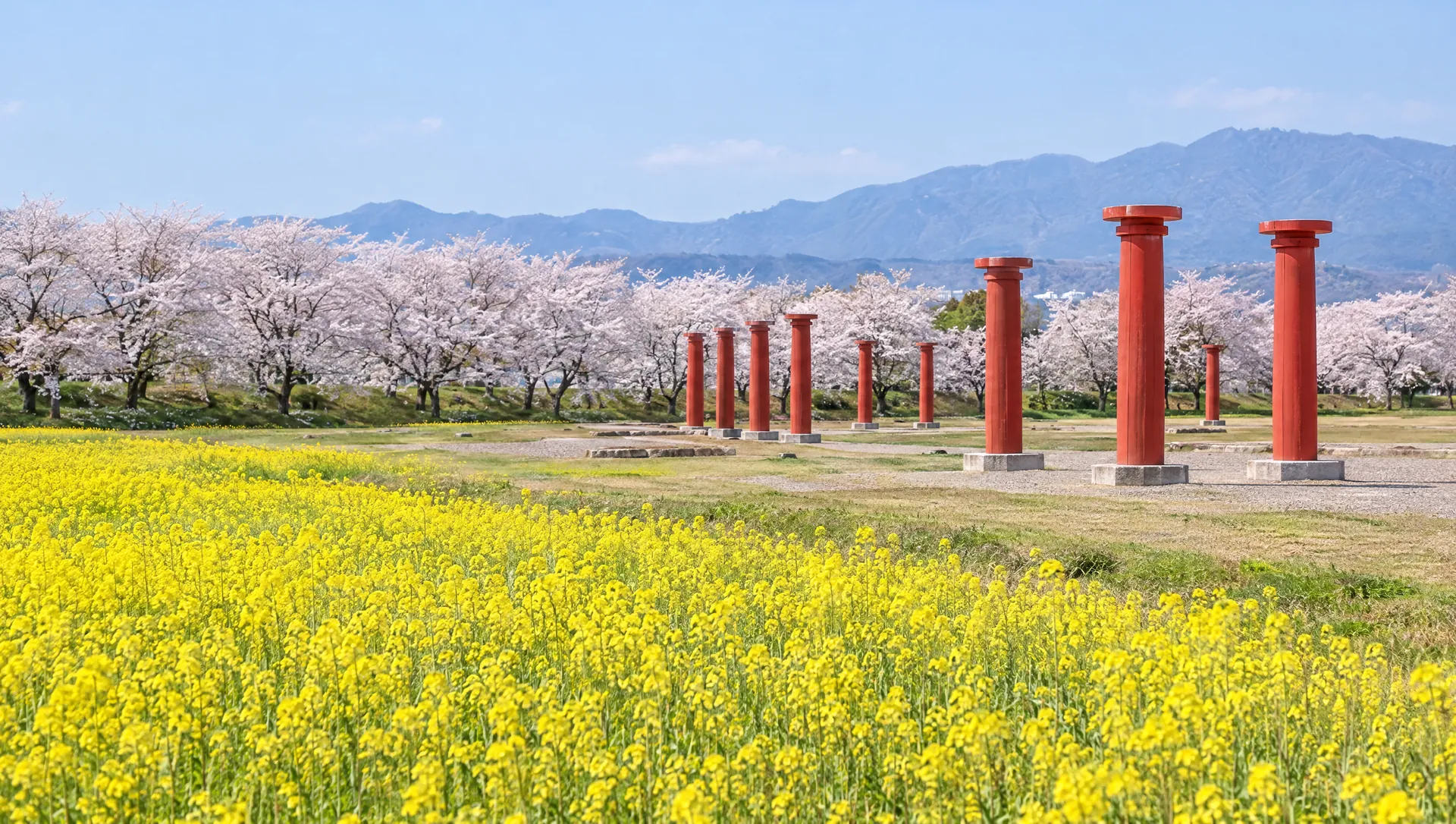 AI-generated visual study · not a documentary photograph
Discover Fujiwara Palace Site: Read the First Planned Capital
Fujiwara Palace stood near the centre of Fujiwara-kyō, the capital used from 694 to 710. Its buildings have not survived above ground. What visitors see today is a protected broad site, a few reconstructed red pillar lines, fields and seasonal flowers; the enormous court complex must be imagined from archaeology and plans. Kashihara City identifies this as the political centre under Empress Jitō and Emperors Monmu and Genmei. East of Daigoike, a modern Manyoshu monument records Jitō's famous verse about white garments drying on Mount Kagu. The same poem was also carved on a separate monument at Amanokaguyama Shrine, so use the setting and the specific city record to distinguish them. A visit becomes much richer when the open landscape is paired with an explanatory museum rather than treated as a flower field alone.
Measure the empty space
Kashihara City puts the palace enclosure at about 925 metres east to west and 907 metres north to south. The central area held the Daigokuden and other ceremonial courts, while administrative offices occupied eastern and western sections. Walk between public paths and the reconstructed pillars to sense the distance: a few red posts mark former building positions, not a rebuilt hall or a complete palace. A directory pin cannot stand in for the many entrances to this broad site.
Follow the sequence from Asuka to Fujiwara
Nara's research institute describes a capital laid out with streets and a central palace after earlier Asuka courts, with planning begun under Tenmu and the move accomplished under Jitō in 694. The capital lasted sixteen years before the move to Heijō-kyō. The Taihō legal code was completed in 701 during this period. This is why an apparently quiet field matters to the story of government: buildings and streets were instruments for running a new court system, even though most traces now lie below ground.
Place the palace within the 2026 World Heritage inscription
On 26 July 2026, UNESCO inscribed the serial property Ancient Capitals of Asuka and Fujiwara, which has nineteen component parts, including Fujiwara Palace Site. UNESCO describes the wider property as evidence of the emergence of a centralised state in East Asia and of exchanges with China and the Korean Peninsula. The inscription recognises the archaeological landscape; it does not mean the buried palace has been rebuilt or that every component has the same facilities, opening arrangements or visitor route. At Fujiwara, read the open field and ground-level remains alongside the interpretation at a separately operated museum.
Treat the flowers as a recent use of ancient ground
The city has organised seasonal planting with local residents since 2006. Its guide gives approximate viewing windows of late March to early April for rapeseed and cherry, mid-July to early August for lotus, and early to late October for cosmos. These are cultivated displays, not ancient palace gardens, and flowering depends on the year's conditions. The city says one summer yellow-cosmos area stopped being planted after 2024; follow its current bloom page, not an old photograph or an assumed annual pattern.
Use the mountain backdrop and a museum together
The Yamato Three Mountains form the palace site's distinctive horizon; the city describes the ridge view as a protected important view. For the excavated story, the city's Fujiwara-kyō exhibition room and the Nara National Research Institute's Fujiwara Palace Site Museum are separate indoor venues with their own hours. Neither is included in a single outdoor ticket, and the institute's room is east of the palace area rather than on the same spot as the reconstructed pillars.
Find Jitō's poem beside Daigoike
On the east side of Daigoike in Daigocho, Kashihara City identifies a modern monument bearing Empress Jitō's verse 「春過ぎて 夏来るらし 白栲の 衣乾したり 天の香具山」 (Manyoshu, book 1, poem 28). The city records calligraphy by Takashi Inukai and gives the stone's dimensions as 140 cm wide and 105 cm high. This is a different monument from the same-verse stele inside Amanokaguyama Shrine: Nara Prefecture's Manyoshu record 289 places that one in Minamiura and names Nakao Teishū. Do not use the inscription alone to decide which stone you are looking at; compare the surrounding site and source record. The city describes the verse as a seasonal image, not proof of the exact historical viewpoint.
Choose a lawful route and parking area
Kashihara City estimates about thirty minutes on foot from JR Unebi, Kintetsu Miminashi or Kintetsu Unebigoryōmae. Its community bus from Yamato-Yagi reaches the Kashihara Fujiwara-kyō exhibition-room stop, about four minutes' walk from the site, but current frequency and the last return must be checked. The city's current flower-garden guide assigns two large-bus spaces at the Kashihara Fujiwara-kyō Resource Room car park and 21 at the west-side Suzaku Avenue remains car park; these spaces cannot be reserved. Use the published map rather than field edges or local roads. Paths and planting areas may change during maintenance.
What to look for
Open palace footprint and reconstructed red pillar markers
Fujiwara-kyō history under three rulers
Yamato Three Mountains and cultivated seasonal flower zones
Photo notes
No site or flower photograph is licensed for MyNara. Personal views should be made from paths without entering planted areas or obstructing residents and farm vehicles. Ask the city about commercial shoots or drone permissions; the landscape designation is not a blanket filming licence.
Make a day of it
Explore guides close to this map point, then check the actual route before travelling. Distances below are straight lines, not walking distances or travel times; map points may not be entrances.

Sources & editorial status
Original MyNara draft based on the linked sources. Sources reviewed 24 October 2026. Opening arrangements, prices and offers may change; use the operator's current information before travelling.
- Kashihara City — palace story, visible remains, flowers and access
- UNESCO World Heritage Committee — inscription decision and outstanding universal value (26 July 2026)
- Kashihara City — Special Historic Site conservation plan: public access and no admission fee
- Kashihara City — Daigoike Jitō poem monument, location, poem and Inukai Takashi calligraphy
- Nara Prefecture Manyo database — distinct shrine-ground copy of Jitō's poem, record 289
- Kashihara City — special historic site and excavated plan
- Kashihara City — flower planting, routes and seasonal parking
- Kashihara City — current Fujiwara Palace flower garden and visitor access (updated 9 Sep 2026)
- Nara National Research Institute — Fujiwara-kyō archaeological context
- Official Nara Travel Guide — distinct venue identity A01000 and map point