Yakushi-ji Hana-eshiki: Seven Days of Spring Rituals
A week-long March repentance ritual at Yakushi-ji, known for its handmade paper flowers, six daily services and the closing Oni-oi fire rite.
 Verified site photographs are being prepared.
Discover Yakushi-ji Hana-eshiki: Seven Days of Spring Rituals
Hana-eshiki, literally a flower ceremony, is Yakushi-ji's spring Shuni-e. The temple says the central Yakushi-keka repentance liturgy has continued since the Nara period. Its flower offering has a later origin story: after Empress-consort illness prayers were answered in 1107, ten kinds of artificial blossoms were made and offered the following year. The service is therefore not a spring flower festival in the modern sense; the flowers frame a serious ritual of reflection and prayer. The Nara City Tourism Association lists the 2027 observance for 25–31 March. That confirms the annual date window, while the temple's detailed 2027 timetable and visitor arrangements still need to be checked when its year-specific notice is released.
Read the flowers as part of a ritual
Yakushi-ji says about 1,600 handmade washi blossoms are arranged in twelve vessels, representing ten kinds of flower: plum, peach, cherry, camellia, Japanese kerria, peony, wisteria, iris, lily and chrysanthemum. The flowers do not simply decorate a seasonal display. Their offering accompanies the Yakushi-keka liturgy before the principal Yakushi Buddha. The temple says two Nara City households continue the flower-making tradition, dyeing the paper with plant materials. Visitors can look at the arrangement as an artwork, while remembering it is part of worship and should be approached quietly.
Understand the six daily services
The seven-day observance includes six periods of liturgy, known as the six-times practice: early morning, morning, midday, late afternoon, evening and night. The temple describes ten ascetic monks taking part. The first and second services, third and fourth, and fifth and sixth are paired as continuous sequences. In the 2026 schedule, evening and night services began at 19:00 and around 20:30 on most days. The final-day vow-fulfilment service was attended from outside the Main Hall, not inside. This is a schedule for 2026, not a promise that the next year's access pattern will be identical.
Watch how the final night closes the week
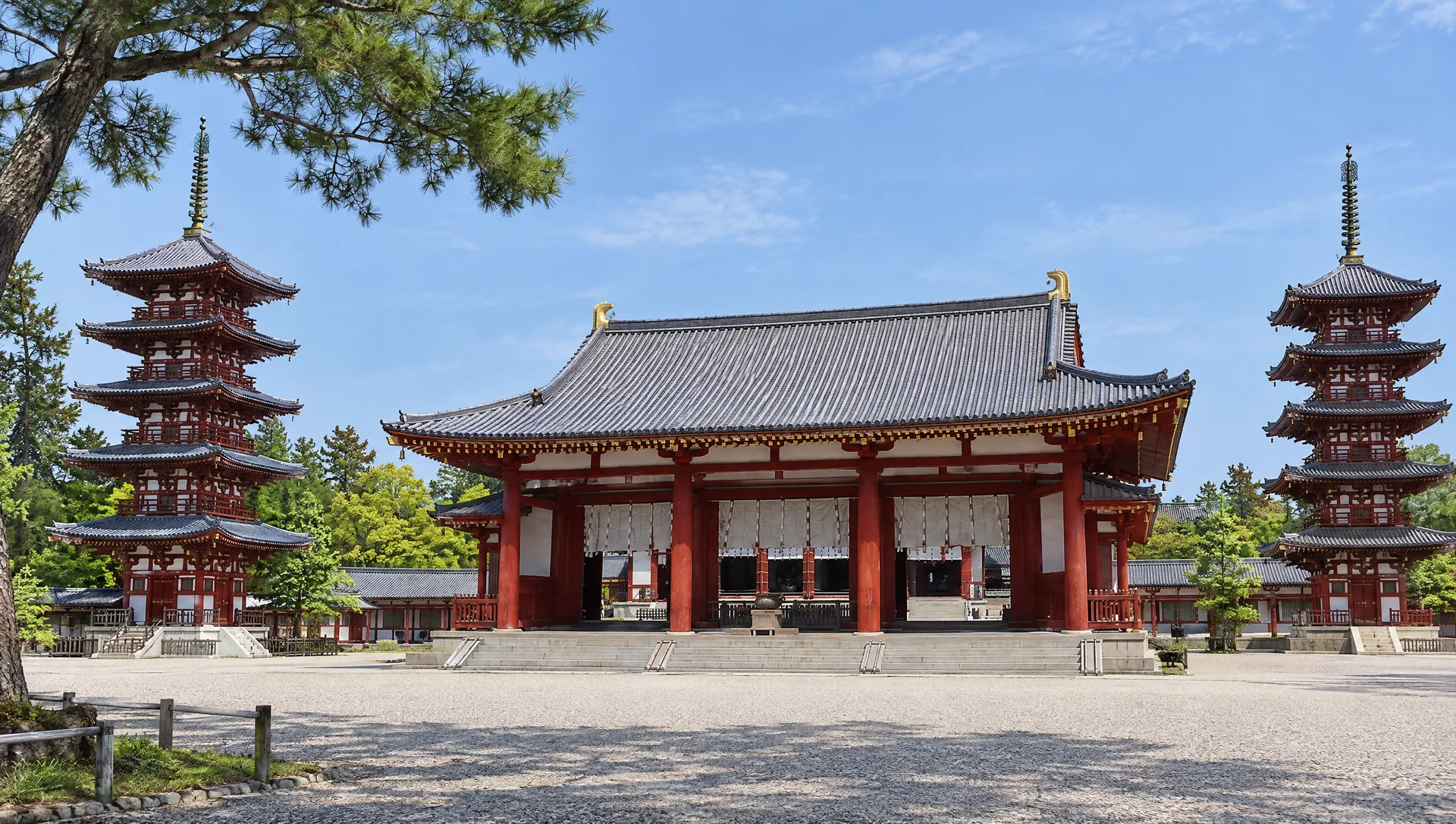
On the final night, the service includes offerings and prayer before the Oni-oi, or demon-expulsion rite, outside the Main Hall. Yakushi-ji explains the demon figures as symbols of afflictions and the ritual as a visible expression of repentance and change. The 2026 temple calendar placed the vow-fulfilment service at 19:00 and the Oni-oi around 20:30. Expect a large crowd and follow the current staff directions; the temple may limit where visitors can stand. The event's meaning is better understood as a religious observance than as a staged show.
Plan around temple rules and the 2027 calendar
The Nara City Tourism Association lists the next Hana-eshiki for 25–31 March 2027 and directs visitors to Yakushi-ji for current programme details. The temple's currently published detailed schedule is for 2026, so it does not establish 2027 service times, registration, prices or viewing access. Check the temple's year-specific notice before booking, especially for night services, photography, special sutra-copying sessions and participation by children. Respect signs and do not photograph a ritual where photography is restricted.
What to look for
A seven-day spring Shuni-e centred on Yakushi-keka repentance liturgy
About 1,600 handmade washi flowers in ten traditional varieties
Final-night Oni-oi rite; next annual visitor schedule must be confirmed
Photo notes
Do not reuse Yakushi-ji or Nara Prefecture images without permission. Photography inside halls and during rituals is subject to temple rules; follow staff and signs, avoid flash, and never block worshippers or processions. MyNara uses a photo-pending placeholder until licensed event imagery is secured.
Make a day of it
Explore guides close to this map point, then check the actual route before travelling. Distances below are straight lines, not walking distances or travel times; map points may not be entrances.
Sources & editorial status
Original MyNara draft based on the linked sources. Sources reviewed 19 October 2026. Opening arrangements, prices and offers may change; use the operator's current information before travelling.
- Yakushi-ji — Hana-eshiki history, liturgy, flowers and 2026 schedule
- Yakushi-ji — annual and recurring event calendar
- Yakushi-ji — ordinary visiting information
- Yakushi-ji — admission hours and standard entry fees
- Yakushi-ji — station access and address
- Nara Prefecture — Shuni-e background, checked 2026
- Nara City Tourism Association — 2027 dates, venue and station access
- Nara Yakushiji Youth Association — preparation and volunteer role