
Fujinoki Kofun: A Sixth-Century Burial beside Hōryū-ji
See the preserved mound west of Hōryū-ji, then discover what its unlooted chamber revealed without assuming you can enter it.
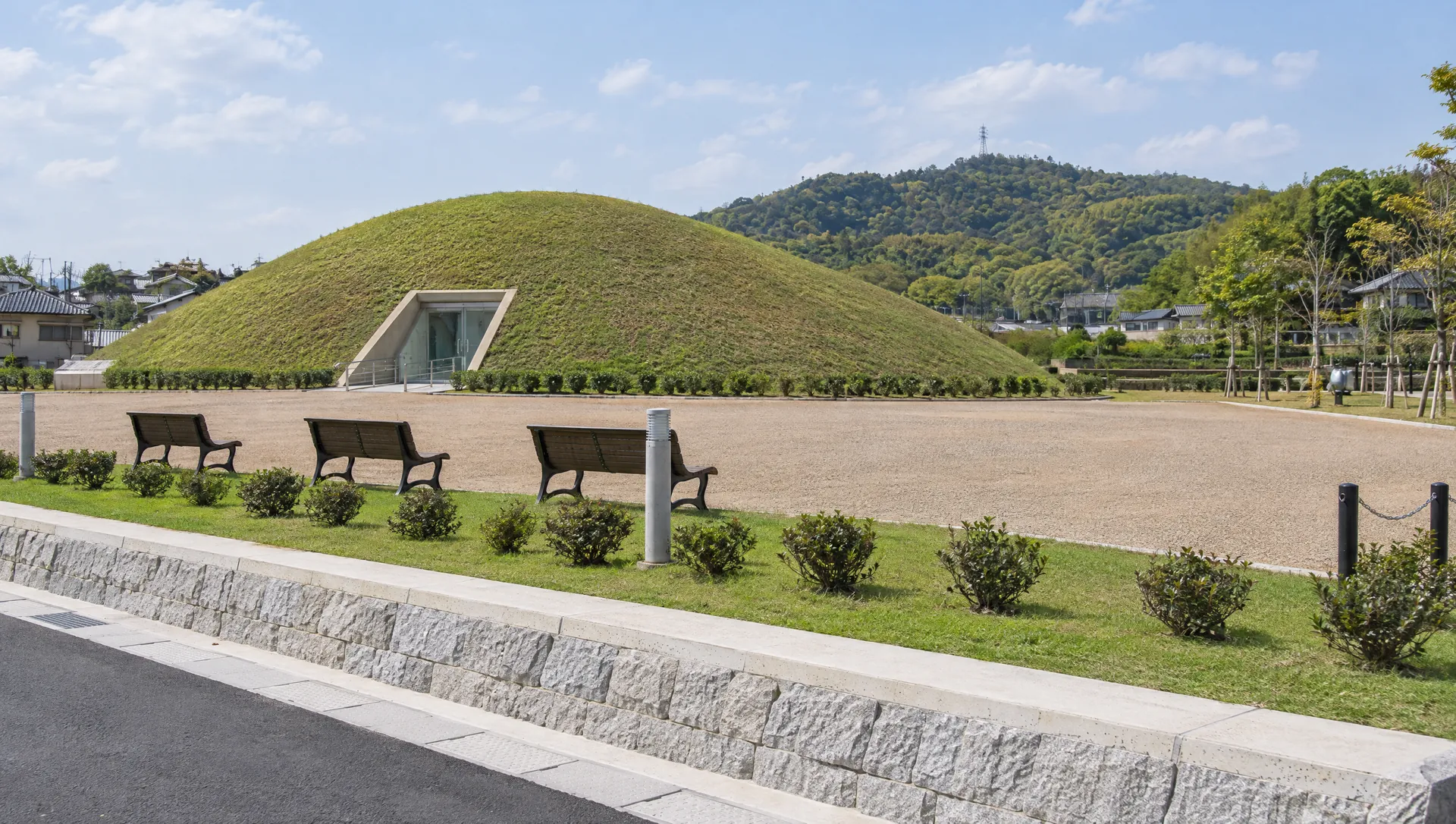 AI-generated visual study · not a documentary photograph
Discover Fujinoki Kofun: A Sixth-Century Burial beside Hōryū-ji
Only a few minutes west of Hōryū-ji, a rounded mound carries Ikaruga's story back to the late sixth century. Fujinoki Kofun became remarkable when excavators found an unlooted stone chamber, a red-lacquered house-shaped coffin and lavish horse fittings. The people buried here have not been identified with certainty; the objects and their careful conservation tell the more dependable story. A normal visit is an outdoor stop with a view toward the chamber through a protected glass door, not a walk into the tomb. Pair it with the nearby Ikaruga Cultural Heritage Center, which explains the finds through replicas and film, and check the town's own notices if chamber access is the purpose of your journey.
Read the mound before imagining the treasures
Ikaruga Town dates the circular burial mound to the later sixth century and estimates it at about 50 metres in diameter and 9 metres high. The site lies roughly 350 metres west of Hōryū-ji. Excavation began in 1985; a lateral-entry stone chamber held a vermilion-coated, house-shaped stone coffin. Tourism descriptions report two people interred with swords, crowns, shoes and elaborate gilt-bronze saddle fittings. Their identities remain debated, so do not turn a possible connection to Prince Shōtoku into a named burial. The mound became a nationally designated Historic Site in 1991, and the discoveries make this short detour a different way of reading Ikaruga's past.
Know what is visible on an ordinary day
The exterior is listed as freely viewable without a regular admission charge. That does not mean the protected stone chamber is normally open: the town says visitors usually see the chamber and coffin through the window glass in the entrance door. The grassed mound and its immediate setting are the principal everyday experience. Allow time to find the signed approach, keep to public paths and avoid climbing or touching protected fabric. The visit is most rewarding if you know beforehand that the spectacular grave goods are not displayed here at the tomb.
Separate three kinds of special access
Town-run chamber openings are occasional, date-specific events. Its 16–17 May 2026 spring opening has already passed; it was free and first-come, with an introductory film, roughly ten visitors at once, a one-to-two-minute chamber stay and a bad-weather cancellation rule. A different town scheme offers reserved, approximately twenty-minute private visits as a hometown-tax return gift for qualifying donors of at least ¥50,000; it is not a standard ticket or the cost of an ordinary outdoor visit. The town also advertises particular guided heritage tours, each with its own booking terms. Check the current town announcement before making any journey specifically to enter the chamber.
See the finds in context, not in the wrong building
Ikaruga Town says some original excavated objects are exhibited at the Kashihara Archaeological Institute Museum. Near this tomb, the Ikaruga Cultural Heritage Center presents fine replicas of about sixty major finds, images and a reconstructed coffin, so it is useful for understanding the discovery but not a display of the original National Treasures. Temporary exhibitions can reduce that regular gallery and charge admission; the centre's autumn 2026 programme does both. The tomb, interpretation centre and Kashihara museum are three separate visits with distinct access conditions.
Walk from the temple or use the bus corridor
The local tourism desk estimates about five minutes west on foot from Hōryū-ji's South Gate; the town's spring access guide allows around ten minutes west from Hōryūji Sandō bus stop. From JR Ōji or Kintetsu Tsutsui, a suitable Nara Kotsu bus to Ikaruga Town Hall leaves around five minutes on foot north to the mound. Check the live route and return timetable rather than assuming an old bus line still operates. The mound has no regular visitor car park. A spring-event notice mentioned temporary bicycle and accessible vehicle spaces, but those should not be mistaken for year-round facilities. Surfaces around an archaeological site and the glass viewing point have not been independently checked for step-free access.
What to look for
Late-sixth-century mound and preserved chamber window
Unlooted red coffin and gilt-bronze horse-fittings story
Short Hōryū-ji to heritage-centre walking connection
Photo notes
No tomb, chamber or artifact photograph is licensed to MyNara. General photography rules at the exterior and any special chamber opening were not established in the reviewed notices. Follow protection signs and ask the town or event staff before photographing, especially inside the chamber; do not copy museum images or treat replicas as original artifacts.
SEASONAL CALENDAR
Events connected with Fujinoki Kofun: A Sixth-Century Burial beside Hōryū-ji
These records are shared with MyNara’s event calendar, so dates and notices have one source. Recurring patterns are not confirmed dated editions; check the organizer’s latest guidance.
Special Hōryū-ji West En-dō and Fujinoki Kofun Tour (2026)
Ikaruga Town lists this two-date programme as one of the main projects in its new cultural-property initiative. On November 22 and 28, a cultural-property specialist guides visitors through Ikaruga Cultural Heritage Center and Fujinoki Kofun's normally closed stone chamber, followed by a monk-led visit to Hōryū-ji's West En-dō. This rare access is by a booked tour only; the tomb chamber and hall do not thereby become generally open to visitors.
- Time
- Meet at Hōryū-ji i Center at 13:30; planned finish around 15:10. Times may change.
- Admission
- ¥8,800 per person (adults and children). Includes guide and receiver, Ikaruga Cultural Heritage Center admission, tomb cooperation fee, Hōryū-ji admission, and a limited goshuin; travel to the meeting point is extra.
- Booking
- Advance booking through tabiwa is required, and a WESTER account is needed. Applications close 10 days before departure. Minimum departure is 12 participants; Japan Travel may cancel around 20 days beforehand if the minimum is not met. Current seat availability is not stated on the information page. A temple service may also cancel special access after departure confirmation.
Fujinoki Kofun Spring and Autumn Stone-Chamber Openings
Ikaruga Town's Cultural Heritage Center says Fujinoki Kofun's stone chamber is specially opened in spring and autumn for visitors. These occasional openings are the only ordinary public opportunity to enter the normally closed chamber; do not assume a date, duration or access in any given year until the town publishes its notice. Current visitor terms and weather cancellation rules are set by each notice.
Check organizer informationMake a day of it
Explore guides close to this map point, then check the actual route before travelling. Distances below are straight lines, not walking distances or travel times; map points may not be entrances.
Sources & editorial status
Original MyNara draft based on the linked sources. Sources reviewed 19 October 2026. Opening arrangements, prices and offers may change; use the operator's current information before travelling.
- Ikaruga Town — mound, excavation, designation and original-find locations
- Ikaruga Town — May 2026 chamber opening, everyday glass view, access and parking
- Ikaruga Town — distinct donor-only reserved chamber visit
- Hōryūji i Center — mound history, South Gate walk and lack of site parking
- Agency for Cultural Affairs — Historic Site designation
- CODH historical-places dataset — approximate mapped point, CC BY 4.0