Yatogi Jinja and Its Thatched Worship Hall
Step off the southern Yamanobe-no-Michi to see a rare thatched worship hall and a shrine tied to Kasuga traditions.
 Verified site photographs are being prepared.
Discover Yatogi Jinja and Its Thatched Worship Hall
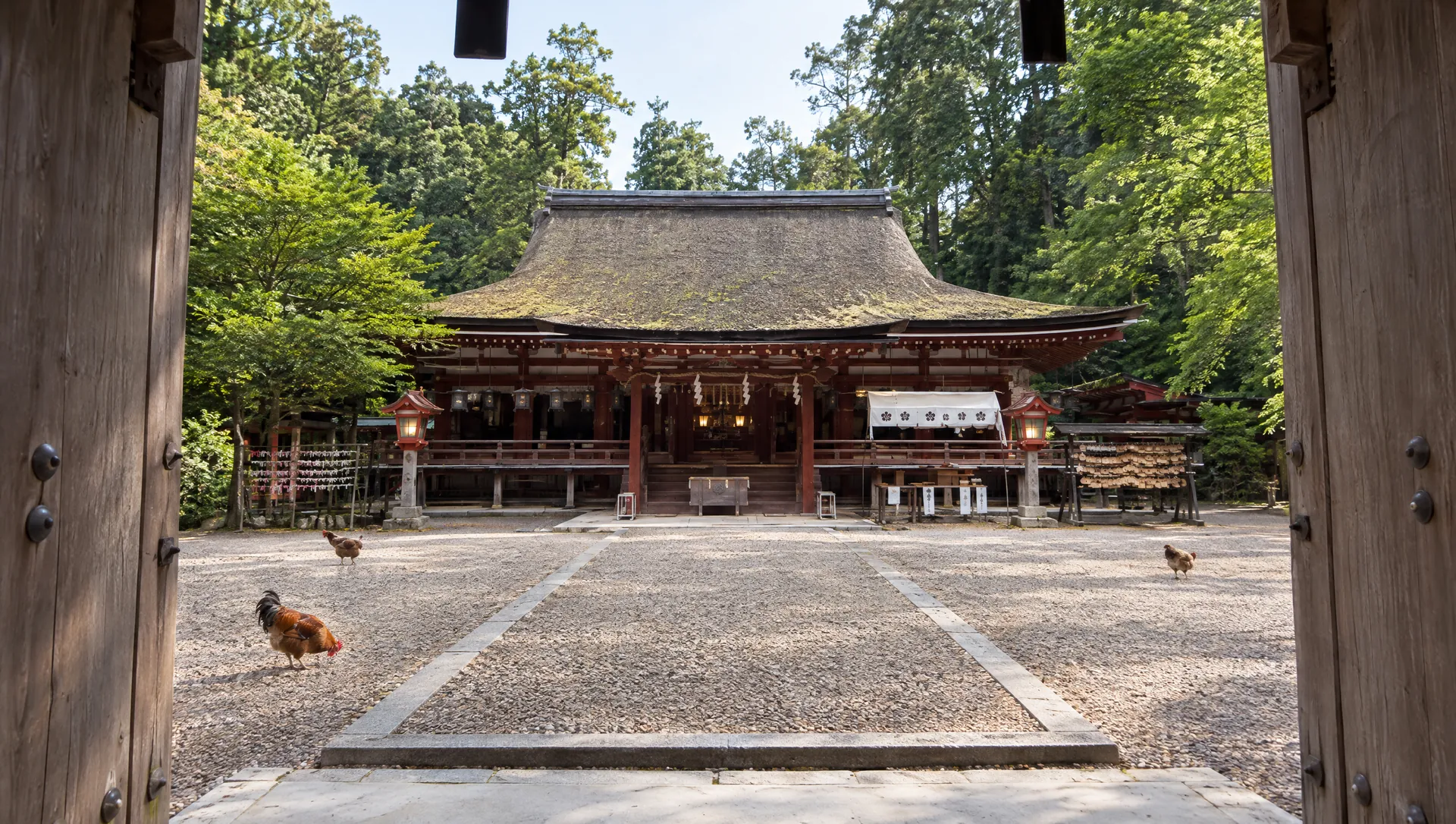
Yatogi Jinja is a small shrine just north of the Otogi settlement on the southern Yamanobe walking route. Its thatched worship hall stands before a separate, more colourful main sanctuary. The contrast matters: a prefectural English listing loosely calls the thatched building the 'main hall', while Tenri's tourism association identifies the thatch as the worship hall and describes the principal sanctuary as a 1906 rebuilding with a cypress-bark roof. A slow stop here reveals local ritual connections to Kasuga rather than just an attractive trail photograph.
Look through the two different buildings
From the public approach, the conspicuous thatched roof belongs to the haiden, the worship hall. Tenri's tourism association describes the honden behind it as a Kasuga-style sanctuary rebuilt in Meiji 39 (1906), with a cypress-bark roof and coloured details. Do not tell visitors that the thatched hall is the ancient original main sanctuary. The setting includes smaller shrines and stone lanterns, but their interiors or sacred structures are not a general sightseeing space.
Trace the Kasuga relationship
The association says the shrine enshrines four Kasuga deities and was also called Kasuga Shrine locally. It records offerings sent from Otogi to Kasuga Taisha and periodic transfers of a Wakamiya sanctuary and torii in the other direction. A Nara Prefecture regional guide adds a separate account of how two local shrines and land were exchanged during the Edo period, after which the Kasuga shrine took the name Yatogi; keep this as a regional historical account. The name also appears in older sources as 夜都伎神 and 乙木明神. These records explain the connection without implying that the former transfers continue today.
Notice the gate and village landscape
One vermilion torii stands roughly one hundred metres west of the shrine according to the tourism association; it says this was originally the second gate and another once stood farther west. The approach connects to agricultural land and Otogi's houses, with the southern Yamanobe route passing nearby. It is a good place to understand the walking path as a lived landscape, but avoid blocking local access or entering fields to get an unobstructed picture.
Treat the autumn rite as a dated local event
Tenri's association gives 12 October as the annual festival date, while Nara Prefecture's cultural-resource account describes a procession from Otogi to the shrine on that date as part of the Chanchan Matsuri traditions. On this guide's October 2026 research date, the 2026 festival day has already passed. The date helps explain the shrine's community role; confirm the next year's ceremony, public viewing arrangements and any road restrictions with the local organizers before planning a trip around it.
Walk rather than drive to the door
The tourism association explicitly lists no visitor parking, rest area or toilet at the shrine. Its place page locates the site on the southern Yamanobe-no-Michi, north of the Otogi settlement; the prefectural guide gives 765 Otogicho and a fourteen-minute taxi estimate from Tenri Station. Use current trail maps and allow enough daylight and time to reach a station or proper rest stop. The shrine directory lists free admission but gives no posted opening hours for interiors or staffed services.
What to look for
Thatched worship hall contrasted with a 1906 cypress-bark main sanctuary
Kasuga-linked local ritual history
Quiet stop on the southern Yamanobe trail, with no on-site visitor facilities
Photo notes
No shrine, festival or tourism-board photograph has been licensed for MyNara. Respect worshippers, village homes and farmland. Ask locally before photographing rites or inner areas, and do not enter the sanctuary or use the approach as a commercial shoot location without permission.
Make a day of it
Explore guides close to this map point, then check the actual route before travelling. Distances below are straight lines, not walking distances or travel times; map points may not be entrances.
Sources & editorial status
Original MyNara draft based on the linked sources. Sources reviewed 20 October 2026. Opening arrangements, prices and offers may change; use the operator's current information before travelling.
- Tenri Tourism Association — shrine buildings, history, route and facilities
- Tenri Tourism Association — southern Yamanobe walking route
- Nara Prefecture — Yamanobe route history and regional shrine account
- Nara Prefecture — Chanchan Matsuri and Otogi procession
- Official Nara Travel Guide — directory address and admission